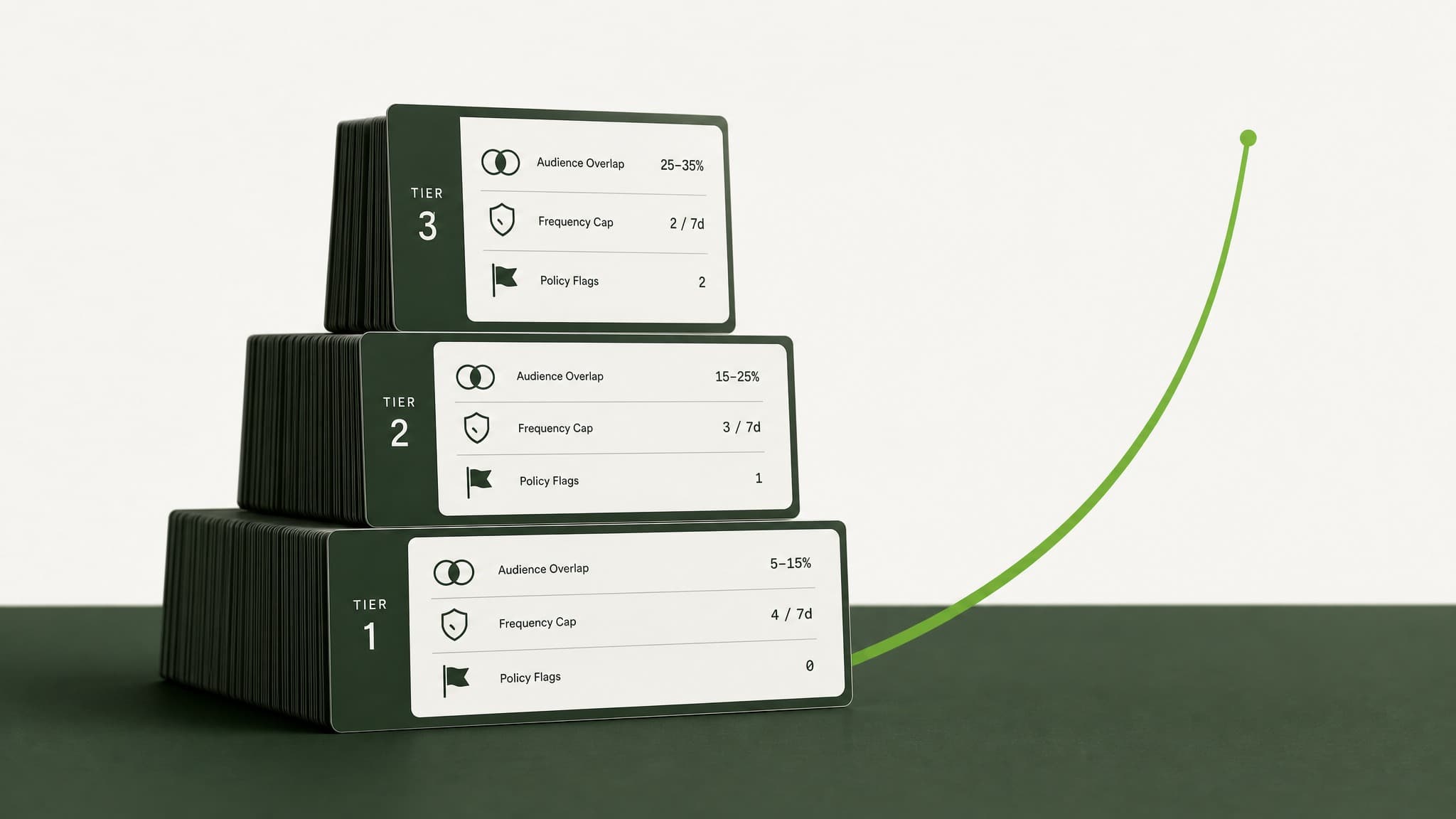
You found a winner. One campaign, a small budget, a clean return, and for the first time in this vertical the numbers actually make sense. So you did the obvious thing. You tripled the budget.
Two days later the account is throttled, the return has fallen off a cliff, or the whole thing is disabled and you are staring at an appeal form.
If that has happened to you, you already understand the real problem with scaling in a restricted category. The budget was never the hard part. The thing underneath the budget was. What follows is how this actually works when you do it for a living: the sequence, the signals, and the judgement calls. I am not going to hand you a step-by-step recipe, because the infrastructure and the ten years of feel behind it are exactly what makes it hold together, and no article replaces that.
Scaling is a different game from getting approved
Getting an ad approved and an account running stable is table stakes. It is the basic work. Scaling is the next problem entirely, and it punishes people who assume the two are the same thing.



 Live general ad creatives from real Icarus client campaigns.
Here is what actually changes the moment you decide to grow spend:
Live general ad creatives from real Icarus client campaigns.
Here is what actually changes the moment you decide to grow spend:
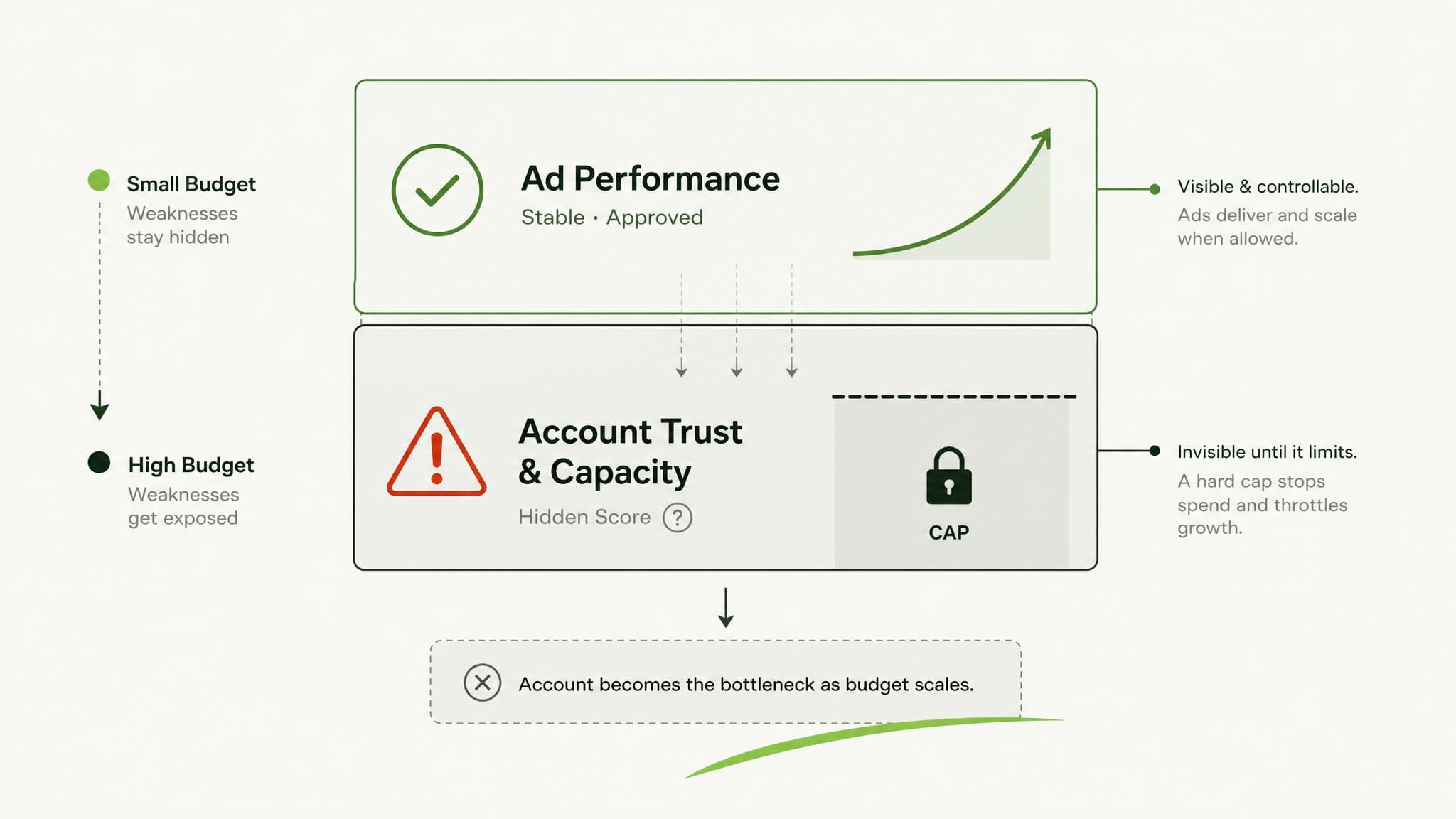
Account trust and spending limits become the constraint when budget scales beyond initial approval.
- The account, not the ad, becomes the ceiling.
- Meta is watching the spend signal far more closely than it was at fifty dollars a day.
- Every weakness in your setup that a small budget was hiding gets exposed under load.
Remember how Meta scores you. It assigns an invisible trust score to your profile, your ad account, and the business manager above them, and trust flows across that whole chain. You never see the number. On top of that hidden score, a new ad account also carries a hard, visible constraint: a Meta-imposed spending limit. That limit is a literal cap on how much you can push through the account per day, no matter how good your winner is. So when you crank the budget on a fresh account, you are not just testing your creative. You are stress-testing a trust score you cannot see and a spend ceiling you may not have cleared. The ad was fine. The account could not carry the weight yet.
Prove the winner is real before you add a dollar
The most expensive mistake in scaling is trusting a number that was never real. Before you increase anything, the winner has to earn it.
Run through these before you touch the budget:
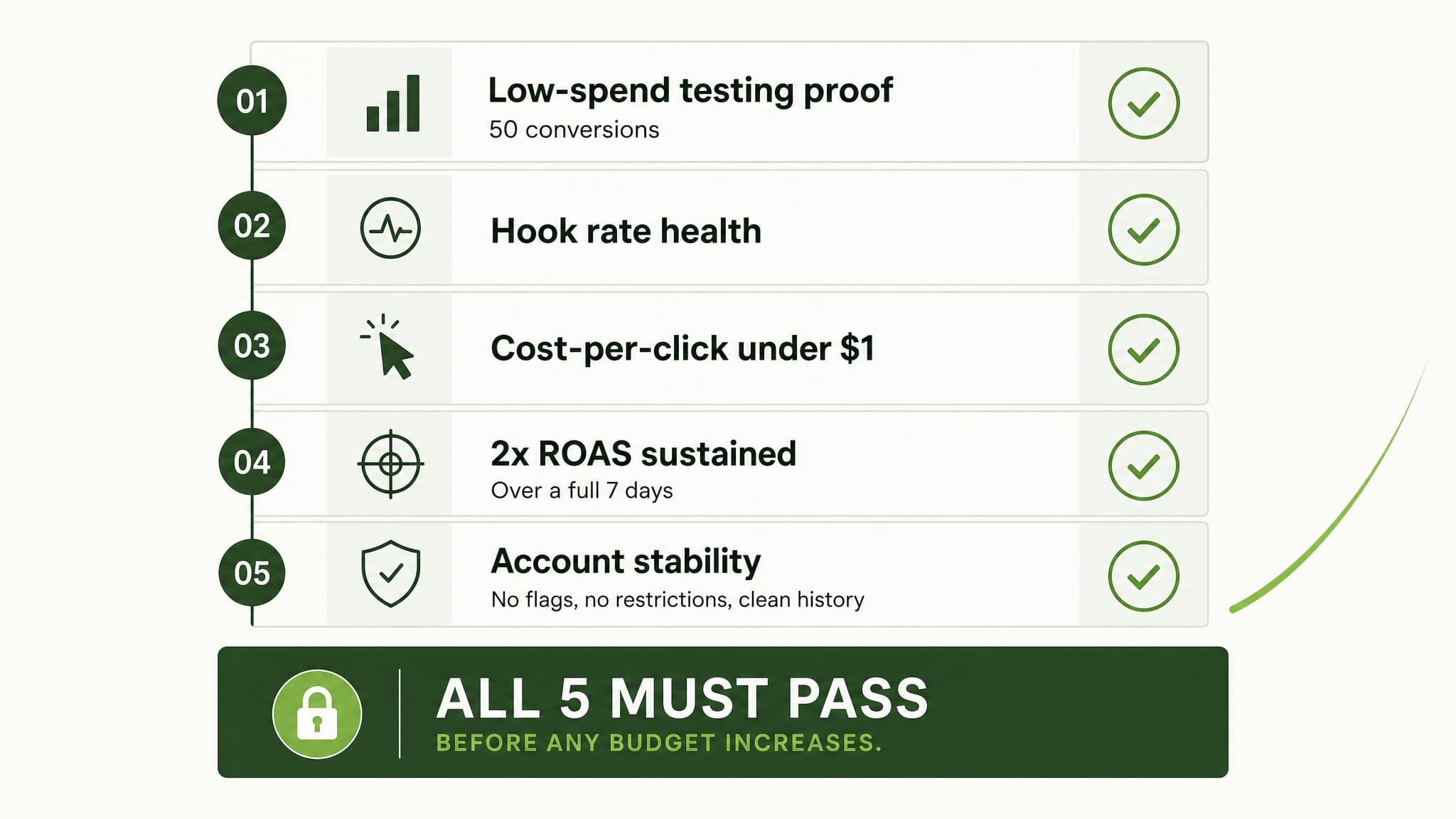
Five validation gates that must all pass before scaling a winning campaign.
- The creative has already proven itself in a low-spend testing pocket, roughly fifty conversions at your target cost per acquisition.
- The hook rate is healthy. A low hook rate is a creative problem, and no budget fixes a creative problem.
- Cost per click is sitting under about a dollar, add-to-carts and checkouts are coming through.
- The return is at or above roughly two times, and it has held across a week, not spiked for one good day.
- The account is stable, with no active wave of rejections on it.
Two of those deserve unpacking. First, the warm-up. Before the main campaign goes live, a good operation runs a small warm-up ad at a few dollars a day. That is a compliance gate, not a performance test, and its numbers are inflated and unrepresentative. Judge readiness on the real campaign data, never on the warm-up. Second, when you do promote a winner into the scaling campaign, you carry the exact same post across rather than rebuilding it, so its existing likes, comments, and shares come with it. That accumulated social proof both lifts performance and reads as legitimate to Meta's review systems. A brand-new post with zero engagement gets more scrutiny than one that already looks like people engaged with it.
If you want the discipline behind reading these signals day to day, that is its own craft. I wrote about it in account health monitoring.
Scale in steps, not leaps
Campaigns ignite, they do not launch hot. The same is true when you scale one. The algorithm has learned who your buyer is at the current budget, and a violent budget change throws that learning out and forces it to start over, usually with worse numbers while it recalibrates.
So you move in steps:
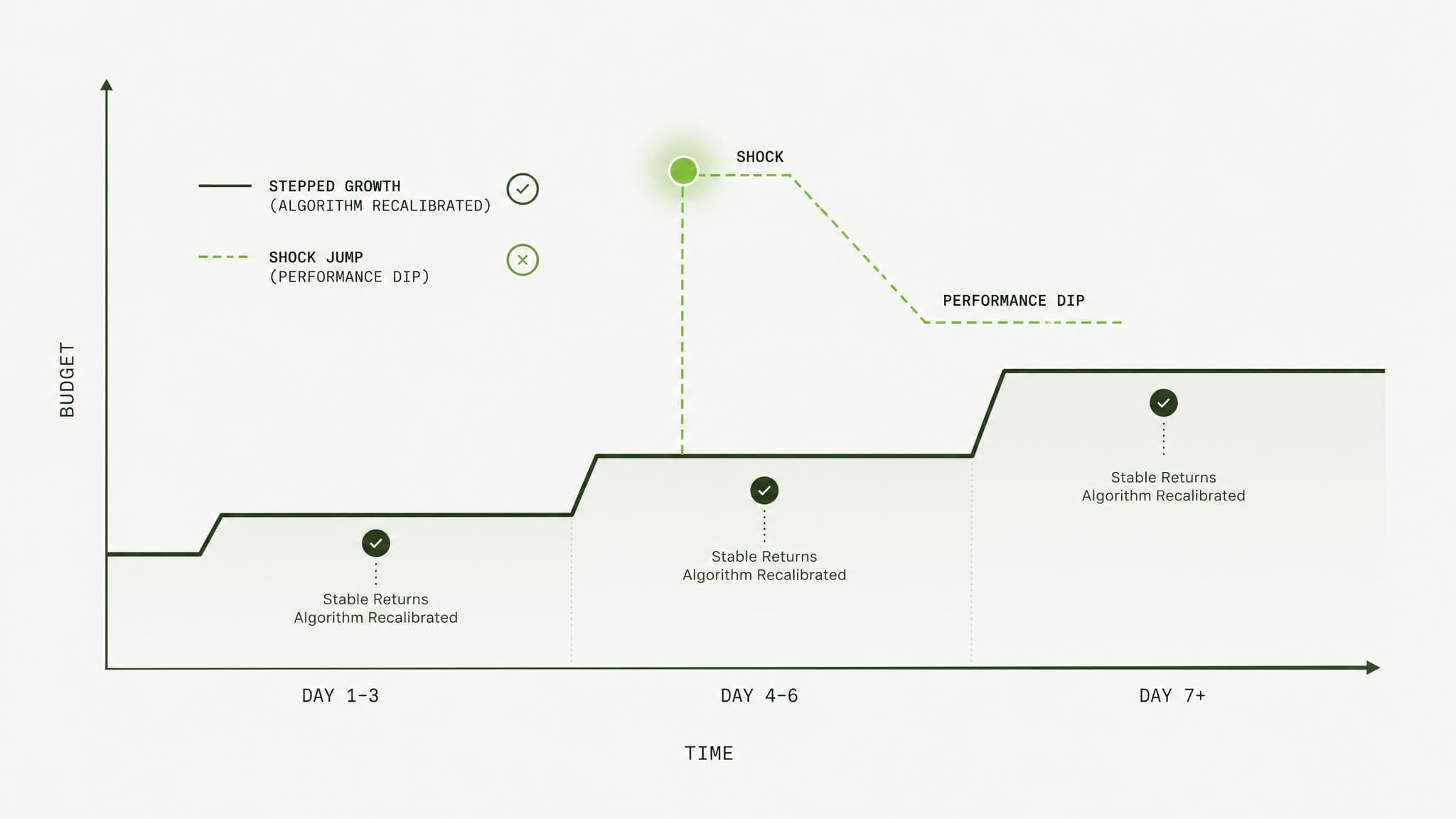
Budget increases in three-day steps maintain algorithm performance, while sudden jumps force costly recalibration.
- Confirm the creative works and the funnel is clean.
- Raise the budget by a modest increment, not a leap to your target number.
- Let it settle and hold that stable return for a few days.
- Only then raise it again.
Space those increases out by roughly three days. Do not shock the system. A brand scaling toward a big daily number gets there by climbing, not by jumping, precisely because each climb gives the algorithm time to hold performance at the new level before you ask more of it.
One more thing that matters at scale: let the creative do the targeting. When you push into broad, machine-driven targeting, the algorithm reads what is in your creative and finds the buyer for you. Chopping your audience into a dozen hand-built segments starves that machine of the volume it needs to optimise. The creative is the targeting. Give it room to work.
You don't scale an account, you scale a fleet
This is the part most people never see, and it is the single biggest reason a professional operation scales where a solo advertiser stalls. You do not pour a growing budget into one precious account. You spread it across a fleet, and you build that fleet on one assumption: accounts will get restricted, on a rolling basis, no matter how careful you are.
That flips the whole mindset. You are not protecting one account. You are running a system designed to lose accounts and keep going. It looks calm from the outside for the same reason a duck looks calm on the water: serene on the surface, paddling like mad underneath.
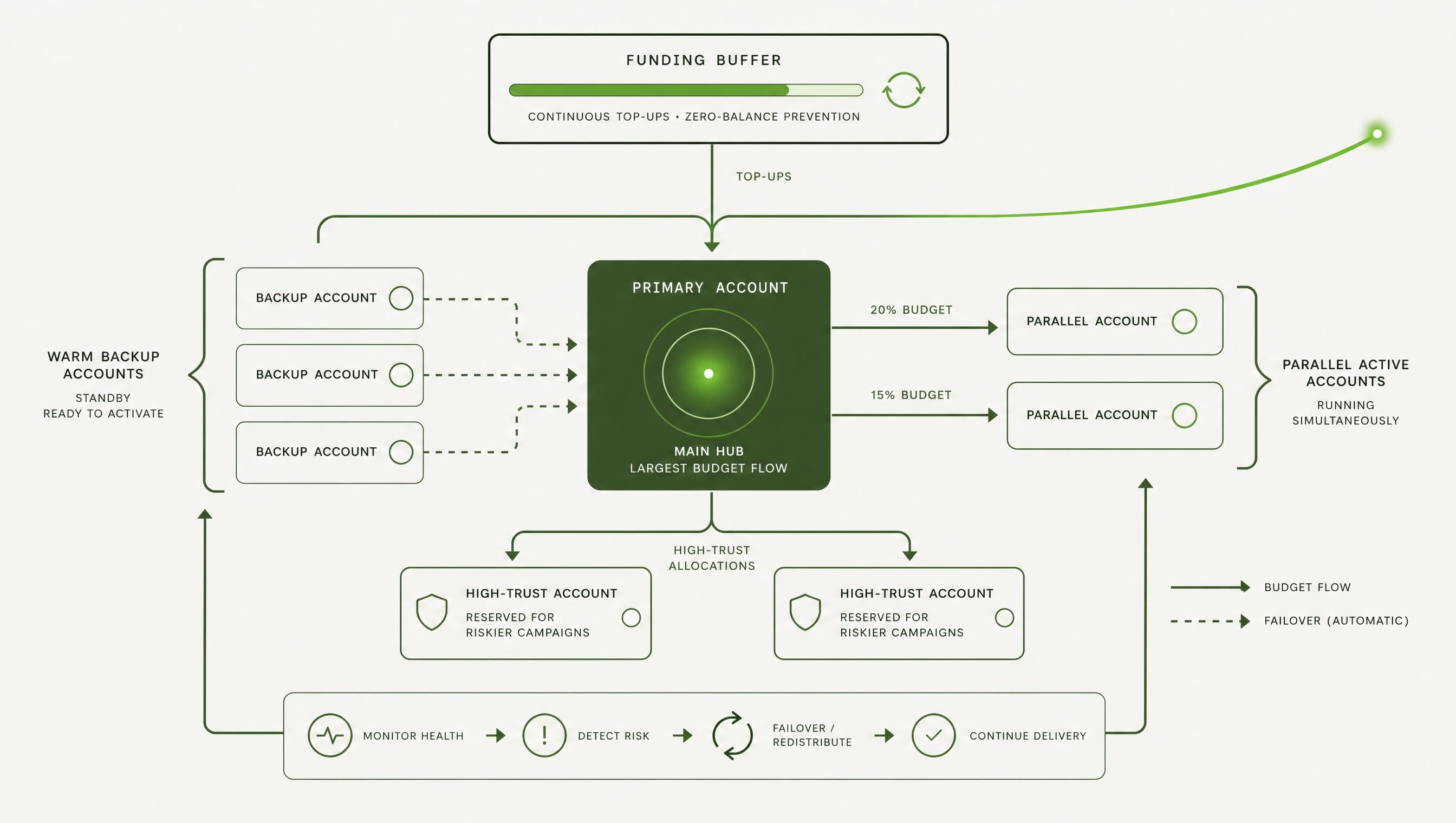
A multi-account fleet system distributes budget across primary, backup, and parallel accounts to survive restrictions.
A fleet built for scale has clear roles:
- A primary account carrying the majority of live spend.
- Warm backup accounts kept alive with small engagement spend, ready to absorb a full budget the moment a primary goes down.
- Multiple active accounts running in parallel for the same brand, so if one gets restricted the others keep spending.
- Stronger, higher-trust accounts held for the riskier pushes, because they tolerate more before they flag.
And the whole fleet has to stay funded. An account that drains to zero does not just pause. It risks getting suspended on top of the delivery you already lost, and coming back from empty can trigger a fresh manual review. The rule is simple: never let an account hit zero. Keep a real cash buffer on it and top up while there are still several days of runway left, not on the last day. At real scale that means pre-funding larger balances so you are not topping up every couple of days and breaking campaign continuity every time.
Protect the signal Meta is actually watching
When you scale, you turn up the volume on the exact signal Meta's systems monitor most closely: money going out. If that spend is not matched by conversion events coming back, you have handed the review system a reason to look hard at your account, fast.
That makes clean tracking a precondition for scaling, not a nice-to-have:
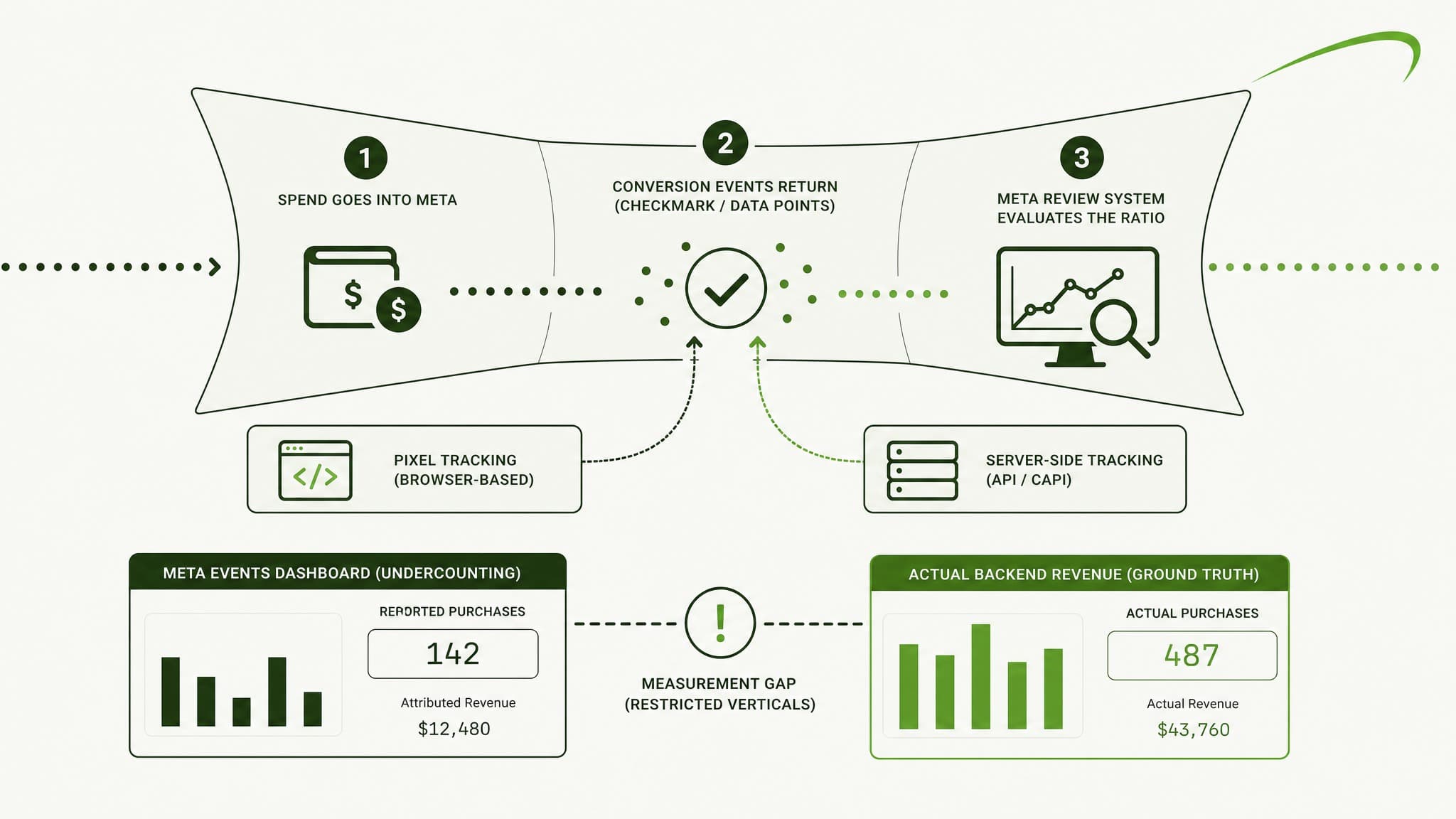
Meta's review system monitors the ratio of spend flowing out against conversion events flowing back.
- Confirm the pixel or server-side events are firing correctly before you ramp.
- Confirm checkout actually completes, on mobile, end to end.
- Only then increase the budget.
In restricted verticals this bites harder than in normal e-commerce, for a specific reason. These accounts often cannot run Meta's pixel the normal way, and landing pages can get blocked or stripped in-browser, so conversions get tracked server-side instead. That works, but it means the platform dashboard will always undercount your real sales. If you scale while staring at an undercounting dashboard, you will panic at a return that looks worse than reality and yank a budget that was actually fine. Judge scaling on backend revenue and the multi-week trend, and make sure the page carrying all that new traffic is built to hold up, which I cover in building compliant landing pages.
When it flags mid-scale, and it will
Push harder in a grey-hat vertical and you will draw rejections. That is not a sign you did it wrong. It is the cost of running bolder creative than a normal advertiser can, and a real operation accounts for it rather than being surprised by it.
The judgement call is what you do when it happens:
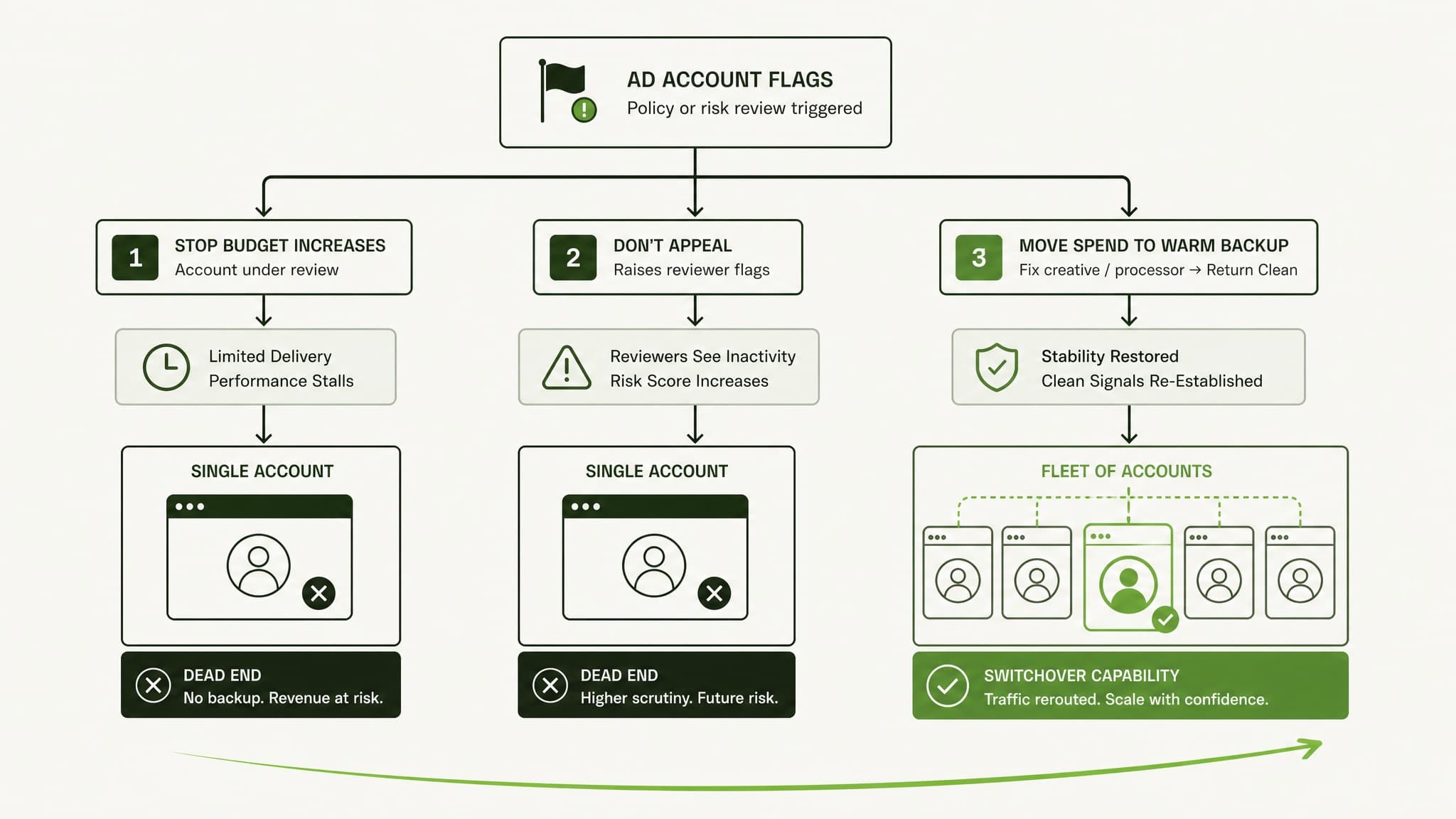
Three response paths when an ad account hits rejection: stop spending, skip appeals, or switch to backup accounts.
- When an account hits an active rejection wave, stop raising the budget on it. Pushing more spend through an account under review invites deeper review, even if the return still looks good on the day.
- Do not sink weeks into an appeal. Every appeal you file is a flag you raise with Meta's reviewers, and for a hard-restricted category there is often no clean appeal that fixes it anyway.
- Move the spend to a warm backup, fix whatever actually triggered the flag, usually a creative angle that crept over the line or a payment processor with a high decline rate, and come back clean.
This is exactly why the fleet exists. A single rejection wave on a solo account is a shutdown. The same wave across a built-out fleet is a switchover you handle before lunch. If you want the deeper picture of how the enforcement itself works, I broke it down in how Meta's ad policies really work for high-risk verticals.
So what are you actually scaling toward?
Here is the question to answer before any of this: scaling toward what number? Because if the answer is "a higher front-end return on the dashboard," you are optimising the wrong thing.
Front-end return is the acquisition price of a new customer. It is not a verdict on whether the business makes money. Most restricted categories, cannabis, vape, peptides, kratom, are repeat-purchase businesses, so the numbers that actually decide profitability are cost per acquisition against lifetime value, not first-order return. A customer acquired at break-even can be worth several times that over the next year. Lit Farms, one of the cannabis brands we run, settled at a 2.26x return across $330K of revenue, and that number only means anything because it is stable and repeatable, not a lucky Tuesday.
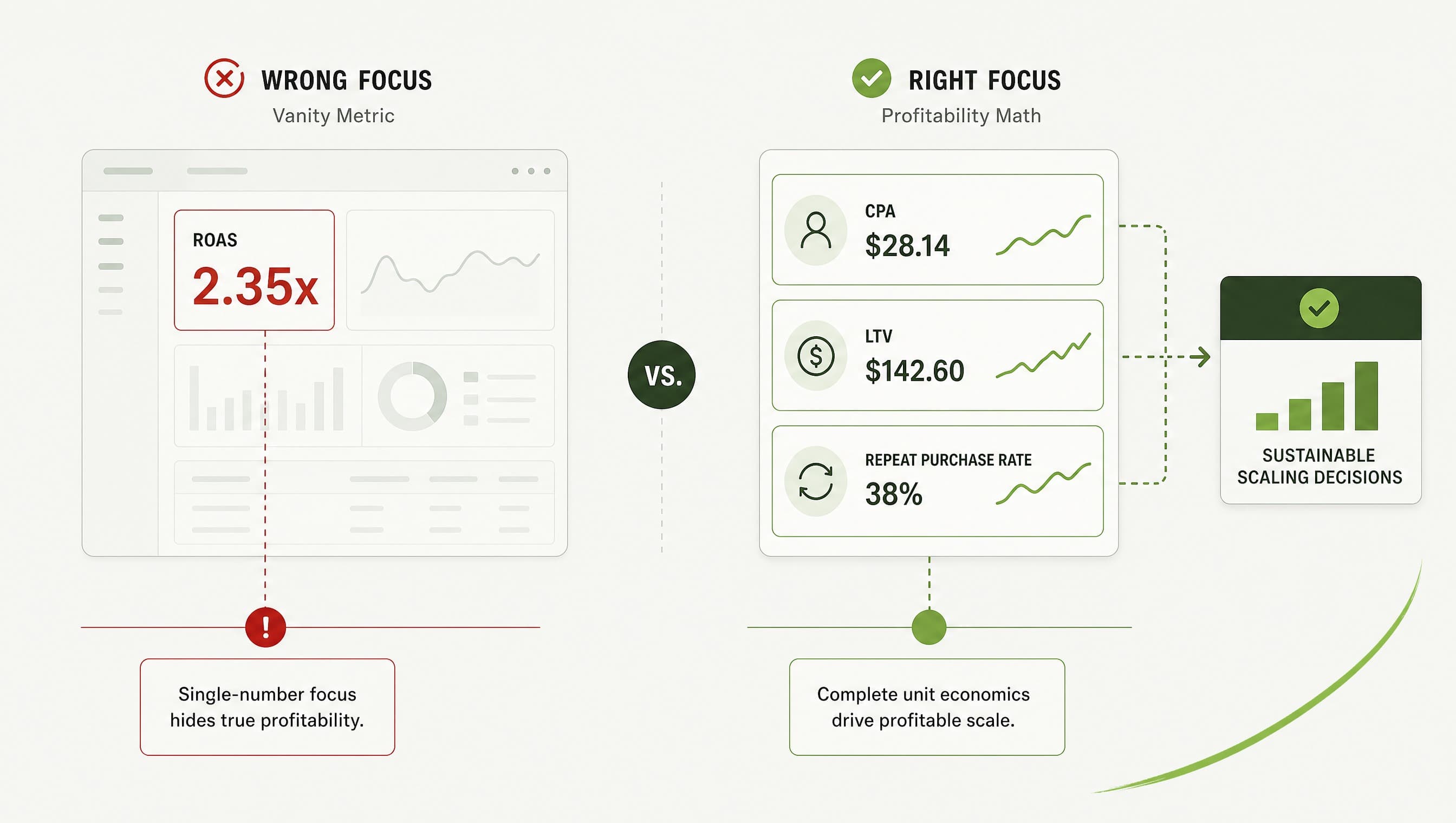
Front-end ROAS alone doesn't reveal profitability; lifetime value and repeat-purchase economics do.
So before you scale, get honest about your own economics. What does a customer cost you, and what are they worth over twelve months? Our ROAS calculator will move you from "is my return bad?" to the CPA and LTV maths that actually tells you how hard you can afford to scale.
Scaling in a restricted vertical is not a budget slider. It is proving the winner, climbing in steps, spreading spend across infrastructure built to be replaced, feeding the accounts, guarding the signal, and having somewhere to go the day it flags. That is a system, and it is the system we have been running for brands across every restricted vertical since 2016. If you have a winner and you are scared to scale it, that fear is well earned, and it is exactly the problem we solve. Book a call and we will look at whether your setup can carry the weight.