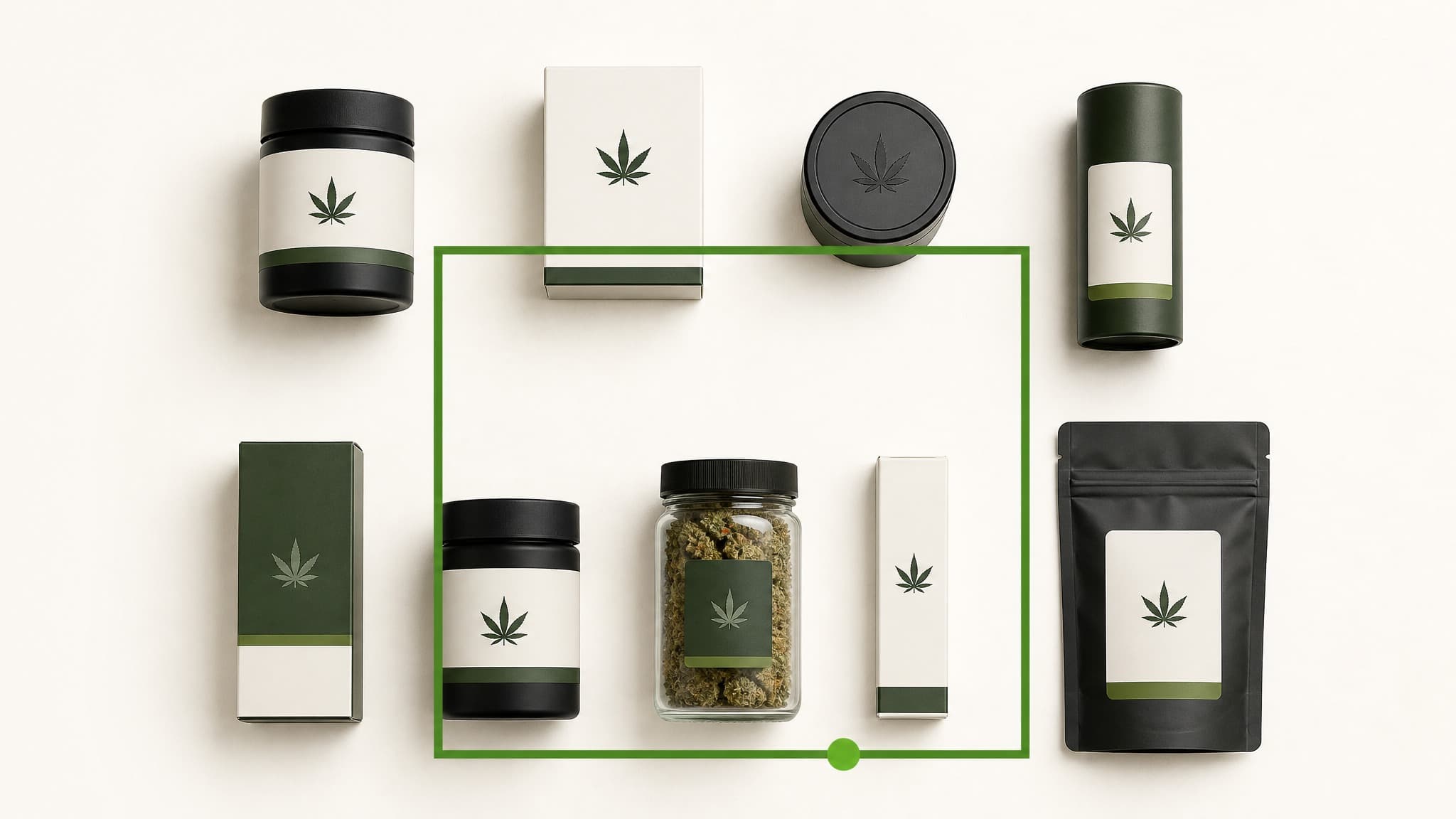
Let me give you the real version of how cannabis advertising works on Meta in 2026, because almost everything written about it is either scared or wrong.
Here is the honest starting point. Meta's policy prohibits cannabis. Officially, you cannot run these ads. And yet compliant-looking cannabis and hemp ads run on Facebook and Instagram every single day, spending real money and driving real revenue. Both of those things are true at once. The gap between them is the entire craft, and it has almost nothing to do with the ad you upload.
If you run cannabis ads, you already know the pain: an ad that looked fine gets pulled, an account dies for no reason you can see, a batch that ran for weeks suddenly gets reported and rejected. This guide walks through why that happens and how the operation is actually built. I will give you the real shape of it. I will not hand you a DIY recipe, because the infrastructure and the ten years of feel behind it are exactly what makes this work, and no article replaces that.
Why cannabis ads get pulled (and it is rarely the ad)
Start here, because this is the thing most people get backwards. On Meta, everything is connected. Meta ties every asset together in a chain, profile to ad account to business manager, and trust flows across the whole chain. It assigns an invisible trust score to each of those assets. You never see it. There is no number in the interface. Protecting that score across the whole connected chain is the actual game.
So when your ad gets rejected, the ad is usually not the problem. The account behind it is.
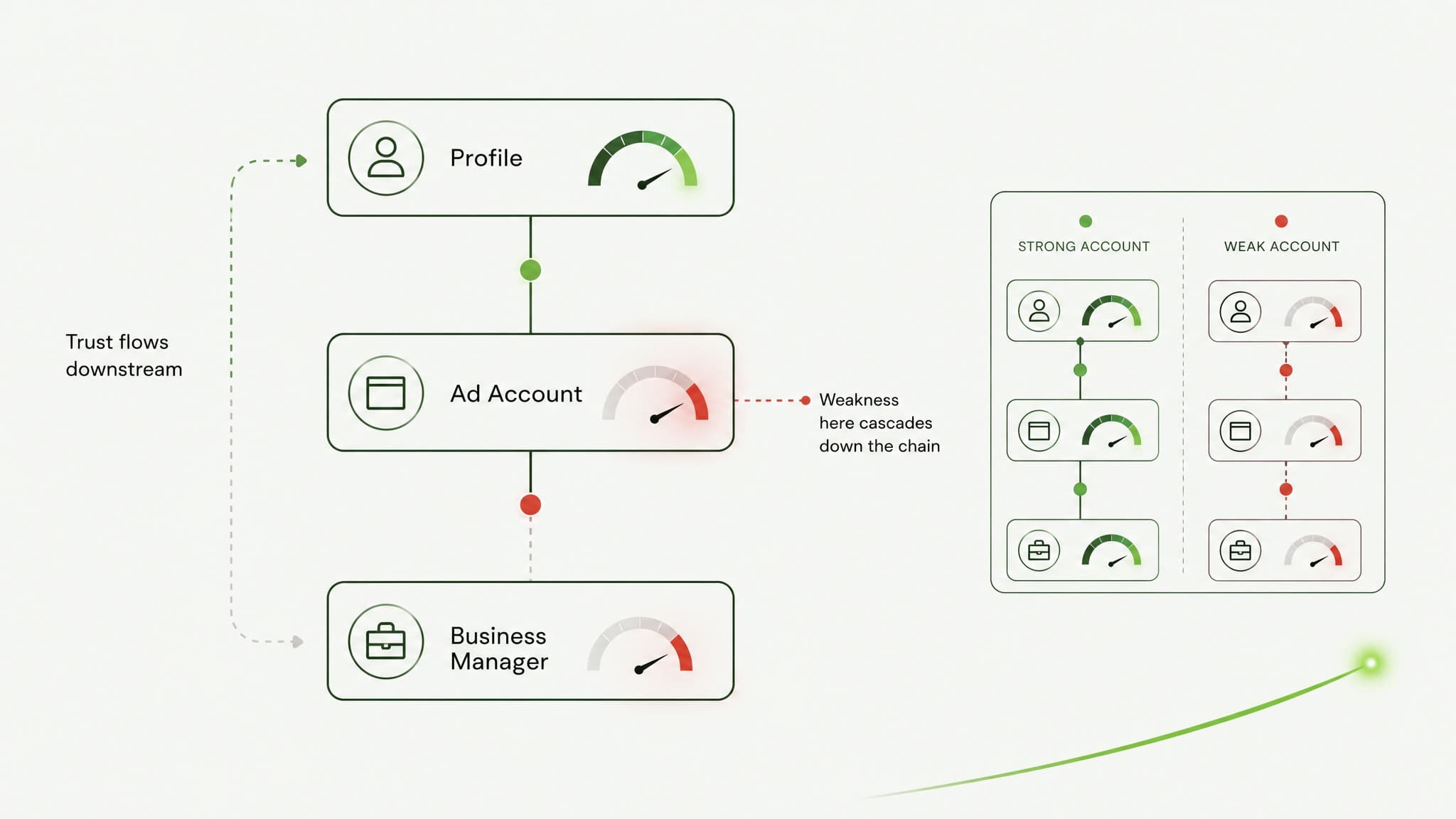
Meta's invisible trust chain connects your profile, ad account, and business manager, weakness in one drags down the rest.
- Meta scores the profile, the ad account, and the business manager sitting behind every ad you run.
- Run a genuinely good ad from a weak, brand-new account and it gets rejected, or the account gets flagged, because the trust to carry that ad was never built yet.
- A weak profile can drag down the ad account it operates. A damaged ad account can drag down the business manager it was born from.
Think of it like credit. A person with no credit history walks into a bank and asks for a large loan, and the answer is no, not because the request is unreasonable but because there is no track record to justify it. A new ad account asking to run cannabis creative is that person. The creative was never the issue. The trust behind it was not there.
Meta also watches your approved-to-rejected ratio in the background. Rack up rejections and the account gets flagged as a problem, regardless of what any single ad said. That is why the whole approach is built around protecting the score, not around clever wording on one image.
The account infrastructure that keeps you live
If trust is the game, infrastructure is the board you play it on. This is table stakes, the basic layer everything else sits on, and getting it right is what separates an account that survives from one that dies in a week.
The core pieces:
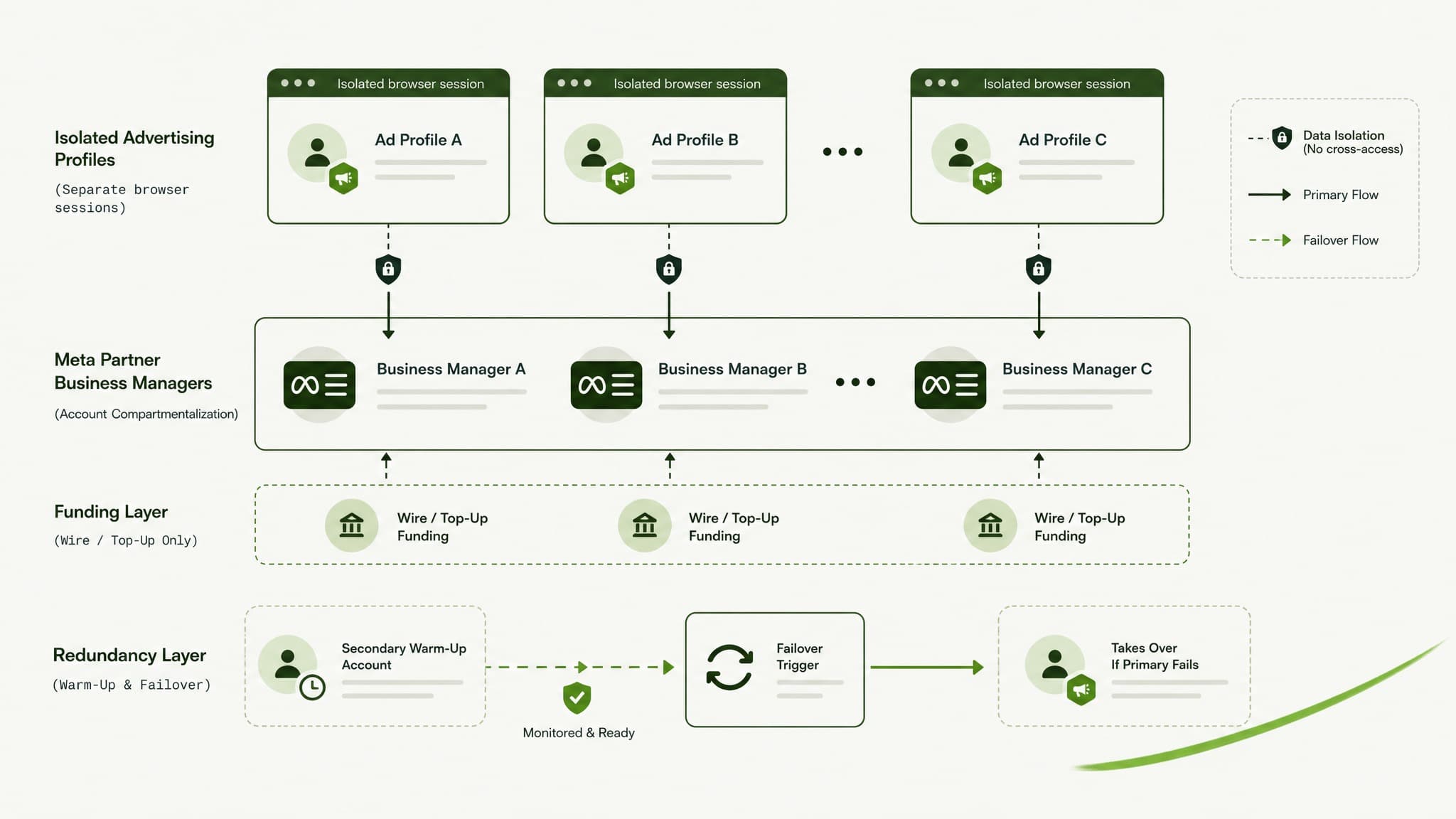
Isolated profiles, partner business managers, and backup accounts create redundancy when primary accounts fail.
- Aged, real-looking advertising profiles, sourced through vetted partners and warmed before they touch a client account. Each one is run in its own isolated browser session so it behaves like a real person on a real machine, and so one profile going down cannot spread to the others.
- Ad accounts from Meta partner business managers, which carry higher trust and a direct credit line to Meta, funded by wire or top-up rather than a credit card.
- Compartmentalisation. Multiple profiles, multiple partners, multiple accounts, each client kept in its own isolated slot, so one weak asset can never take the whole operation down with it.
Why avoid the credit card? Because a card is an extra failure node. It ties a real bank identity to the account, and Meta's risk systems link accounts that share a payment method and can disable them together. Cards also trigger "suspicious activity" suspensions that have nothing to do with what you are advertising, just bugs in how Meta's billing treats them. Remove the card and you remove a whole category of ways to die. Pre-funded accounts sidestep all of it.
Here is the part nobody tells new advertisers: accounts going down is not a failure state in this industry, it is a weather condition. There are days when Meta runs platform-wide risk-control sweeps and everything gets touched at once. So you always keep a second account already mid-warm-up in the background. When the primary drops, you transition to the standby instead of starting from zero. And when a business manager starts throwing risk signals, the recovery play is to move the assets out before the whole thing gets killed. None of that is glamorous. All of it is the difference between a bad afternoon and a dead campaign.
Warming up a new account before you touch cannabis creative
You never launch a fresh account straight into hard cannabis creative. You warm it up first, and the warm-up is where the freedom to run bold ads is earned.
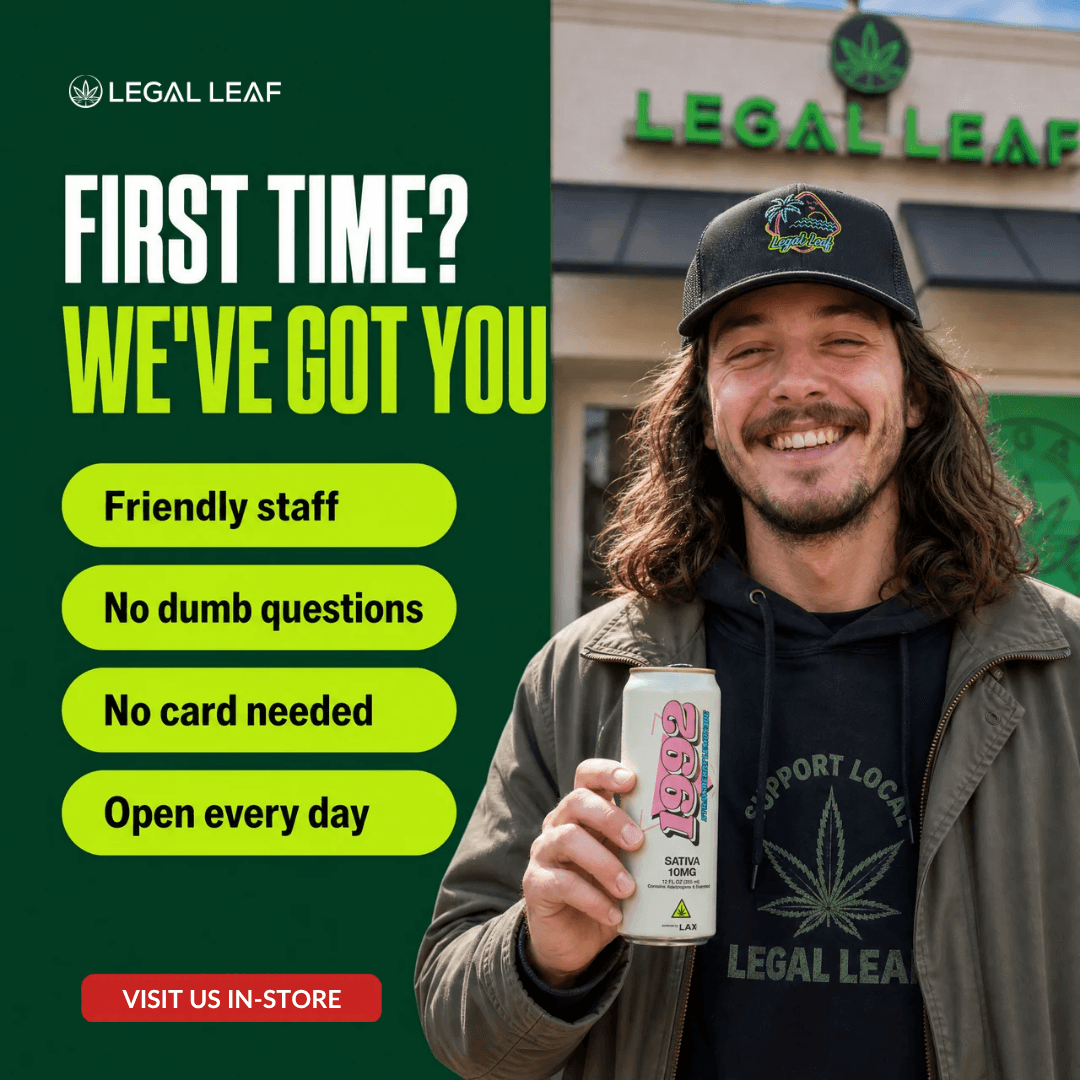


 Live cannabis ad creatives from real Icarus client campaigns.
The shape of it:
Live cannabis ad creatives from real Icarus client campaigns.
The shape of it:
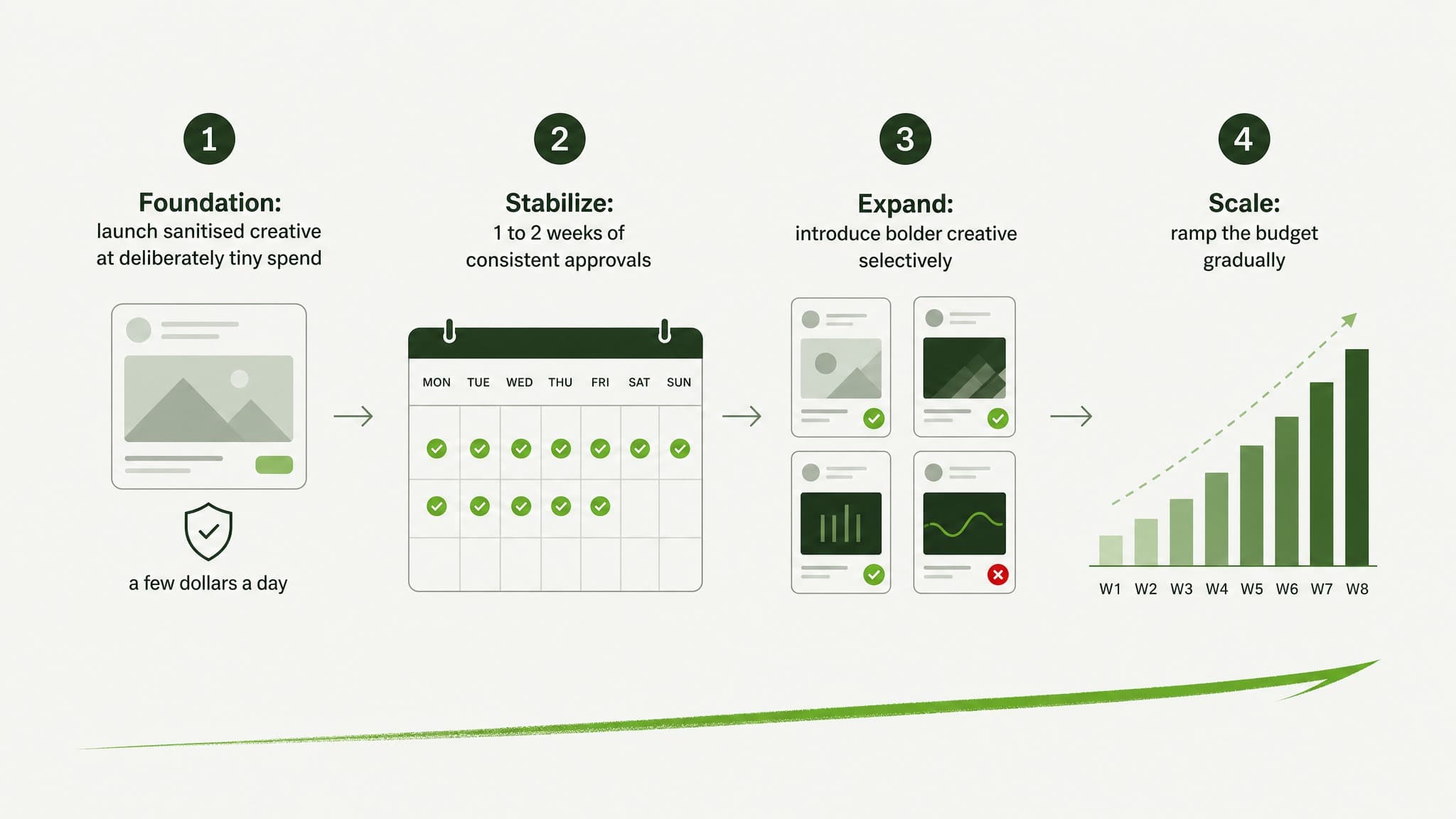
Four-stage account warmup: sanitised creative at low spend, approval stacking, gradual creative introduction, then budget ramp.
- Launch on sanitised creative at tiny spend. Clean, lead-gen-style ads with nothing that flags policy, running at a dollar or a few dollars a day. The spend is deliberately insignificant. The point is approvals, not volume.
- Let approvals stack for one to two weeks. You are aiming for a run of approved ads with close to zero rejections. An account that hits that clean is a high-quality account, and Meta reads it that way.
- Introduce unsanitised creative slowly. Once the trust is there, you start showing more, publishing as each ad gets approved rather than dumping everything live at once.
- Ramp spend gradually. Do not flip from a few dollars a day to full budget overnight. Step it up over about a week.
One rule sits underneath all of it: if the account starts rejecting even your sanitised creative during warm-up, do not sit there fighting appeals. Request a fresh account and start again. Time spent arguing with review is time the account is telling you it was never healthy.
And knowing exactly when to escalate, when the account is ready to carry something riskier, is not a date on a calendar. It is feel. An experienced media buyer reads the account's health signals and makes the call. That judgement is the craft, and it is the part that does not come from a template.
Sanitised versus unsanitised: the creative tiers
People think this is a two-way split. It is really three, and understanding the ladder is what stops you burning accounts.
- Highly sanitised. No cannabis terms, no leaf or bud imagery, no regulated references at all. Lifestyle, offer, brand. This is the most conservative tier and the fallback when accounts are getting touchy.
- Sanitised. Coded or substituted language, regulated terms blurred where they appear on packaging, product shown but not the loose bud. A blurred bud sitting next to packaging still counts as sanitised.
- Unsanitised. Explicit terms, visible product, plain language. This is the honest version of the pitch, and it belongs on the landing page, not in the ad account.
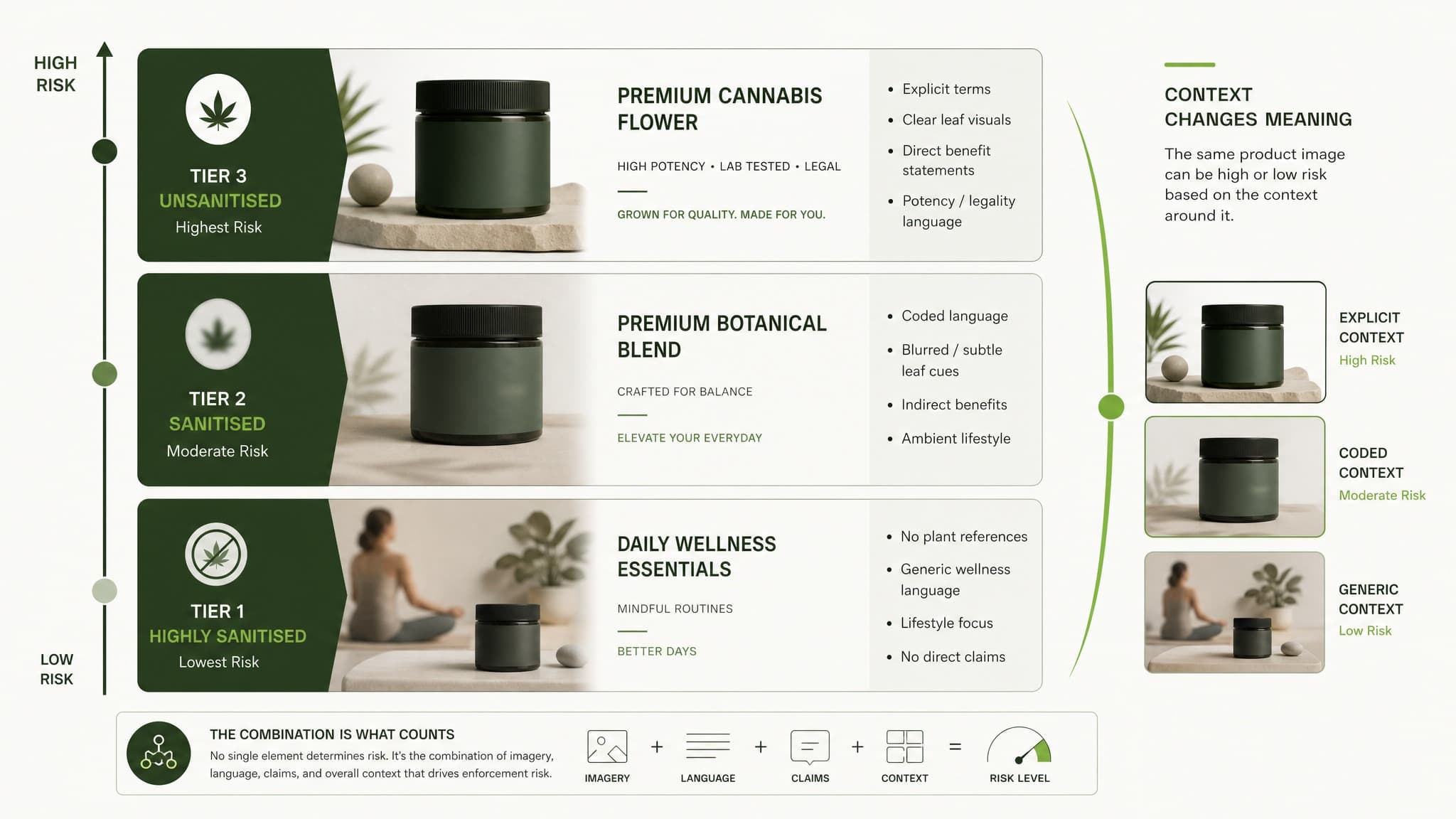
The three creative tiers for cannabis ads, from highly sanitised lifestyle to unsanitised product-forward messaging.
Here is the thing worth burning into your head: rejections usually come down to context, not a single banned element. A product image on its own might sail through. The same image with a "420 SALE" label slapped across it, or copy written in obvious stoner language, tips the whole thing over. The algorithm reads the combination. One bud shot can kill a single creative in an otherwise clean batch. A brand logo alone has been enough to trigger rejections. It is rarely one word. It is the picture the elements paint together.
What actually lets a bold-looking creative get approved is two things at once: the creative carries no trigger words or keyword density that fires automated review, and it runs on a warmed, high-trust account. That combination is why a creative can be obvious to the customer, showing the product, the offer, the brand, while carrying nothing that trips the machine. The goal was never a toothless ad. It is a trustworthy account that can carry a creative with real teeth and still get it approved.
Statics versus video: what each can actually show
Both have a job. They are not interchangeable.
Statics are the testing workhorse. They are fast and cheap to produce, so you make and test a lot of them quickly to find what resonates. Healthy soft metrics come first here, a strong thumb-stop and a low CPC tell you the brand, product and offer are landing before the sales even show up. High spend with a weak thumb-stop is a creative problem, not a targeting one.
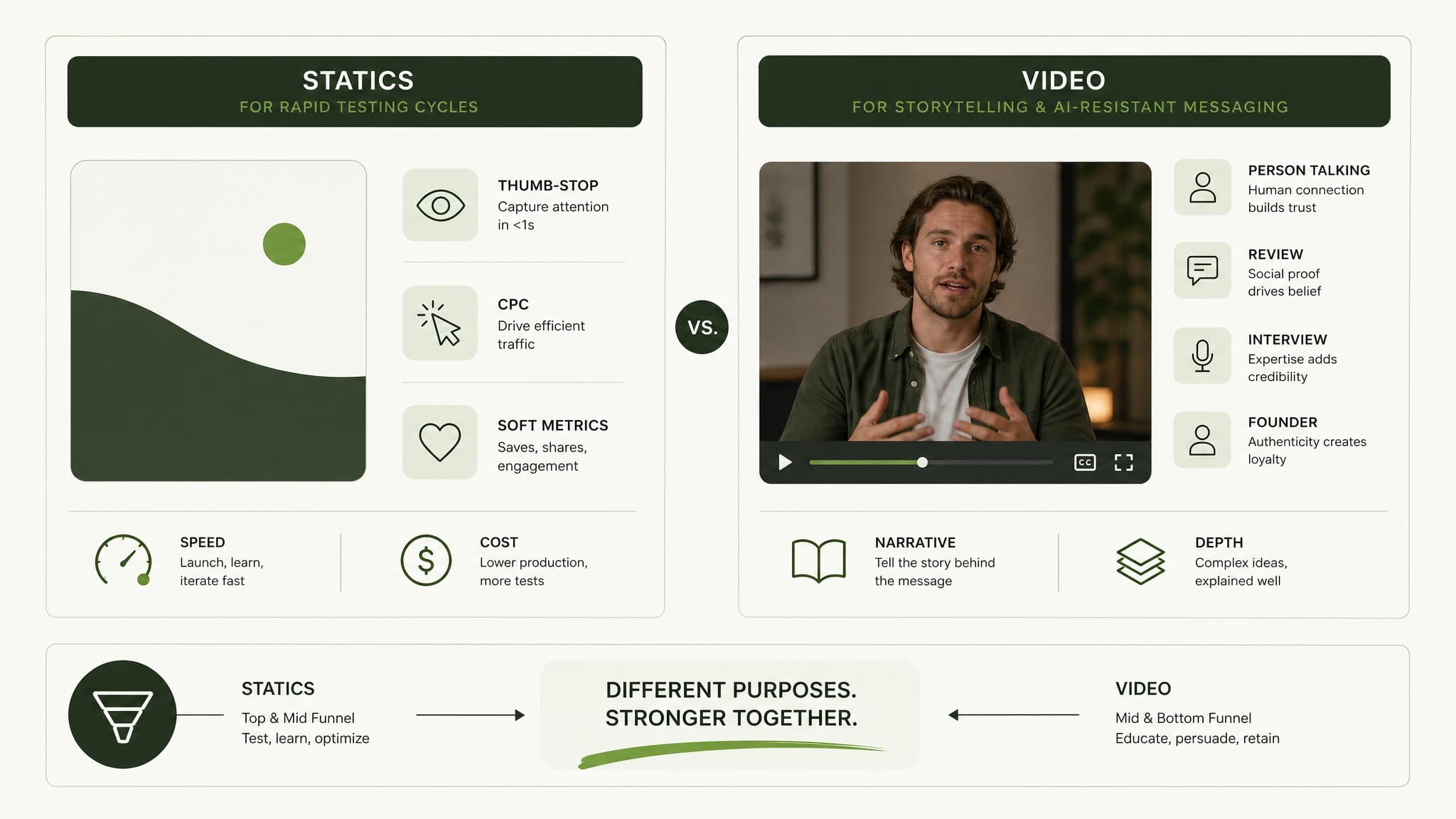
Statics test fast and cheap; video tells stories the algorithm can't easily decode.
Video gives you more room. Meta's AI finds it harder to read specific things inside a video than inside a flat image, which means video lets you show and say more of what your audience actually wants to see. The formats that work are the human ones: someone talking about the product, a review, a street interview, a founder to camera, safe footage from several clips compiled together. Often you do not need to show the product or say anything overt for the video to sell. The person and the story carry it.
None of this is about polish for its own sake. Minor design tweaks move performance almost not at all. Compliance, hook strength and a clear offer are what move it. You are making creative for an algorithm first and a human second, and the algorithm decides what is good by spending money on it.
The landing page is where you get to be honest
The ad is the compliant face of the operation. The landing page is where the real pitch lives, and most restricted accounts die on the page, not the creative.
The architecture is simple to describe and hard to execute: the destination is built so that automated policy review and a real human buyer each see the page they are meant to see. Review sees a compliant page. The real click lands on the page that actually sells. That is table stakes in this space, dialled in over years, and I am going to describe the outcome rather than write you a how-to, because the how-to is exactly the part that is not going in a public article.
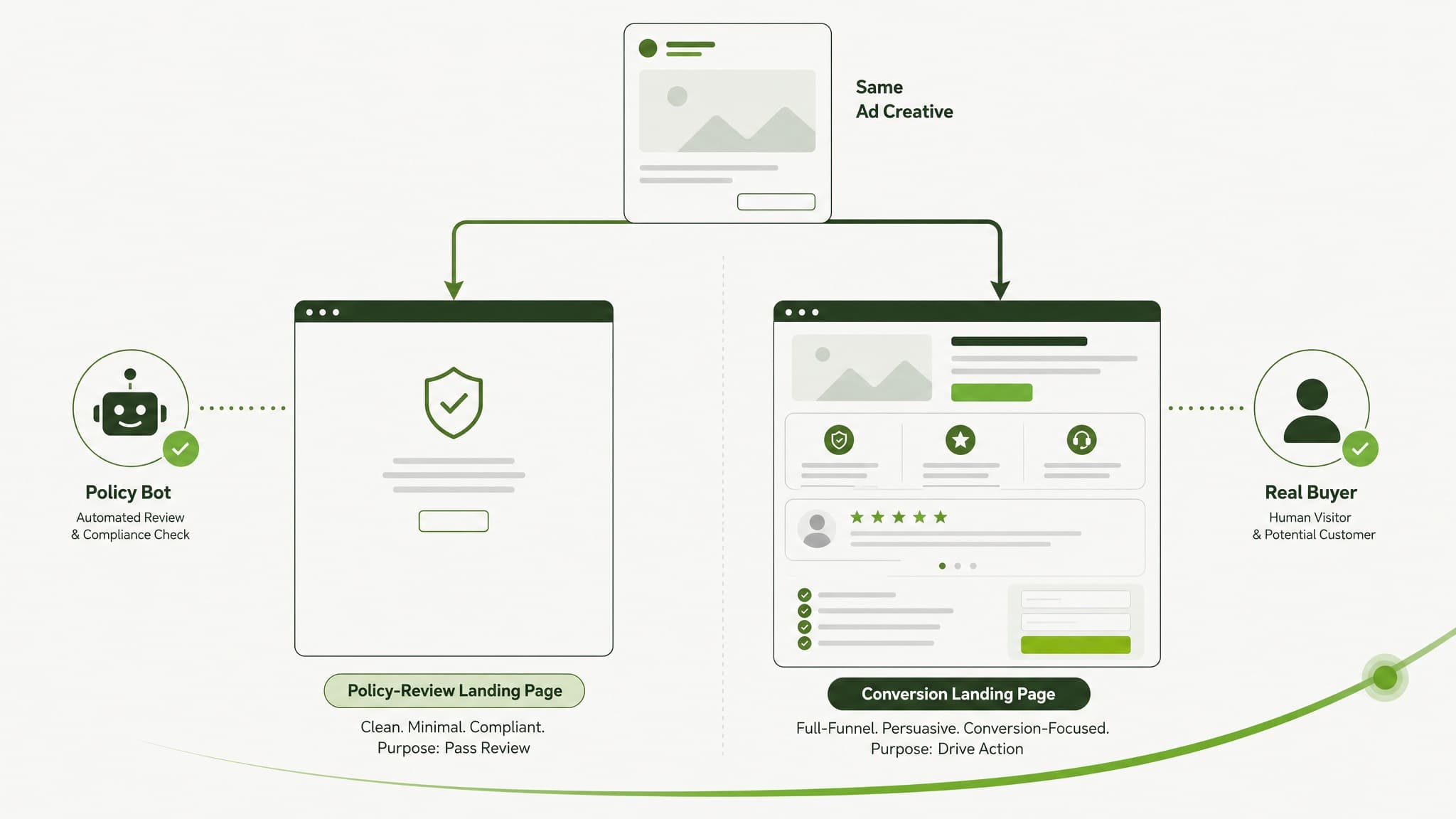
Two landing page paths: one compliant for policy review, one conversion-focused for actual buyers.
There is a simpler, more transparent route too, an age gate, a clear pop-up that confirms the visitor before they proceed. It carries its own trade-offs. Which approach fits depends on the brand, the market and the account. Either way, the principle holds: you keep the ad clean so the account stays alive, and you do your honest selling on the destination, where you have the room to speak to a real buyer in plain language. We wrote a whole piece on building compliant landing pages for restricted ads if you want to go deeper on that layer.
How to actually judge a cannabis campaign
This is where more cannabis campaigns get killed than by any rejection, and it is almost always a measurement problem, not a performance one.
Start with the thing nobody warns you about: cannabis carries the widest attribution gap of any vertical we run. These brands cannot use the Meta Pixel, so conversions are tracked server-side through the brand's own infrastructure. It works, but it means Meta's reported ROAS will systematically undercount actual sales. There is a real disconnect between what the platform dashboard shows and what is genuinely being measured. If you judge cannabis ads on the Meta dashboard alone, you will undervalue what the campaign is doing every single time.
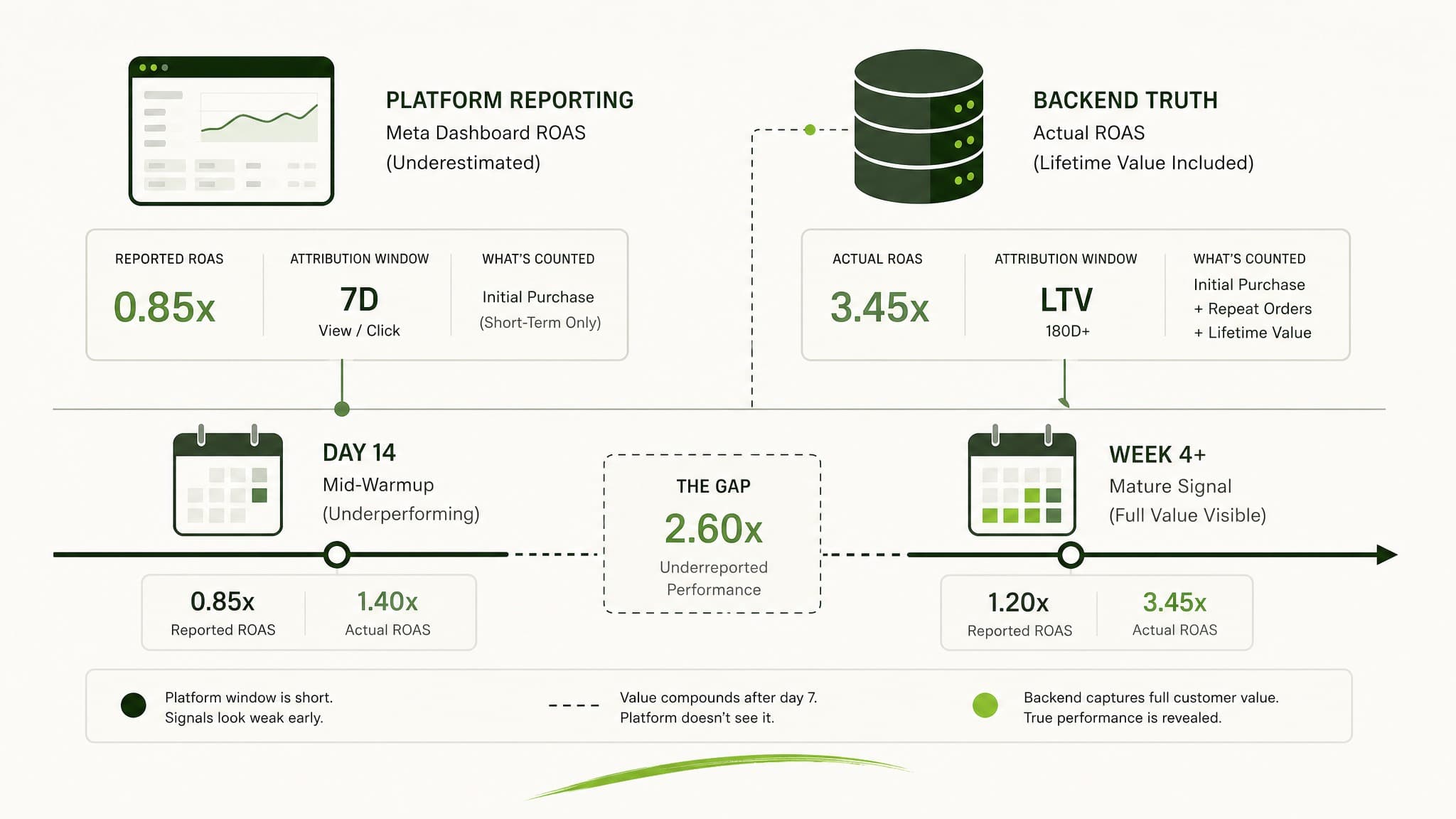
Meta dashboard ROAS versus actual backend performance over time, showing the attribution gap in cannabis advertising.
Then there is the number itself. Front-end ROAS is not a profitability verdict. It is the acquisition price of a new customer.
- Cannabis is a repeat-purchase business, so the real scoreboard is CPA against lifetime value, not first-order ROAS.
- A customer acquired at break-even can be worth several times that over the following year. That maths lives in your backend, not on the ad platform.
- A brand-new brand with no organic footprint converting cold traffic at break-even is doing genuinely well, because it started from zero. Trajectory over weeks beats any single day.
If your front-end ROAS looks scary, the honest move is to run the real numbers through a ROAS calculator with your actual margins and repeat rate before you conclude anything. Break-even up front on a repeat-purchase product is often a good customer, not a bad campaign.
Two more things clients get wrong. First, they judge at day 14, mid warm-up, when server-side tracking is still accumulating signal and the first creative set almost always underperforms. Judging a campaign during its ramp is judging it before it has started. Second, they blame the ads when the checkout is broken. Cannabis payments get blocked by processors that quietly refuse the category, redirects break trust, discounts stack wrong and eat the margin. All of that kills conversions after the click, and none of it shows up in the ad account. Rule out the plumbing before you touch the creative.
For proof that this holds up when it is done right: Lit Farms ran at 2.26x ROAS on $330K in revenue. Everything420 at 2.63x on $228K. Rxtracts at 2.86x. Those are blended results over time on properly warmed infrastructure, not day-seven dashboard snapshots, and that distinction is the whole point of this section.
If you want the deeper mechanics on any single layer, we have separate guides on Meta's advertising policies for high-risk industries, monitoring account health before an account dies, and scaling high-risk campaigns without killing the account.
Where this leaves you
Everything above is table stakes. Getting cannabis ads approved, running and stable is the price of entry, not the finish line. The real craft that sits on top of it, building creative that actually converts, mapping the four or five personas in your market and speaking their language back to them, structuring offers and pages at the right level of buyer awareness, is what turns a stable account into a business.
Icarus has run ads in the hardest verticals since 2016, across roughly 300 brands, and cannabis is one of the categories we know best. If you are tired of watching accounts die and want the infrastructure and the judgement behind it handled by people who do this every day, take a look at the industries we work in and start a conversation. The ban is not the problem. Building on the wrong foundation is.