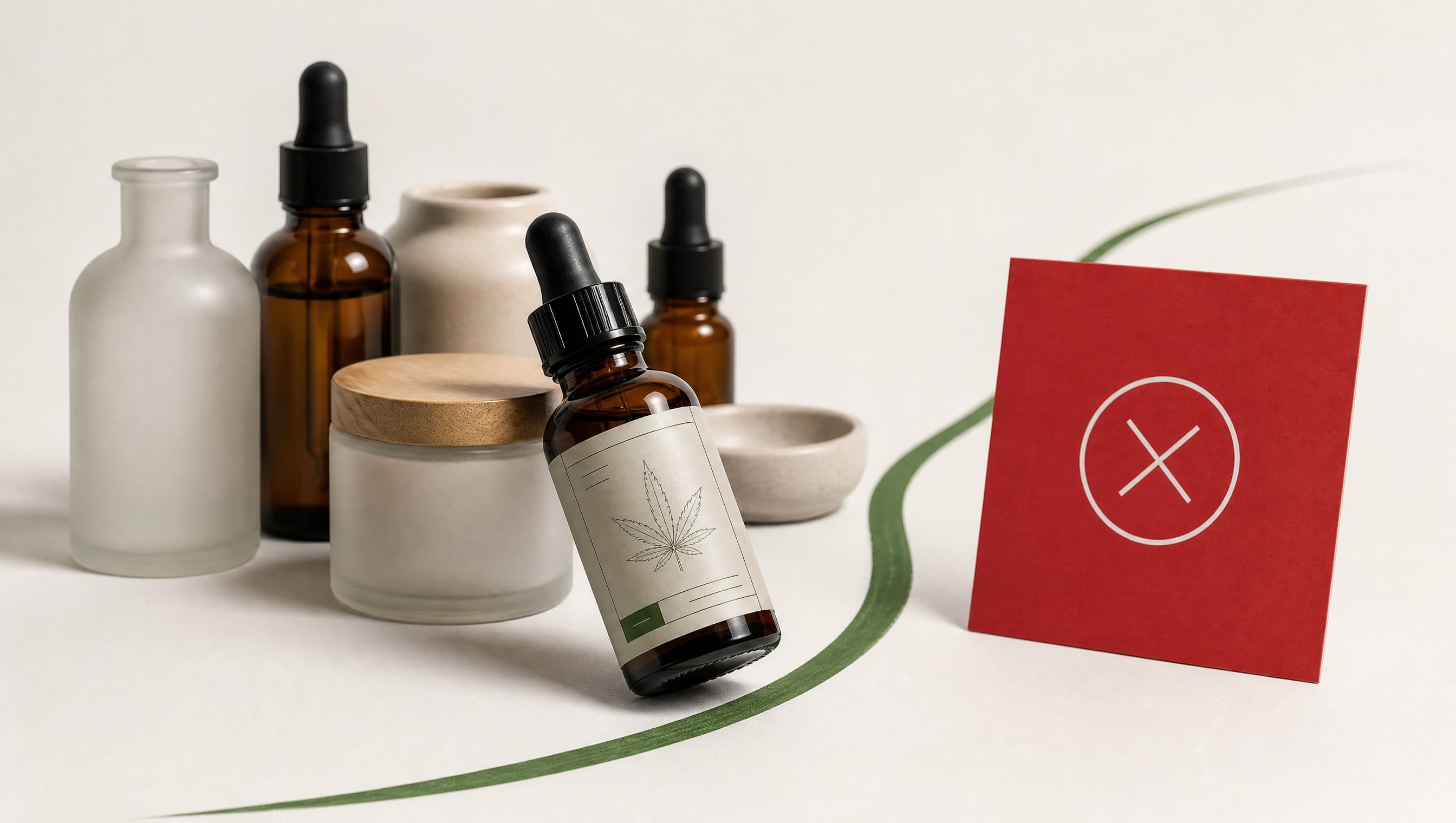
You built a clean ad. No wild claims, no leaf, nothing that should scare anyone. You hit publish. Rejected. You strip it back further, resubmit, and it gets rejected again. Somewhere in that loop most CBD advertisers land on the same wrong conclusion: that the word CBD is radioactive and there is nothing to be done about it.
That is not what is happening. The rejection is real, but the reason behind it is almost never the single thing you are staring at. CBD is one of the hardest categories on Meta, and after running it since 2016 across a few hundred restricted brands, I can tell you the rejection loop has a shape. Once you can see the shape, it stops feeling random.
The rejection is usually about the account, not the ad
Start here, because it is the thing most people get backwards. Meta does not just judge your ad. It judges the account carrying it.
Meta ties every asset you have into one chain:
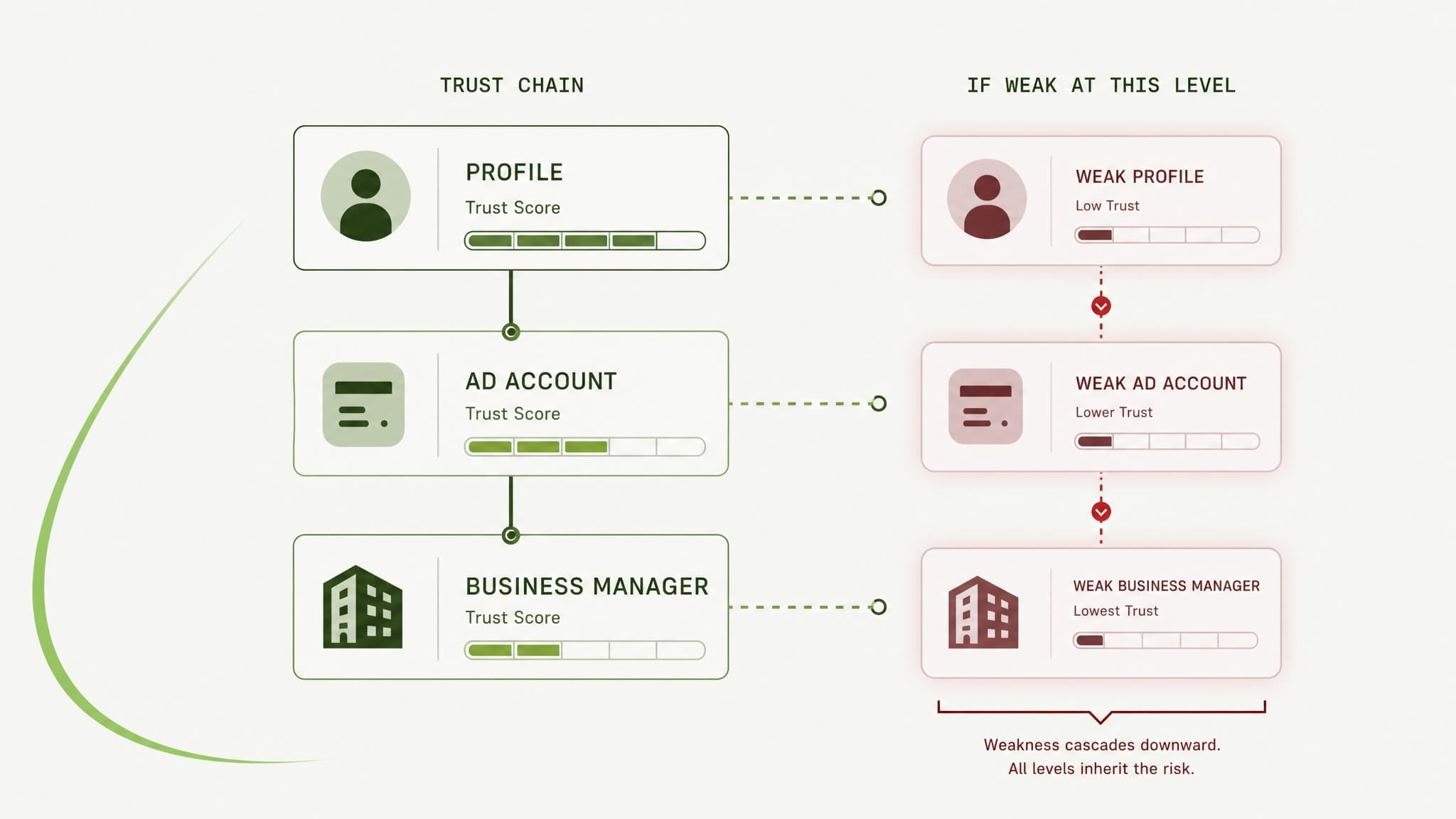
Meta's trust chain: profile, ad account, and business manager each carry invisible scores that flow together.
- Your profile, the person running the ads
- The ad account that profile operates
- The business manager the ad account was created inside
Trust flows across that whole chain, and Meta assigns each part an invisible score you never get to see. There is no number in the interface. A weak profile drags down the ad account it runs. A battered ad account drags down the business manager above it.
Here is why that matters for your rejections. The exact same creative can sail through on a warmed, high-trust account and get killed instantly on a fresh one. Same image, same copy, different outcome. So when an ad you know is clean gets pulled, the first question is not "what is wrong with the ad." It is "what is the standing of the account I just ran it from." Most of the time, that is where the answer lives.
What actually trips a CBD rejection
When the ad itself is the problem, it is usually not one giant red flag. It is a stack of small signals firing at once. These are the ones that come up again and again:
- Text baked into the image. Meta's automated review reads the words inside your picture, not just your caption. A product shot where the bottle or box says CBD, THCA or a similar term on the label gets read the same as if you typed it. Your copy can be spotless and the creative still dies on the packaging. Blurring or cropping those labels off product shots removes the trigger.
- Health language next to the product. The word CBD on its own is survivable. CBD plus a therapeutic claim in the same creative is not. "Relax" tends to pass. "Relieves pain" sitting beside a hemp product reads as a health claim, and health claims on a restricted substance are a fast rejection.
- The page the ad points to. Review does not stop at the ad. It crawls your destination. If the landing page is loaded with restricted product names, aggressive claims or a missing disclaimer, the ad gets pulled even when the creative was clean. That is a whole discipline of its own, and I have written about building landing pages that pass review and still sell.
- Your targeting. Building an audience out of CBD and hemp interest groups tells Meta's system exactly what category you are in before anyone reads a word of your ad. The targeting itself raises the scrutiny level on otherwise clean creative.
- The account's own rejection history. Every rejection you rack up makes the next approval harder. More on that below, because it is the one that quietly ends accounts.
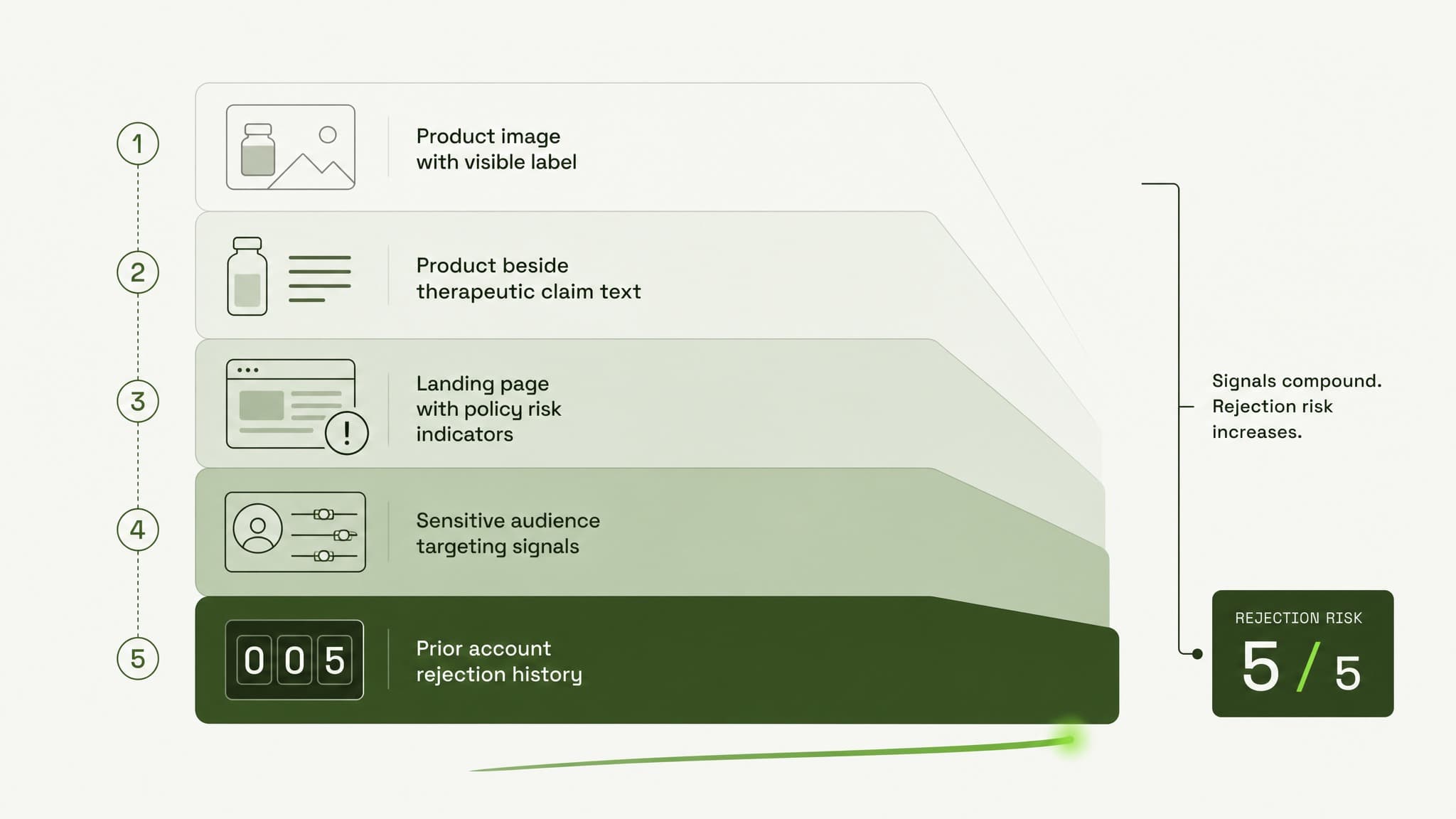
Five rejection triggers that fire together: packaging text, health claims, landing page content, targeting, and account history.
The reason cluster rejections feel unbeatable is that these fire together. Restricted keyword in the copy, plus an unblurred label, plus a pain claim, plus a flagged page, and the rejection is basically guaranteed. The fix is to treat each layer on its own rather than rewriting the same caption ten times.
Why a legal product gets filed as a drug
This is the part that drives compliant hemp brands up the wall. Your product is Farm Bill compliant, under 0.3% Delta-9 THC on a dry weight basis, fully legal to sell. Meta rejects it as a prohibited drug anyway. What is going on?
Legal status and Meta's policy category are two completely different things. Meta's automated review is tuned to catch anything that looks like drug advertising, and it would rather over-catch than let one slip. So it casts a wide net, and compliant hemp gets swept up in that net at a meaningful rate. The system is not checking whether your product is legal. It is sorting your ad into a bucket, and it defaults to the safest bucket for itself, which is the prohibited one.
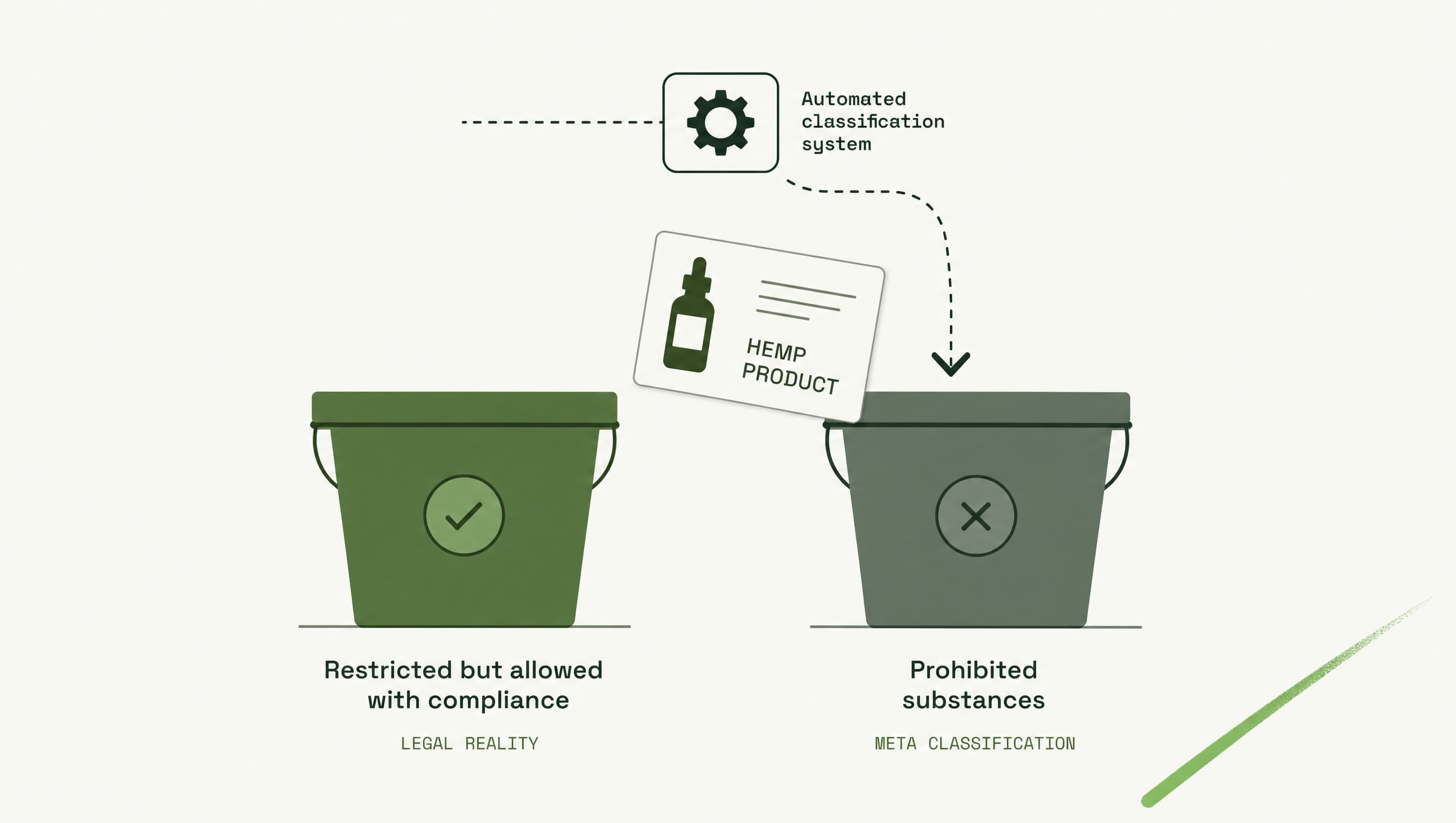
Meta's automated system sorts compliant hemp into the prohibited bucket instead of the restricted-but-allowed one.
There are really two buckets that matter here:
- Restricted but allowed with compliance, which is where hemp actually belongs
- Prohibited substances, which is where recreational drugs belong
The review system regularly files a legal hemp product in the second bucket when it belongs in the first. That single misfiling is the source of a huge share of "why was this rejected, it is legal" frustration. Understanding it changes everything about how you respond, because it tells you what a rejection actually is: not a verdict that your product is banned, but a classifier making a mistake you can sometimes correct.
The signal tax: why appealing everything backfires
Here is the trap. Your ad gets rejected, you know it is clean, so you appeal. You win. It gets flagged again, you appeal again, you win again. Feels like you are beating the system. You are not. You are quietly killing the account.
Every time a creative gets rejected, the account pays what I think of as a signal tax. The rejection degrades the account's trust score in the background, and a lower trust score means future creatives, even genuinely clean ones, face tougher scrutiny and a lower chance of approval. Win the appeal or lose it, the flag itself left a mark. Do that enough times and you lose the ad account, not just the ad.
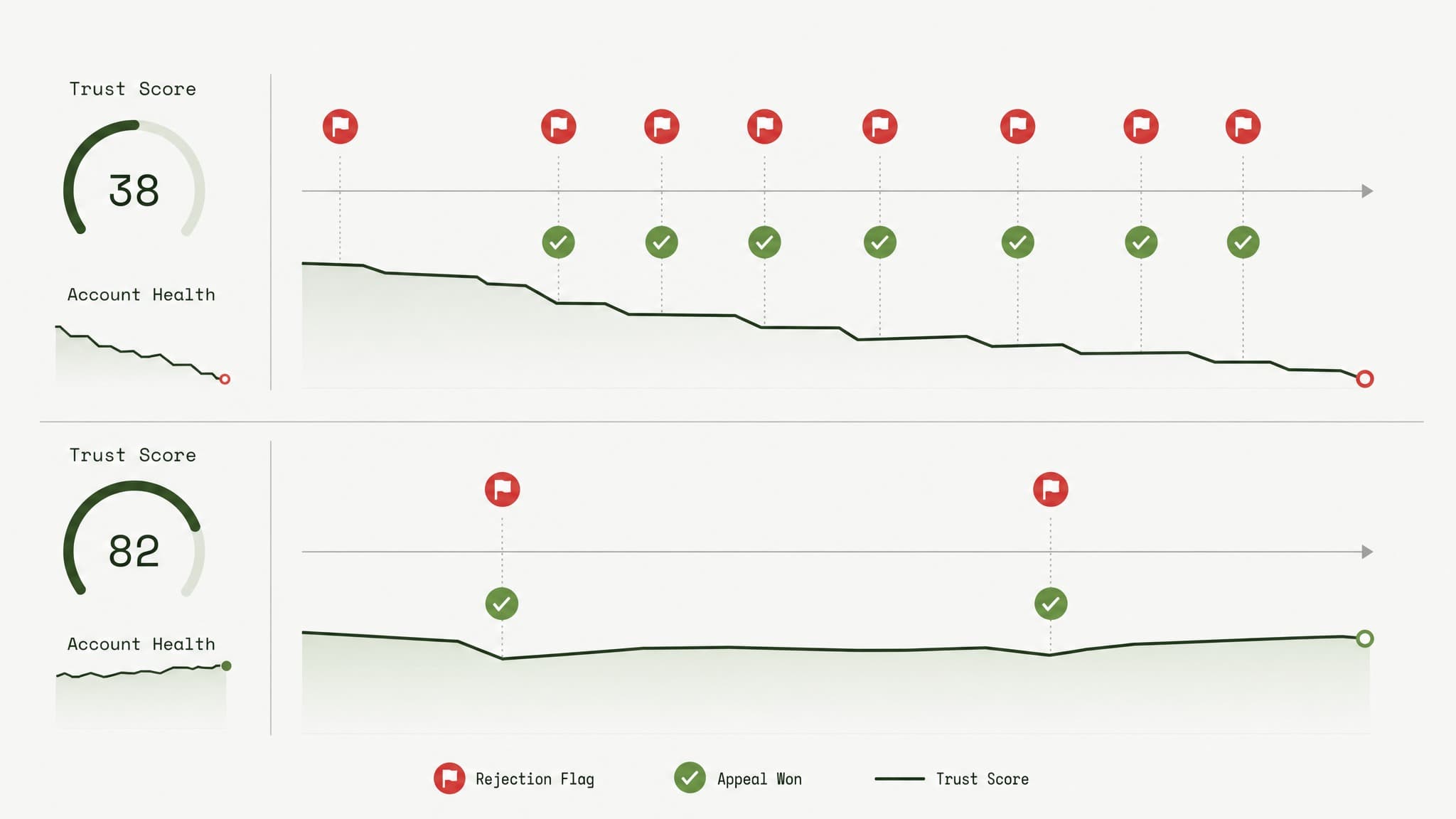
How repeated rejections and appeals quietly erode account trust, even when appeals succeed.
So the operators who last do the opposite of fighting everything:
- Keep a sanitised backup ready. If the bolder creative gets rejected, switch to a tamer version that keeps delivery alive instead of appealing on repeat while your spend sits frozen.
- Appeal selectively. Save appeals for the genuine miscategorisation, the legal product wrongly filed as a drug, not for every knockback.
- Retire creatives that keep flagging. If an ad gets pulled again and again even when you win the appeals, that ad is a liability. Rebuild the angle in a cleaner creative rather than dragging the account through another cycle.
Meta watches your approved-to-rejected ratio. Keep the rejected side low and the account stays healthy enough to carry your bolder work. Let it climb and every ad you run gets harder to land.
When an appeal is worth filing
Appeals are not useless. They are a scalpel, not a hammer. The time to file one is when your legal product got dropped in the prohibited bucket, because that is a mistake the review system can be argued out of.
Before you touch the appeal, one rule matters more than any wording: clean the account first. If a flagged creative is still live when you appeal, the system cross-references your appeal against what is actually running, sees the contradiction, and logs a second strike against you. Pause the flagged ad before you say a word.
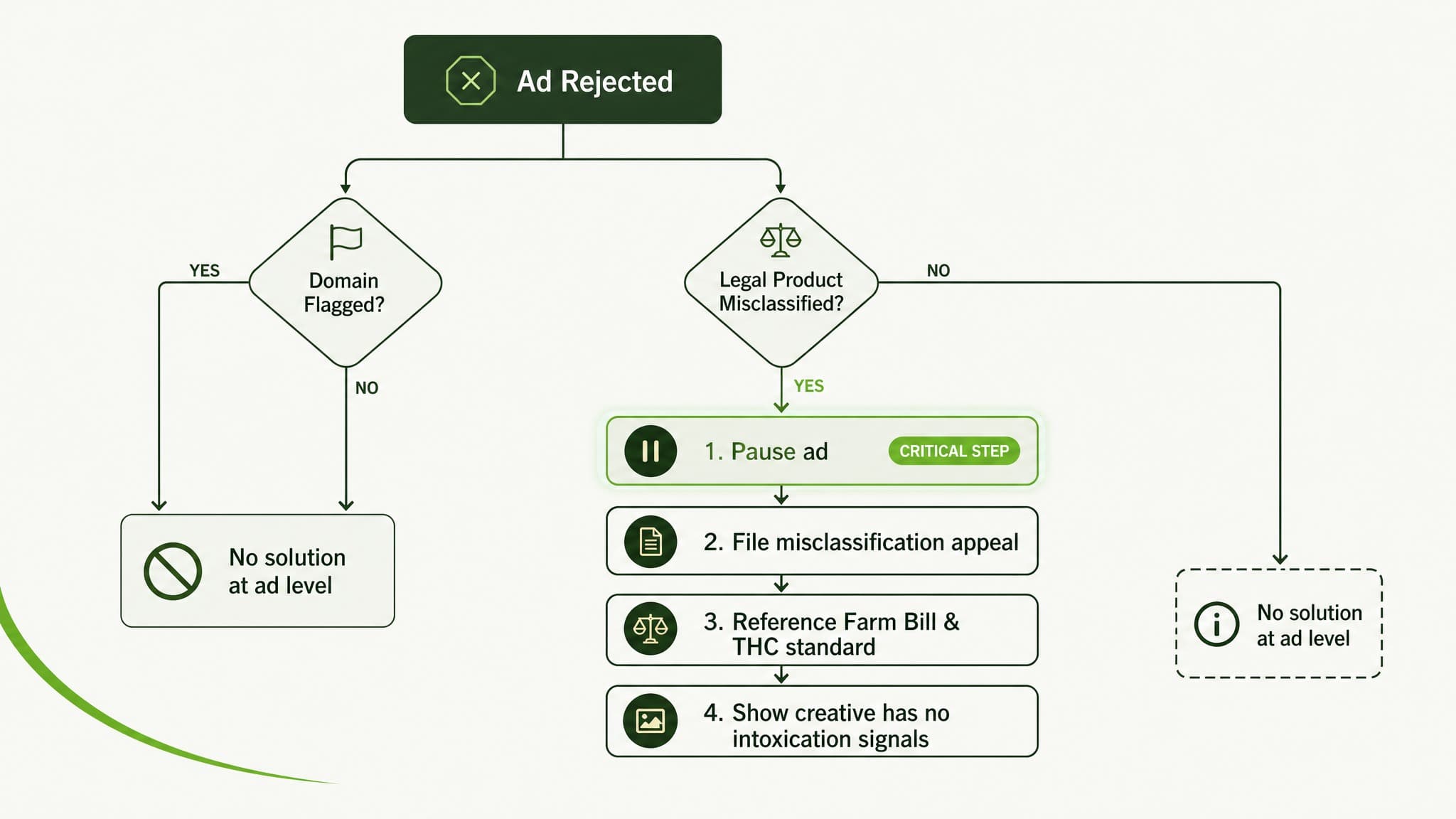
A decision tree showing when to appeal a rejected CBD ad and the required steps before filing.
The winning argument is a misclassification argument, and it rests on a simple idea. You are not telling Meta its policy is wrong. You are telling it the classifier put you in the wrong category. That means naming the real regulatory ground your product stands on, the Farm Bill and the sub 0.3% Delta-9 THC dry weight standard, drawing the line between hemp and marijuana clearly, and showing the creative carries nothing that signals intoxication or drug use. It was a false positive, and you are handing over the facts that prove it.
One hard limit to know: some rejections are not at the ad level at all. If Meta has flagged your whole domain, no creative edit and no appeal script fixes it, because every ad pointing at that domain is dead on arrival. That is a different problem with a different solution, and it is worth diagnosing early so you are not appealing ads when the domain is the thing that is burnt.
Warming the account so bold creative survives
If trust is the currency, a brand-new account is broke. You cannot walk a cold account straight into product-forward CBD creative and expect it to live. You have to earn the right to run the bold stuff.
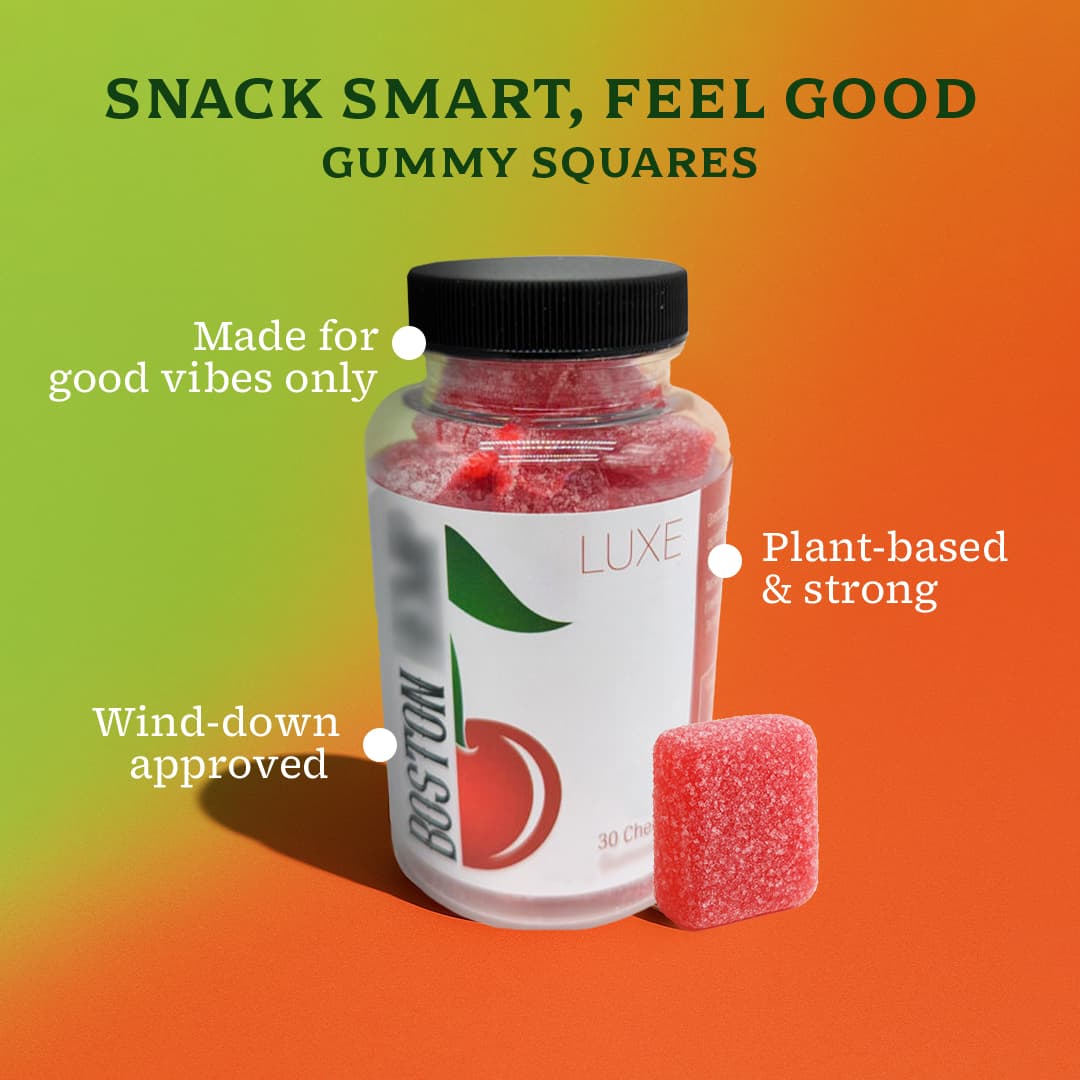


 Live cbd ad creatives from real Icarus client campaigns.
The warm-up is not complicated in principle:
Live cbd ad creatives from real Icarus client campaigns.
The warm-up is not complicated in principle:
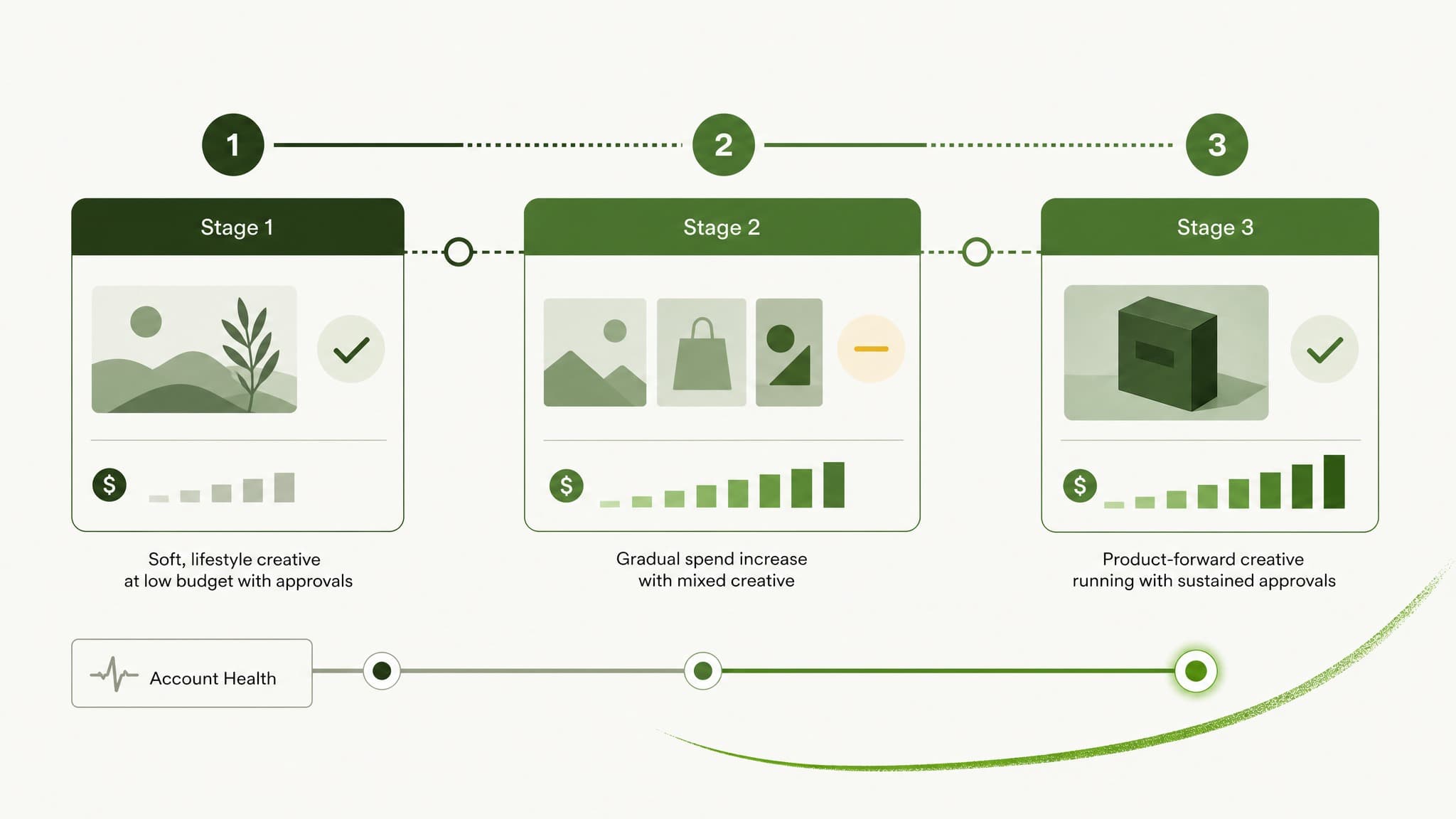
Account warming progresses from soft lifestyle creative through gradual spend increases to product-forward creative as trust builds.
- Open on engagement or awareness, not conversions. Run something soft and lifestyle-led for the first week or so, at a low daily budget, whose only job is to season the account and build a clean, all-approved history.
- Ramp spend slowly. A warming account is not meant to scale yet. Pushing budget too fast is its own risk signal.
- Switch to product-forward creative once the account has earned it. After a stretch of clean running with approvals and almost no rejections, you introduce the riskier, more product-direct creative gradually, keeping each one approved.
Knowing exactly when to make that switch is not a date on a calendar. It is a judgement call an experienced buyer makes by reading the account's health signals, and it is most of the actual craft. It is also why you should never judge a warming account by its front-end numbers. A young account running soft creative at five dollars a day is mid-ignition, not underperforming. If you want to see why that early ROAS is a bad scoreboard for a repeat-purchase product like CBD, run the numbers through the ROAS calculator and look at cost per acquisition against lifetime value instead.
When the account dies anyway
Sometimes you do everything right and Meta restricts the account regardless. In CBD, that is not a failure. It is the weather. Payment hiccups, a run of rejections, a domain flag, any of them can take a whole account down through no fault of your creative. Brands in this category cycle through accounts as a matter of course.
The difference between an operation that shrugs it off and one that goes dark for two weeks is preparation:
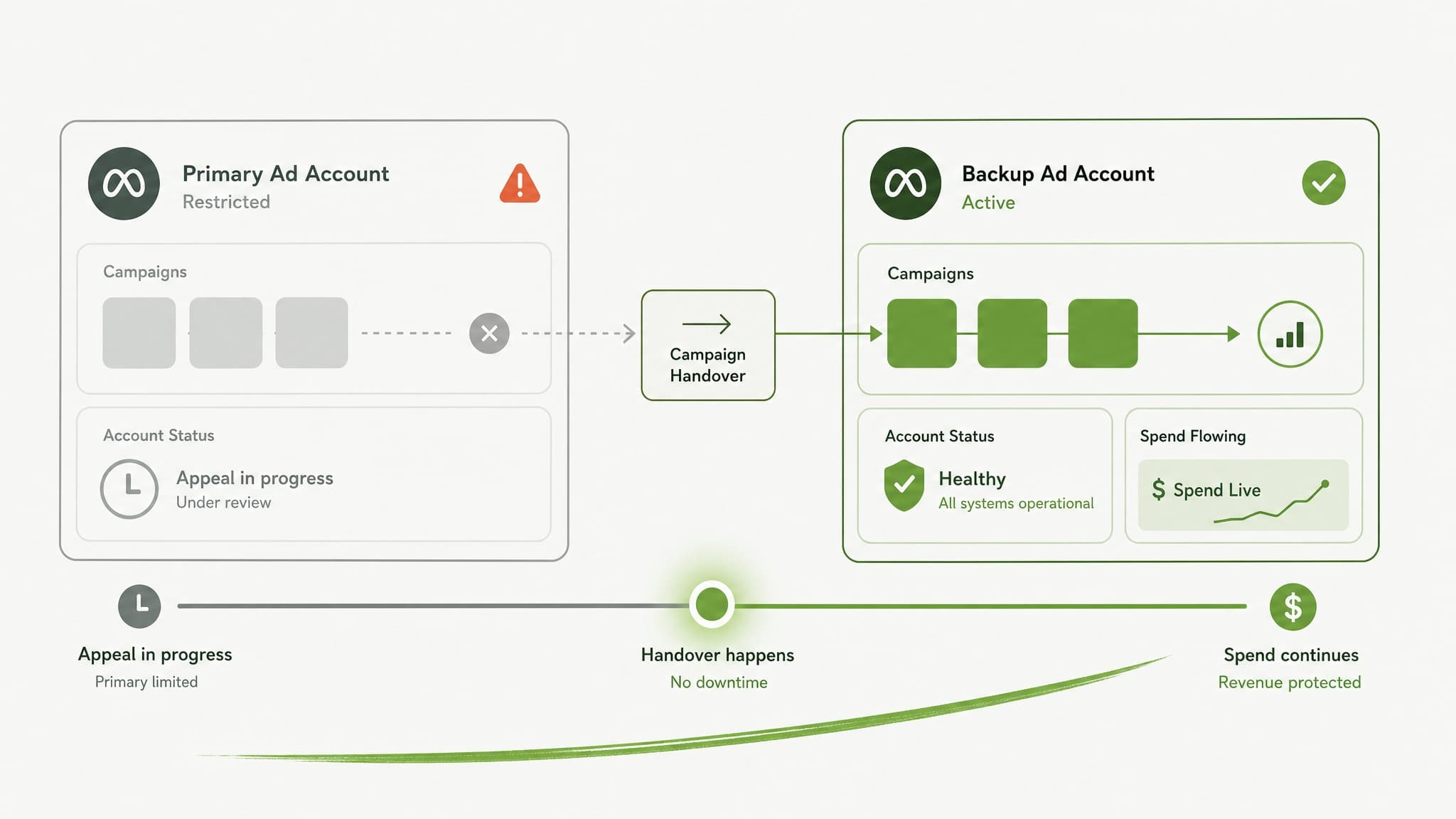
A backup account keeps campaigns running while the restricted account appeals in parallel.
- Always keep a second account already warmed. The backup should never be cold when you need it. If it has existing warm-up spend on it, the handover is fast.
- Rotate delivery to the standby immediately. Move the campaigns over and keep spending while you sort out the disabled one.
- Appeal the dead account in parallel, but do not wait on it. Keep the business running on the backup while the appeal plays out on its own timeline.
That is the whole game in CBD: not never getting restricted, but never letting a restriction stop the money. This is exactly what monitoring account health is for, catching the signals early enough that you have already rotated before delivery drops.
The honest bottom line
Your CBD ads are not getting rejected because CBD is impossible to advertise. They are getting rejected because Meta reads a stack of signals you cannot see, scores an account chain you cannot see, and enforces a policy category that is not the same as the law. Fix the signals one layer at a time, protect the trust score instead of burning it on appeals, warm your accounts, and keep a backup ready, and the rejection loop turns back into a running campaign.
That is the difference between the brands that quit the channel and the ones that scale on it. The results we run for CBD and hemp clients, brands like Lit Farms at a 2.26x return on $330K in revenue, Everything420 at 2.63x on $228K, and Rxtracts at 2.86x, do not come from beating the review bot once. They come from an account that stays alive long enough to spend, on infrastructure built to carry it.
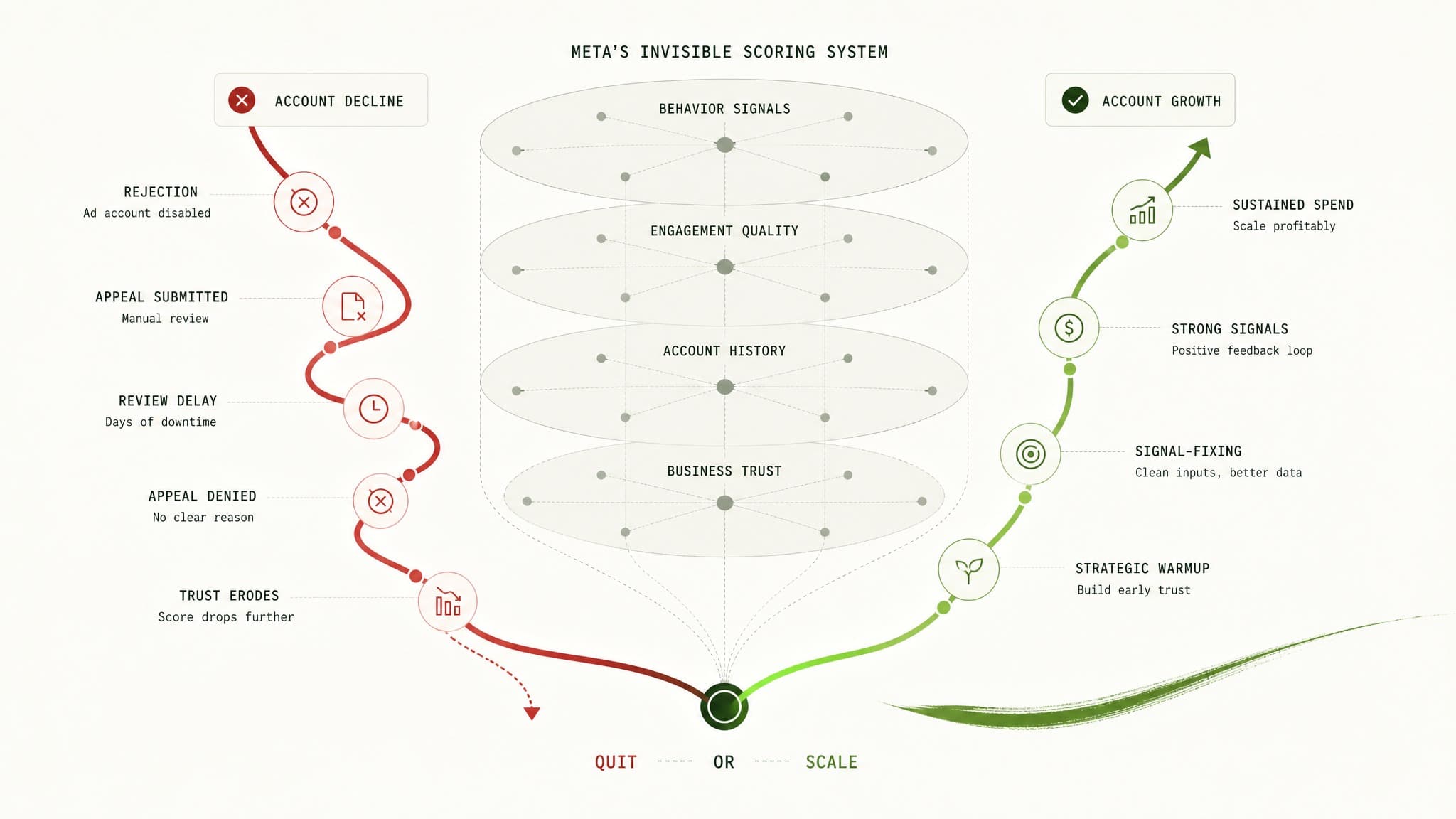
Two paths: accounts that quit versus accounts that scale on restricted platforms.
If you are stuck in the rejection loop and you want the version of this that runs on our accounts and our decade of doing it, see how we work across restricted verticals or start a conversation. We do this every day, in the hardest categories on the platform.