Kratom sits in a strange spot. The plant is federally legal, sold in gas stations and smoke shops across most of the country, used by millions of Americans. And you still cannot say its name in a Facebook ad without the ad getting pulled. Legal product, un-sayable word. That gap is the whole problem, and once you understand why it exists, running kratom ads stops feeling like luck and starts looking like a process.
I have run ads in restricted verticals since 2016, across something close to 300 brands, and kratom is one of the more misunderstood ones. People treat it like cannabis or CBD because they all live under the same "high-risk" umbrella. It is not the same animal. The regulation is shaped differently, the platform rules bite differently, and the strategy that keeps kratom ads alive follows from those differences. Let me walk you through how this actually works.
Why kratom is its own advertising problem
Most people advertising kratom assume the rules match cannabis or CBD. They do not, and the mismatch is where accounts get burned.
- The regulation is alkaloid-specific, not product-wide. Cannabis bans are product-wide. CBD restrictions are mostly claim-based. Kratom is different: in July 2026 the DEA issued a notification of intent to ban 7-hydroxymitragynine, known as 7-OH, the concentrated alkaloid. That is not a ban on the leaf. It targets one isolated compound.
- A single brand can be legal and illegal at once. Because the ban targets the alkaloid and not the plant, a brand selling both leaf powder and a 7-OH product is compliant on one SKU and exposed on the other. That is unique to kratom, and it changes what you can put in front of an ad platform.
- State rules move fast and patchwork. Florida has moved against 7-OH. Idaho has floated bills, one aimed at 7-OH only and one at all kratom. Texas has seen the Attorney General go after retailers. None of this is settled, and it changes month to month.
- The FDA has not evaluated kratom. That is why every compliant page needs the standard "not evaluated by the FDA, not intended to diagnose, treat, cure, or prevent any disease" language.
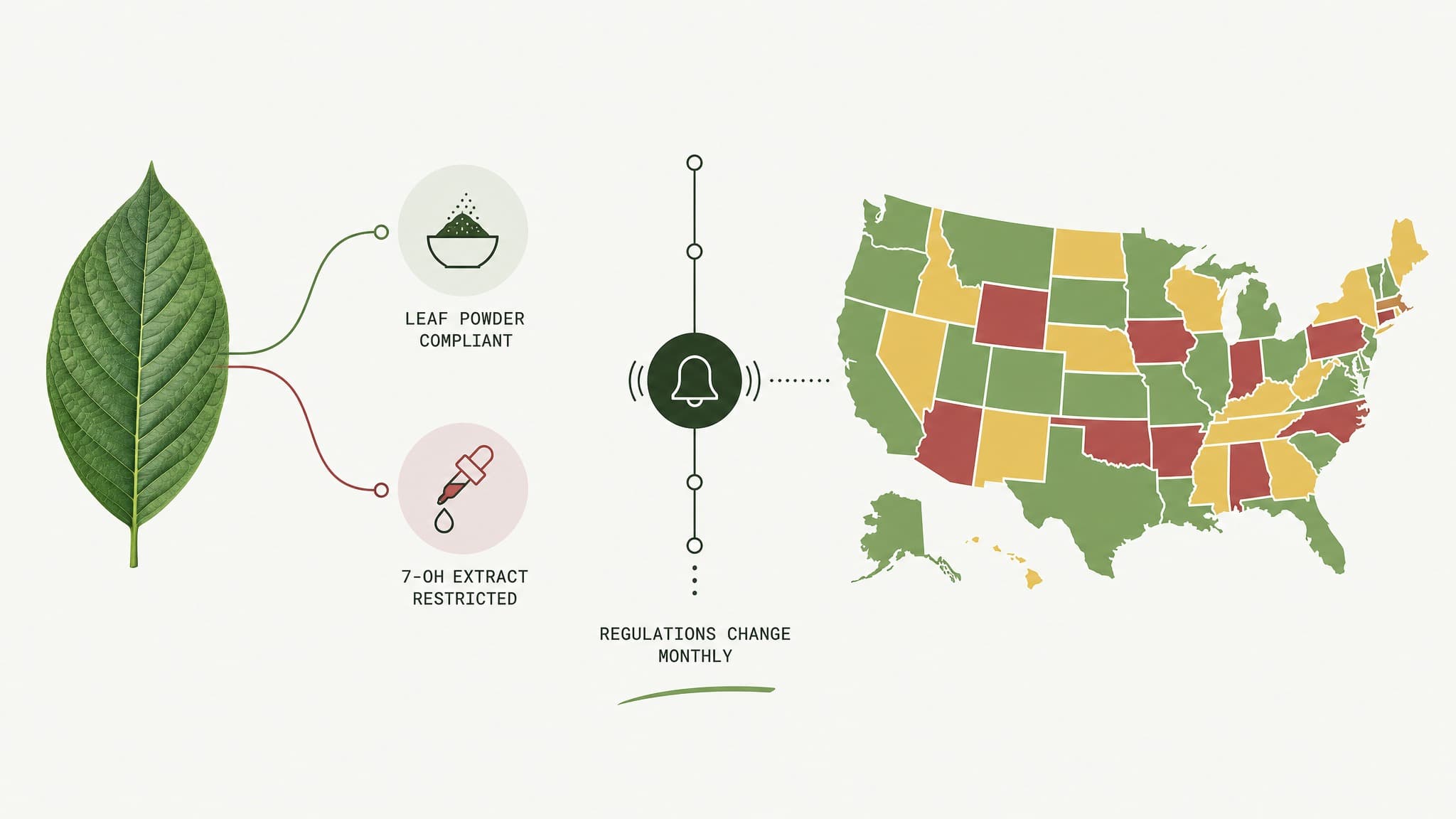
Kratom's legal status splits by alkaloid type and state, creating compliance risk for multi-SKU brands.
So before you write a single ad, the strategy is already being set by two facts: which SKU you are pushing, and where your buyers live. Kratom campaigns run with geo-exclusions built in and SKU-aware creative, because the map of what is legal keeps redrawing itself. Skip that and a policy change in one state can put the whole account at risk.
Google is a closed door. Meta is the game.
There is a fork in the road here, and one path is a dead end.
- Google hard-bans kratom. No exemption exists, and no partner can whitelist it. It does not matter how clean your account is or how careful your copy is. Google's policy on kratom is a wall, not a hurdle. Every hour spent trying to force it is an hour wasted.
- Meta restricts kratom. It does not ban it. Restricted is a completely different situation from banned. Restricted means the door is closed but not locked. Compliant-looking kratom ads run on Meta every single day. They run because the operators behind them understand that the platform is scoring far more than the ad itself.
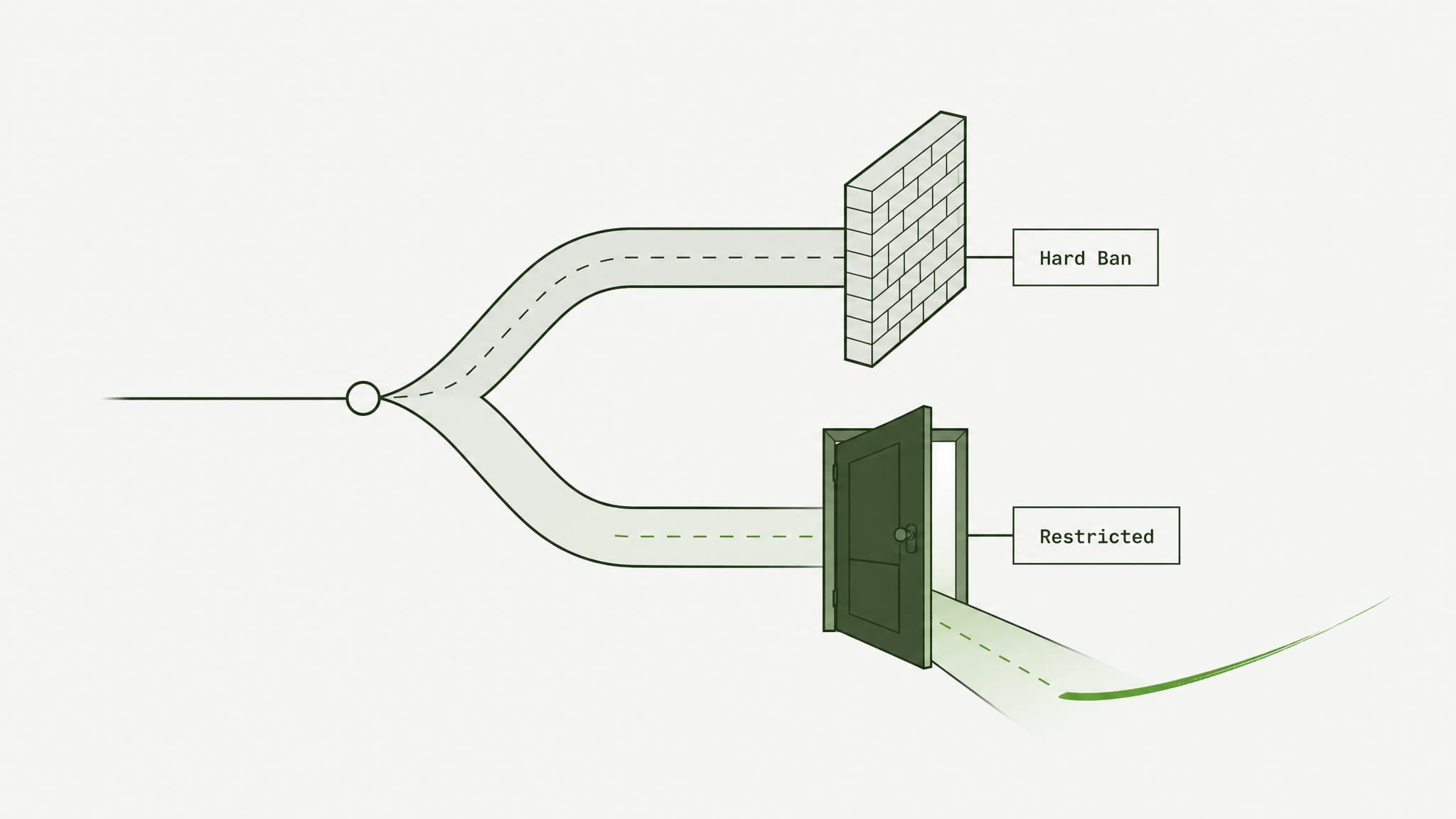
Google blocks kratom entirely; Meta restricts it but allows compliant ads to run.
So the honest answer to "where do I run kratom ads" is Meta, and only Meta, for paid acquisition at any real scale. That focus is a strategy in itself. Stop splitting attention across channels that will never open, and put the effort into running Meta properly.
The word "kratom" is the first thing that gets you rejected
Here is the single most common reason kratom ads die: the word itself.
Meta's review system reads text before it reads intent. The moment "kratom" appears in your ad copy, your headline, or even your Facebook page name, the classifier files the ad under a restricted category and disapproves it. It never got to the part where it decides whether your specific product is a problem. The word was the problem. That is why operators strip it out completely and describe the product by what it does for the customer, or reframe the category around it, and let the destination page carry the actual sell.
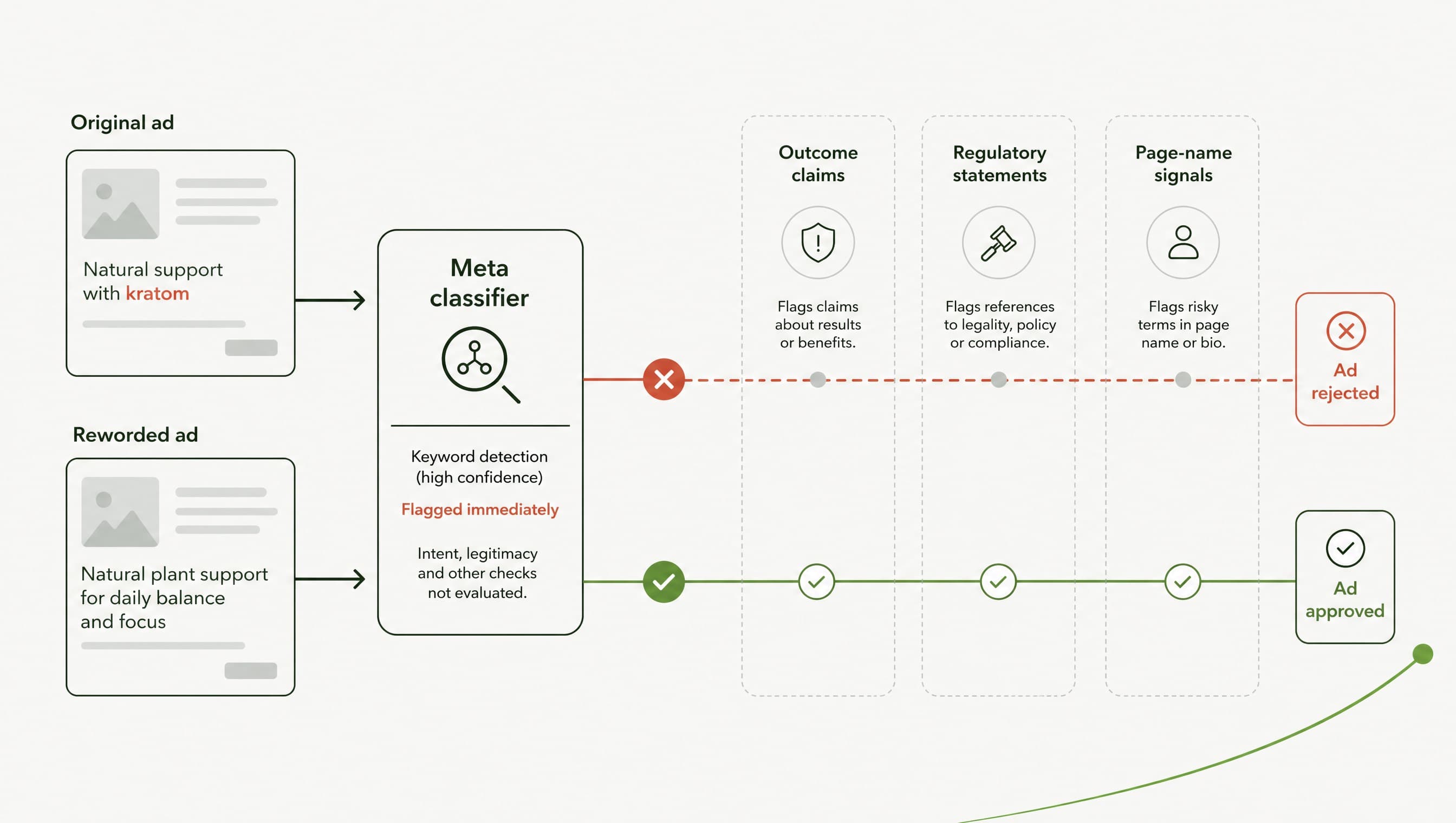
How Meta's classifier rejects ads based on keyword triggers before evaluating product legitimacy.
A few other triggers stack on top of the word:
- Outcome and drug-style claims. Language like pain relief or opioid withdrawal reads as a therapeutic claim on a substance the FDA treats like an opioid. That is one of the fastest ways to get an account flagged, not just an ad rejected. Keep those claims off the ad entirely.
- Blanket regulatory statements. Running an ad that says something like "7-OH is banned" as a flat claim is both inaccurate, because it is legal in most states, and a liability. If you use regulatory news, it has to be tied to the specific state it actually applies to.
- Page-name signals. The classifier reads your page name too. A page with the category word baked into it gets restricted more often, before your creative even enters the picture.
The point is not to make a toothless ad. It is to carry no textual triggers while still speaking clearly to the buyer. The ad can show the product, name the offer, and look bold, as long as the words on it do not fire the review system. Getting that balance right is judgment earned over hundreds of accounts, not a word list you can copy off a forum.
Stable kratom ads are an infrastructure job before a creative job
This is the part almost everyone gets backwards. They obsess over the creative and ignore the thing the creative runs on. Then a perfectly good ad dies and they blame the ad.
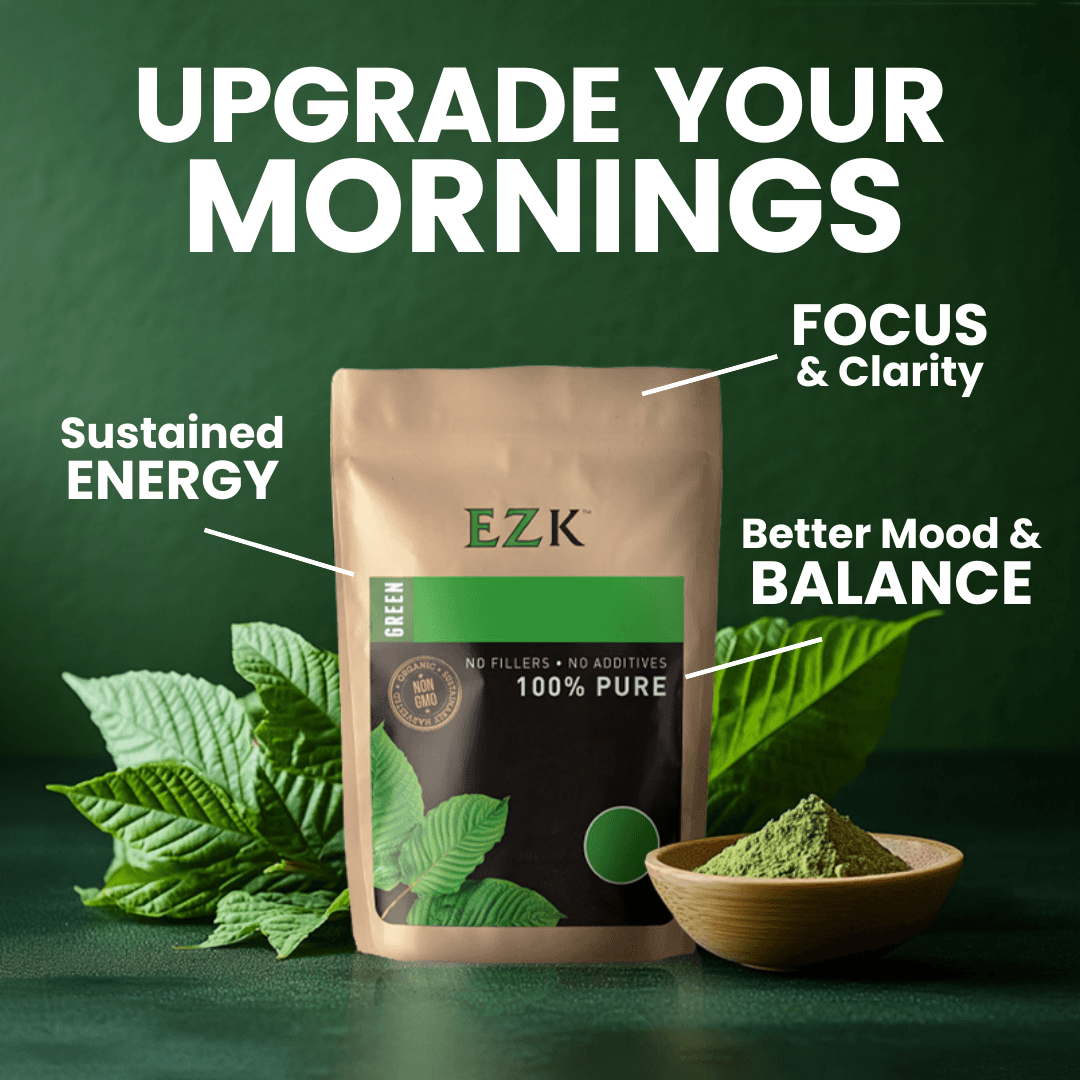
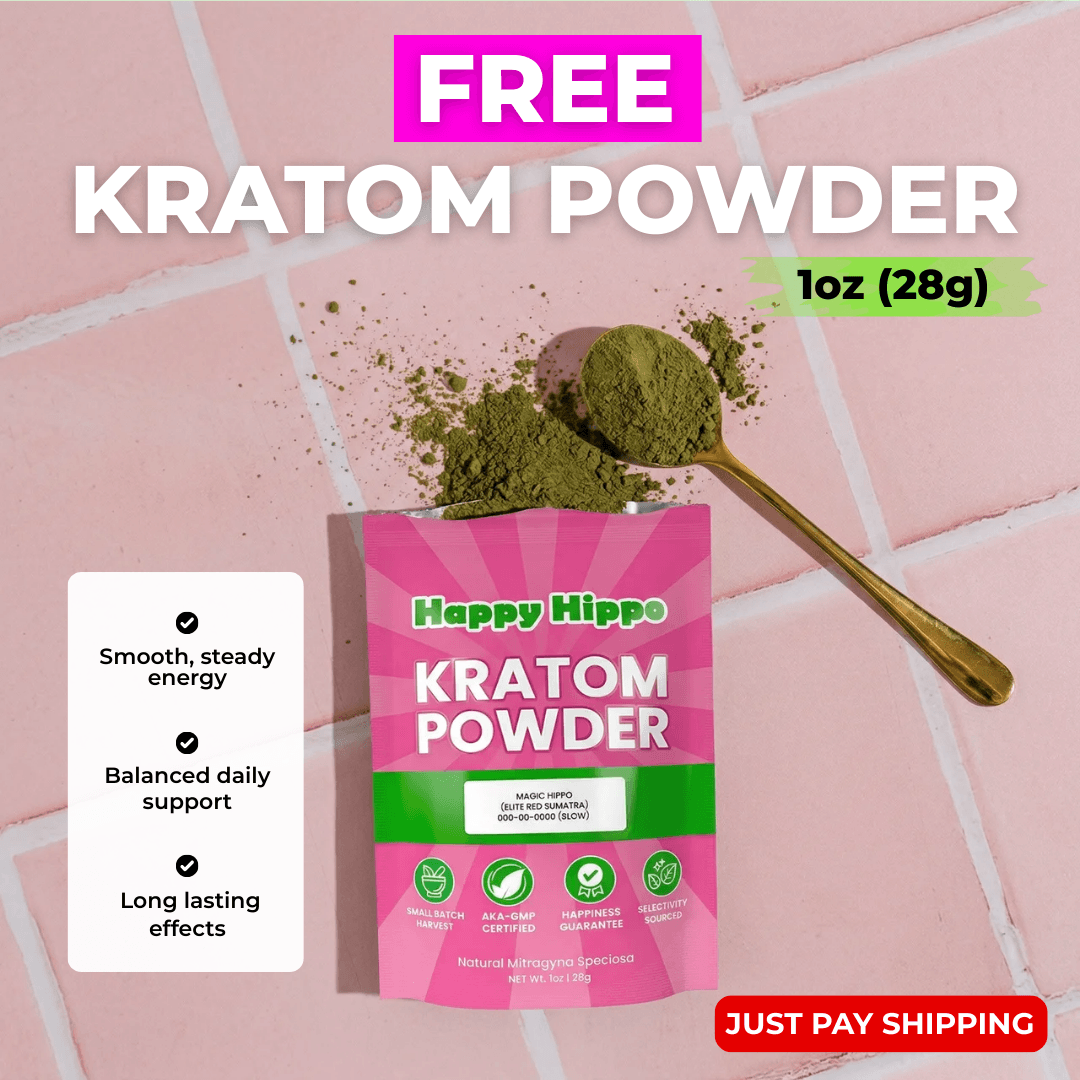
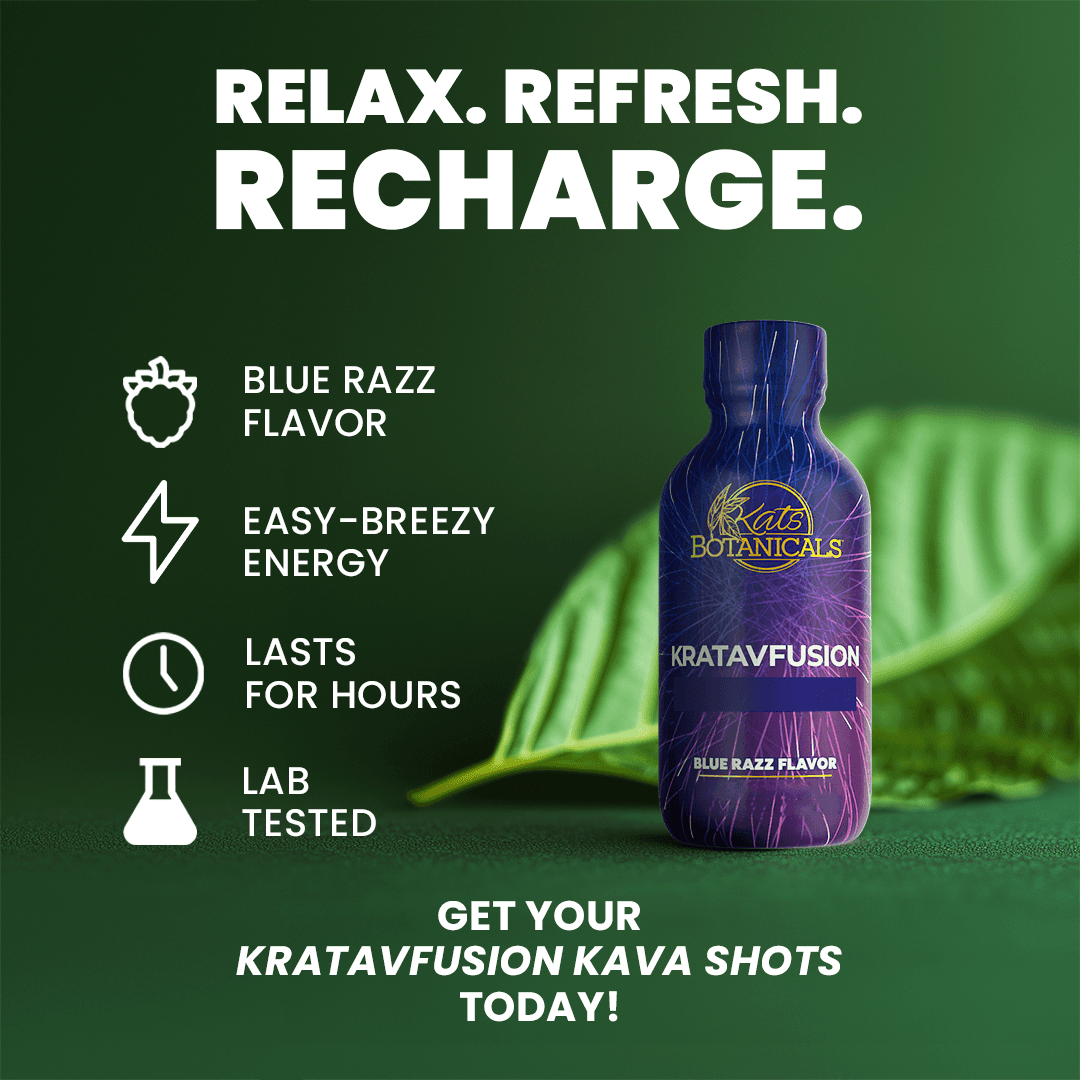
 Live kratom ad creatives from real Icarus client campaigns.
Meta scores the account, the profile, and the business manager behind every ad, and it does it with a trust score you never see. There is no number in the interface. But it is real, and it flows across a connected chain: a weak profile can drag down the ad account it runs, and a damaged ad account can drag down the business manager above it. Run a strong ad from a brand-new, low-trust account and it gets rejected anyway, because the trust behind it is not there yet. The ad was never the issue.
Live kratom ad creatives from real Icarus client campaigns.
Meta scores the account, the profile, and the business manager behind every ad, and it does it with a trust score you never see. There is no number in the interface. But it is real, and it flows across a connected chain: a weak profile can drag down the ad account it runs, and a damaged ad account can drag down the business manager above it. Run a strong ad from a brand-new, low-trust account and it gets rejected anyway, because the trust behind it is not there yet. The ad was never the issue.
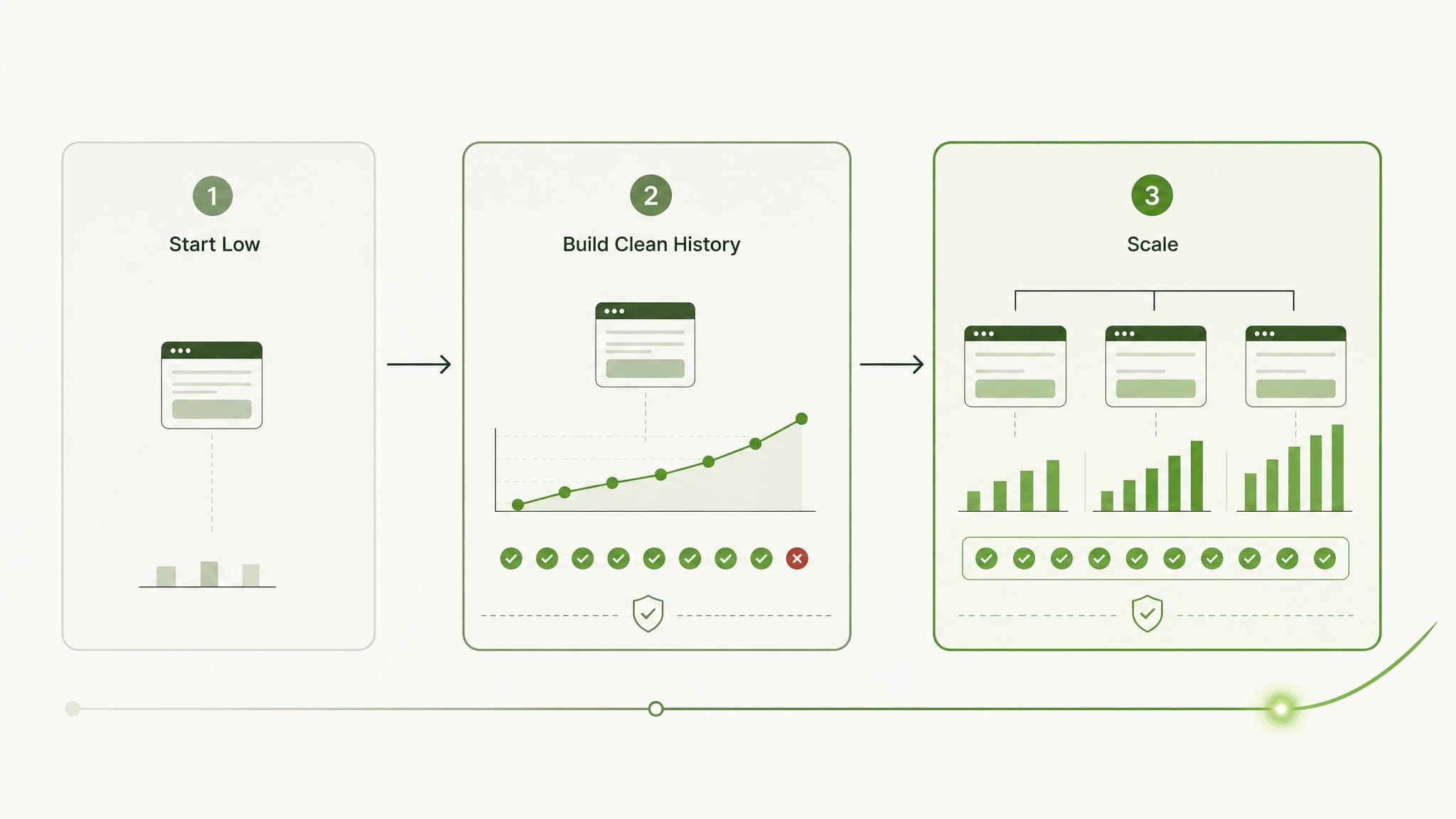
Three-stage account warm-up sequence: starting small, building clean delivery history, then scaling budget across proven campaigns.
That is why serious kratom advertising is built on two ideas: segmentation and warm-up.
Segmentation means you never let one asset carry the whole business. Multiple pages sit on the business manager, so if one page gets restricted, the campaigns keep running on the others instead of the whole account going dark. Multiple accounts run in parallel, so one ban is a setback, not a shutdown. When an account does burn, and in this vertical some will, you move the budget to the surviving campaigns and rebuild in the background. The business never fully stops.
Warm-up is the sequence that earns an account the right to run risky-looking creative:
- Start low. One or two campaigns, well below your normal daily budget, on proven, safe creative only.
- Build a clean history. Let it run until delivery is stable and your approved-to-rejected ratio stays healthy. Meta watches that ratio in the background; let rejections pile up past roughly one in ten and the account gets flagged.
- Scale what is stable. Once the account shows steady delivery, migrate the rest of your campaigns onto it and push the budget up.
Judging a new kratom account in its first two weeks is judging it mid-warm-up. It is supposed to look modest at the start. If you want more on reading account signals over time, we go deep on that in our guide to account health monitoring, and on pushing spend safely in scaling high-risk campaigns.
The compliant page and the money page do two different jobs
Your landing page is part of your ad, and in restricted verticals it is doing two jobs at once.
Automated policy review needs to see a page that is fully compliant: no restricted claims, clear offer, real terms and conditions, a privacy policy, and a contact page. Your actual buyers need to see the page that converts, with the real offer and the product front and center. A properly built kratom funnel is constructed so each side sees the page it is meant to see. This is table stakes in the vertical, dialed in before launch, and it ships at the same time as the creative, not bolted on afterward. I am not going to write the how-to here, because the exact build is part of what clients pay for, but understand that it exists and that without it, kratom ads on Meta do not stay live.
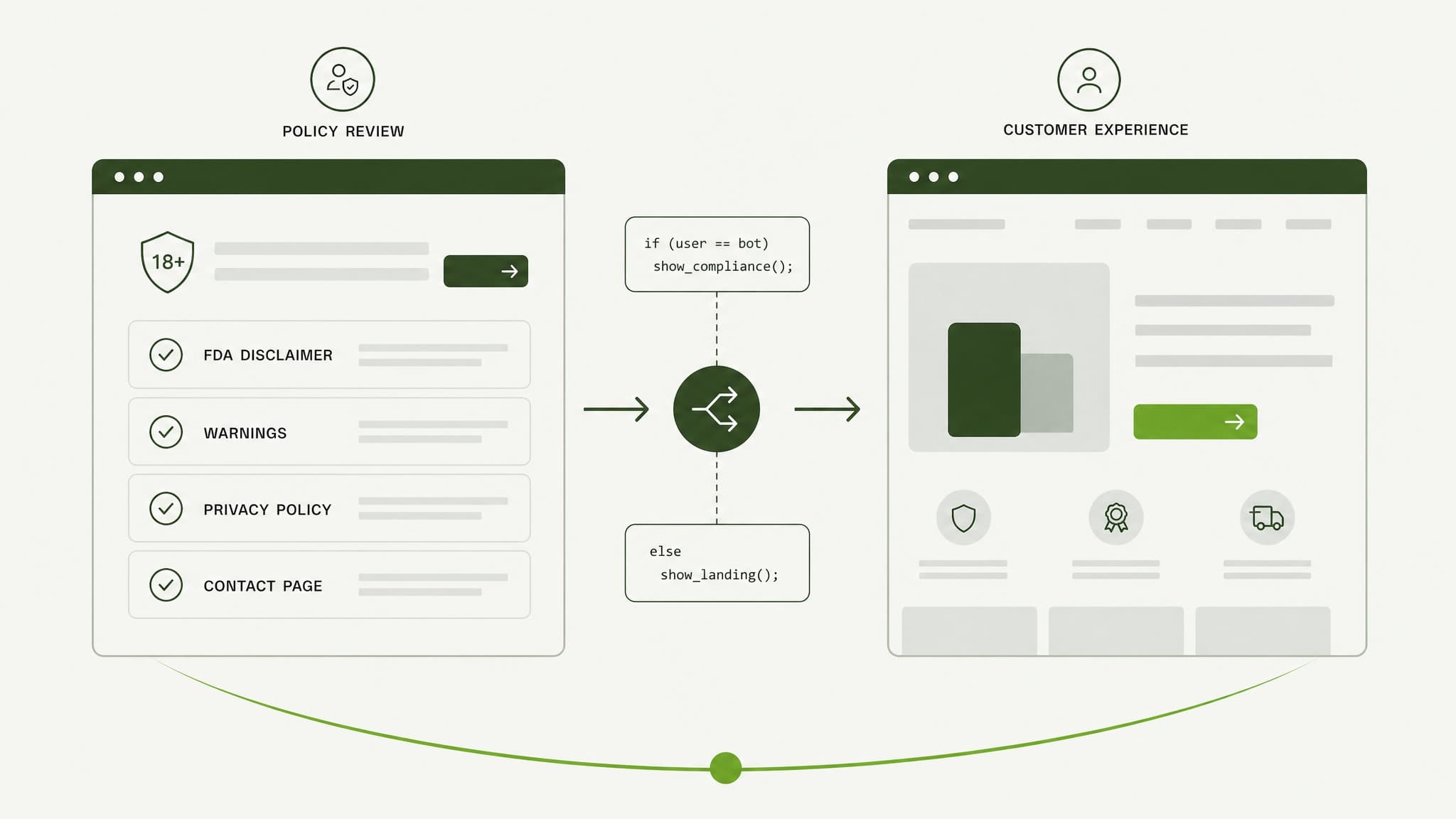
A landing page split into compliant and conversion versions, each optimized for its audience.
Whatever the buyer eventually sees, the compliant side carries the non-negotiable legal furniture:
- A 21+ age gate, standard for the category.
- The FDA disclaimer stating the product has not been evaluated and is not intended to diagnose, treat, cure, or prevent disease.
- Honest warnings, including that the product may be habit-forming, is not for long-term use, and is not for pregnant or nursing women.
None of that is optional, and none of it belongs on the ad creative itself. It lives on the destination. For the full picture on building destinations that hold up to review, see building compliant landing pages.
Creative angles that actually move kratom
Once the infrastructure holds and the funnel is built, the creative question is simple: how do you sell a product whose name you cannot use? Three angles do the heavy lifting.
- Reframe the category. Position the product against something the buyer already understands. An alternative to the afternoon coffee, the energy drink, the pre-workout. The word kratom never appears in the ad, the reframe carries the message, and the cloaked page closes the sale. This is the workhorse angle because it sidesteps the trigger completely.
- Lead with a low-friction offer. A free sample or trial where the customer just covers shipping pulls volume, because it is compliant enough at the ad level and the money page does the closing. Simon's rule holds here: the offer beats the occasion, and shipping fees are kryptonite to a paid campaign, so the offer has to be visible early and the friction low.
- Use real regulatory urgency, carefully. When a genuine ban is moving through a specific state, an advocacy or awareness angle is a fully compliant way to run, build a real audience, and stay in front of buyers. It works because it is true and tied to a real event, not manufactured scarcity. The discipline is keeping it accurate and state-specific.
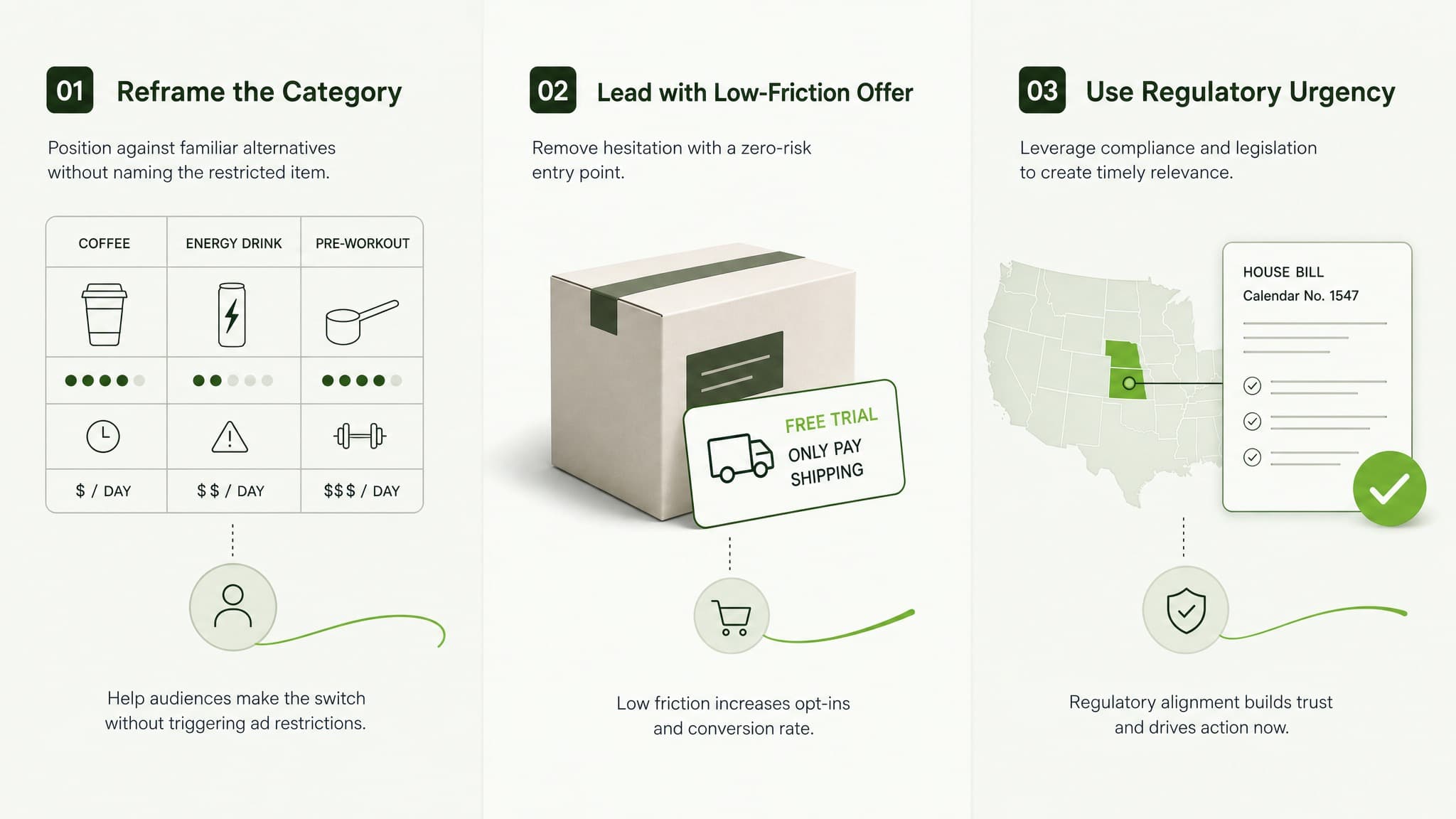
Three compliant creative angles for kratom ads: category reframe, low-friction offer, and regulatory urgency.
Two production notes that come straight from running this vertical. Static images get rejected more often than video, because Meta's AI reads a still frame more easily than moving footage, so video buys you room to show and say more. And a single persona is a weak campaign. Real kratom campaigns speak to several buyer types at once, budget-driven buyers, effect-driven buyers, brand-loyal buyers, each with its own creative and its own angle, because narrowing to one voice starves the algorithm of the variety it feeds on.
Judge kratom campaigns on CPA and lifetime value, not front-end ROAS
Here is where most kratom brands misread their own numbers and kill campaigns that were actually working.
- Front-end ROAS is the acquisition price of a new customer, nothing more.
- CPA against AOV tells you whether that price is sane for your margins.
- Lifetime value is where a repeat-purchase product like kratom actually makes its money.
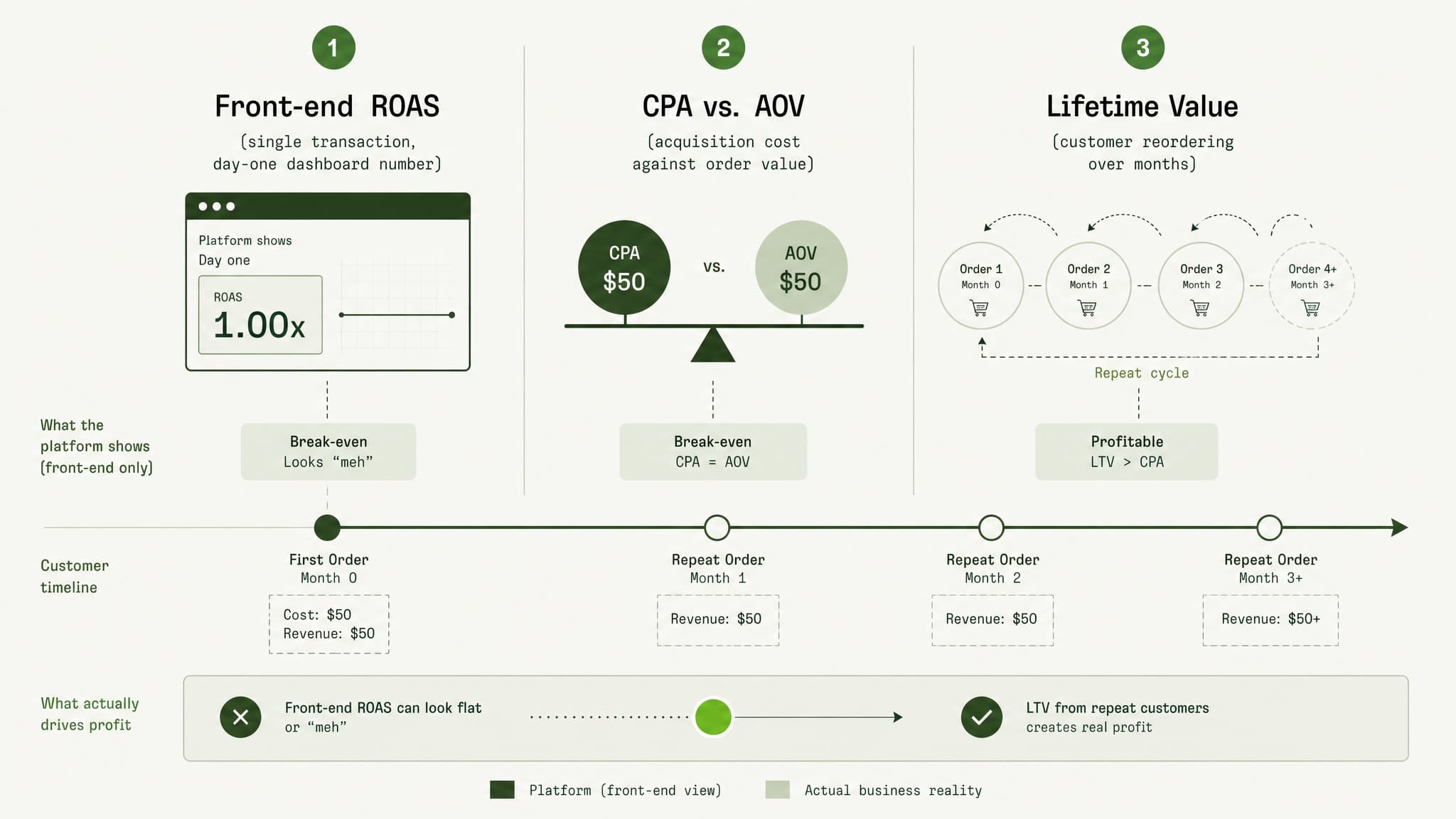
How a break-even first order becomes profitable through repeat purchases over months.
Kratom is a repeat-purchase product. People who like it reorder, often on a regular cycle. That means the money is not in the first order, it is in the relationship. Front-end ROAS, the number the platform dashboard shows you on day one, is just the price you paid to acquire a customer. It is not a verdict on the business. A first order that breaks even and then reorders three times over the next few months is a winner, and a dashboard that only shows you the front end will call that winner a loss.
The numbers that actually decide it are cost per acquisition measured against average order value and lifetime value. That is the frame we hold clients to across every restricted vertical we run, and it is the reason retention-focused management produces results that survive a bad week. Restricted-vertical accounts we manage have held real, sustained returns on exactly this logic, brands like Lit Farms at 2.26x and Everything420 at 2.63x, built by treating acquisition as the start of a customer relationship rather than a one-shot transaction. If you want to see how front-end ROAS, CPA, and lifetime value actually connect for your own numbers, run them through our ROAS calculator before you judge a campaign on the platform figure alone.
What running kratom actually takes
Strip it all back and kratom advertising is a solvable problem, not a gamble. The plant is legal. The demand is real and repeat. Meta is open to operators who run it properly. What it is not is a hack you can pull off a forum thread, because the parts that make it work, the trust infrastructure, the warm-up discipline, the dual-purpose funnel, the SKU-aware and geo-aware creative, are earned over years of running the vertical and getting it wrong enough times to get it right.
That is the honest line on kratom. Understand the shape of it and you can make good decisions about your own campaigns. If you would rather have a team that already runs this every day carry the infrastructure and the judgment for you, that is exactly what we do. See the restricted industries we work in or start a conversation about your brand at our contact page.
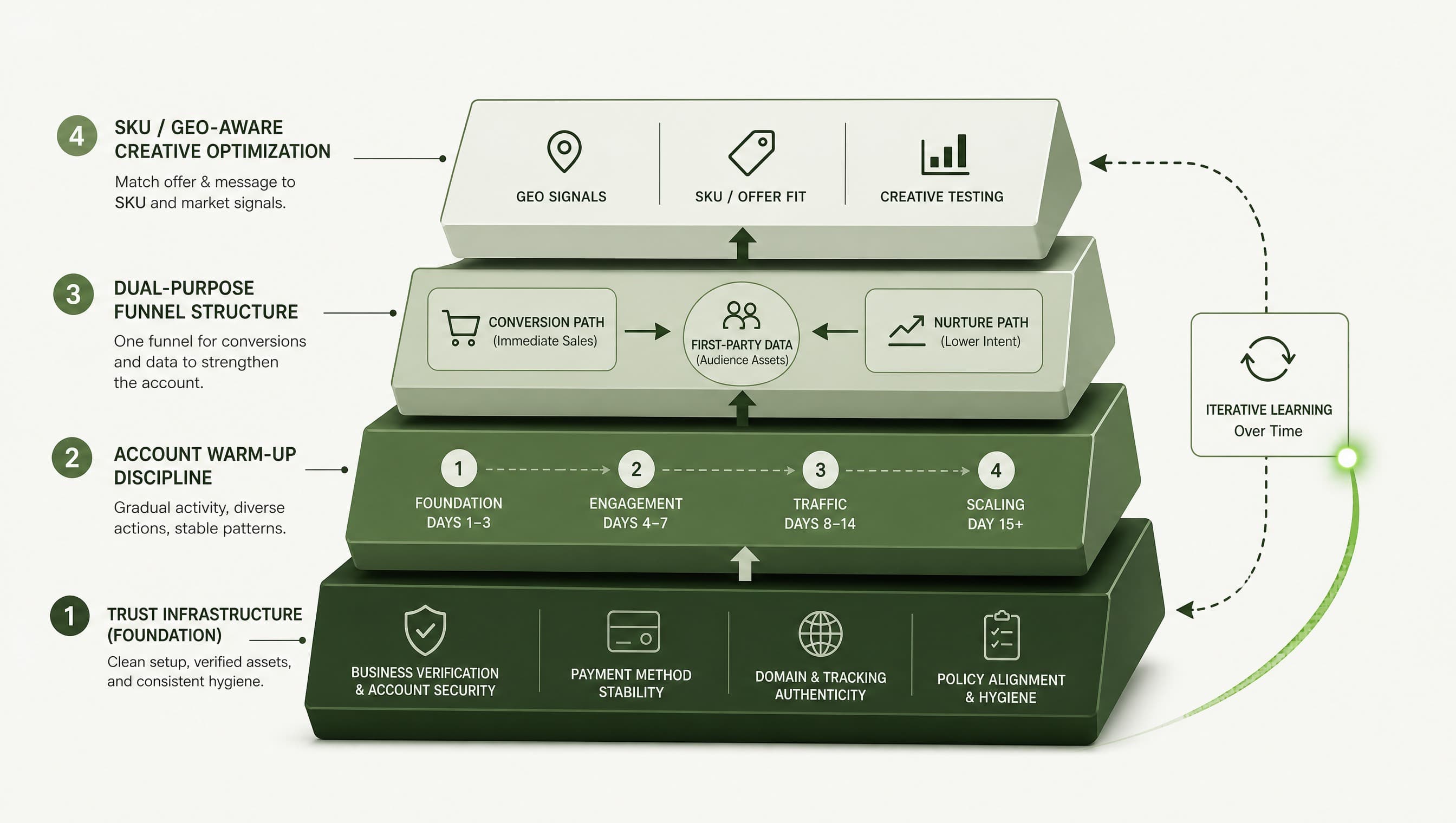
The layered infrastructure required to run profitable kratom campaigns over time.