

Restricted industry advertising statistics are mostly the ad platforms' own enforcement counts. Google's 2025 Ads Safety Report counts 8.3 billion ads blocked or removed, 4.8 billion restricted and 24.9 million advertiser accounts suspended. We've found no public report that counts ad rejections for cannabis, CBD, vape, kratom or peptides.
Last updated 7 November 2026. At Icarus we've run ads for restricted brands since 2016. Below you get the platform numbers, Meta's written rule for each restricted vertical in one table, and how we read those numbers when we plan Meta ads for restricted industries.
Key takeaways
The restricted industry advertising numbers that matter most in 2026:
- Google's 2025 Ads Safety Report counts 8.3 billion ads blocked or removed and 24.9 million advertiser accounts suspended.
- Meta bans THC, tobacco, nicotine pouches and all vapes; CBD and prescription drugs need written authorisation.
- Kratom and peptides aren't named in Meta's policy, so they're judged case by case.
- 68 countries have best-practice bans on tobacco advertising, per the WHO's 2025 report.
- Judge restricted campaigns on cost to win a customer and lifetime value, not one platform number.
What counts as a restricted industry in advertising?
A restricted industry is one whose products an ad platform bans or allows only with conditions: written permission, an age limit or a set list of countries. Google's restricted categories in 2025 included legal requirements (504.4 million ads restricted), financial services (273.4 million), online gambling and games (123.9 million) and healthcare and medicines (119.3 million), according to its 2025 report.
On Meta, the categories our clients sit in fall into three groups:
- Banned: THC products, tobacco, nicotine pouches and every kind of vape.
- Allowed with written permission: CBD and prescription drugs.
- Not named, judged case by case: kratom and peptides.
How many ads do Google and Meta block?
Google blocked or removed more ads in 2025 than in 2024, while restricting and suspending fewer. Restricted industry advertising sits inside these totals, the platform's own counts, from its 2025 report and its 2024 report:
| Google Ads | 2024 | 2025 |
|---|---|---|
| Ads blocked or removed | 5.1 billion | 8.3 billion |
| Ads restricted | 9.1 billion | 4.8 billion |
| Advertiser accounts suspended | 39.2 million | 24.9 million |
By category, Google blocked or removed 270.7 million gambling and games ads, 87.8 million healthcare and medicines ads and 20.6 million alcohol ads in 2025 (Google).
Meta is harder to measure. It publishes its rules in its Advertising Standards, but we haven't found a Meta report that counts rejected ads by category the way Google's does. So for Meta, the written rule is the best public data.
What does Meta allow for each restricted vertical?
In restricted industry advertising, Meta bans some products outright and lets others run only with written authorisation. We checked each row against Meta's own policy pages on 7 November 2026:
| Vertical | Meta's written rule | Source |
|---|---|---|
| Cannabis (THC) | Banned: ads "may not promote or offer the sale of THC products" | Drugs and Pharmaceuticals |
| CBD | Prior written authorisation and LegitScript certification; United States only; 18 and over | Drugs and Pharmaceuticals |
| Hemp products | Canada, Mexico and the United States only | Drugs and Pharmaceuticals |
| Vape and nicotine | Banned, including nicotine-free and "wellness" vapes and nicotine pouches | Tobacco and Related Products |
| Kratom | Not named; falls under "unsafe substances, products or supplements, as determined by Meta at its sole discretion" | Drugs and Pharmaceuticals |
| Peptides | Not named; prescription drugs need LegitScript or Meta's own review, and only run in the US, Canada and New Zealand to people 18 and over | Drugs and Pharmaceuticals |
Each vertical has its own quirks, and we cover them in our pages on cannabis advertising, CBD and hemp, vape advertising on Meta, kratom ad strategy and peptide advertising.
How many countries ban tobacco advertising?
68 countries have best-practice bans on tobacco advertising, promotion and sponsorship, covering over 25% of the world's population, according to the WHO's 2025 report on the global tobacco epidemic. Those national bans sit on top of the platform rules every restricted industry follows in its advertising.
It's a count of country laws aimed at tobacco. For a vape, kratom or CBD brand running social ads, the rule that decides whether an ad runs day to day is the platform's review. That's why the rest of this page sticks to platform numbers.
Why do rejection numbers differ from one ad account to the next?
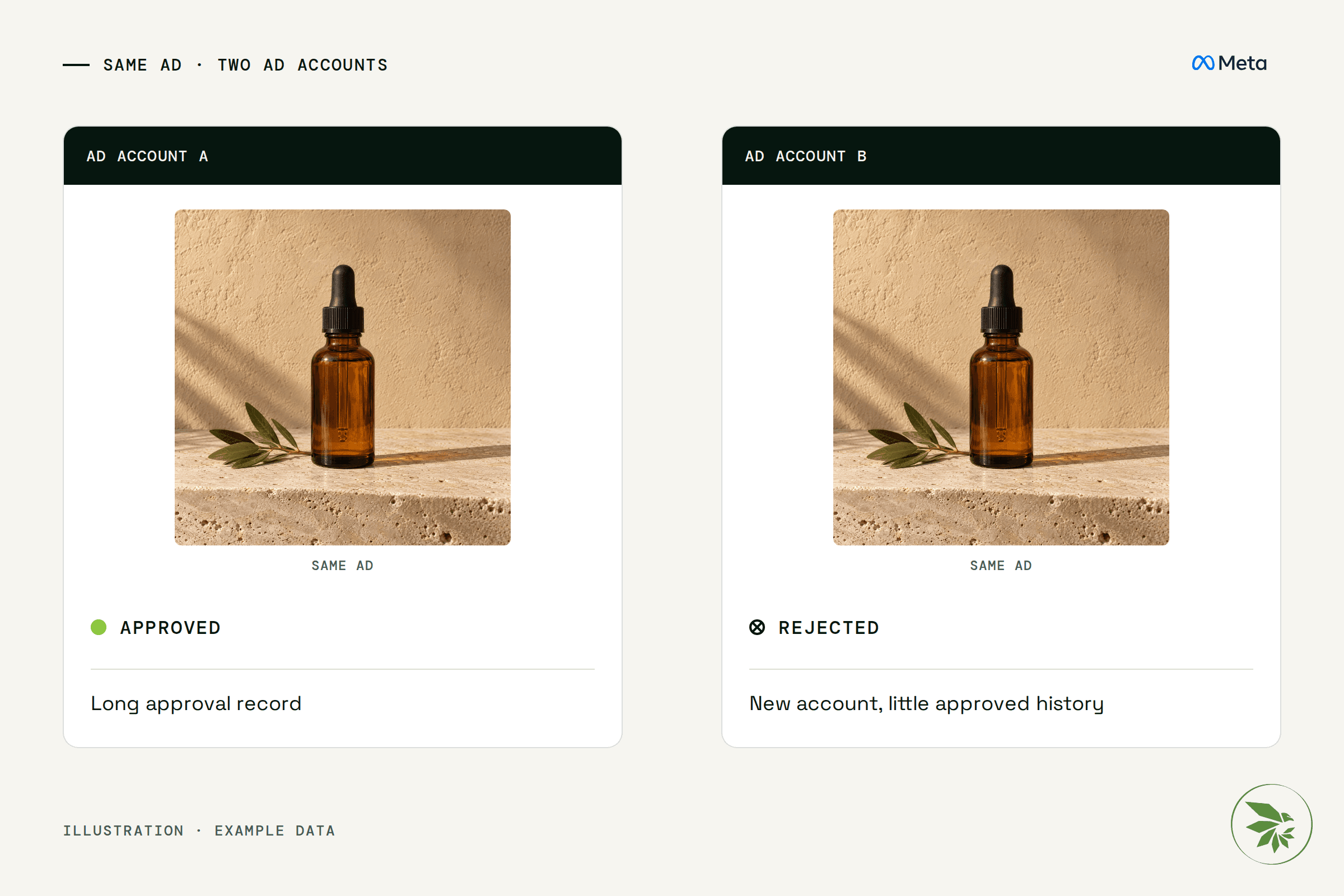
Rejection numbers differ because Meta judges the account behind an ad, not only the ad. Here's what we see running restricted products:
- The same ad can pass on one ad account and fail on another.
- A brand-new account with little approved history gets rejected more easily than one with a long approval record.
- Meta looks at the profile, the ad account and the business manager behind every ad.
Even Google says its review gets this wrong: its systems cut incorrect advertiser suspensions by 80% in 2025, according to the 2025 report. An average rejection rate for a vertical tells you very little about your own account.
When an ad is rejected, we work out which variable caused it: the copy, the image or a product word. There's more on how review works in our guide to Meta's ad policies for high-risk verticals.
We run Meta campaigns through official Meta partners, on those partners' ad accounts.
How big are restricted markets?
Commercial gaming revenue measures market size. It does not measure restricted industry advertising spend.
Gambling is one restricted market with recent US revenue figures published by a trade body. The American Gaming Association puts 2025 commercial gaming revenue at $78.72 billion, up 9.2%:
- Sports betting: $16.96 billion, up 22.8%.
- iGaming: $10.74 billion, up 27.6%.
- All 38 commercial gaming markets grew in 2025.
For cannabis, CBD, vape, kratom and peptides, we haven't found a sourced public figure for ad spend, approval rates or cost per click. That gap is real. Treat any benchmark without a named source as marketing.
We don't publish client numbers either, because an approval count isn't a sales count: ads that say and show nothing get approved and still don't sell.
How to use these numbers in your ad plan
These restricted industry advertising numbers are most useful as a checklist before you spend:
- Find your vertical's row in the Meta table before you write a single ad.
- Run on ad accounts with a long approval record. Meta judges the account behind an ad, so the account matters as much as the copy.
- Judge results on the cost to win a customer and what that customer is worth over six to twelve months, not on one platform number.
- Build search, email and social alongside paid ads, so the ads aren't carrying everything.
- Check the platform numbers again when Google publishes its next report. The 2025 edition came out in April 2026.
If your category sits in the banned or case-by-case rows, that's the work we do every day. Run your own numbers through our CPA and ROAS calculator first, then judge any campaign on what it costs to win a customer.