
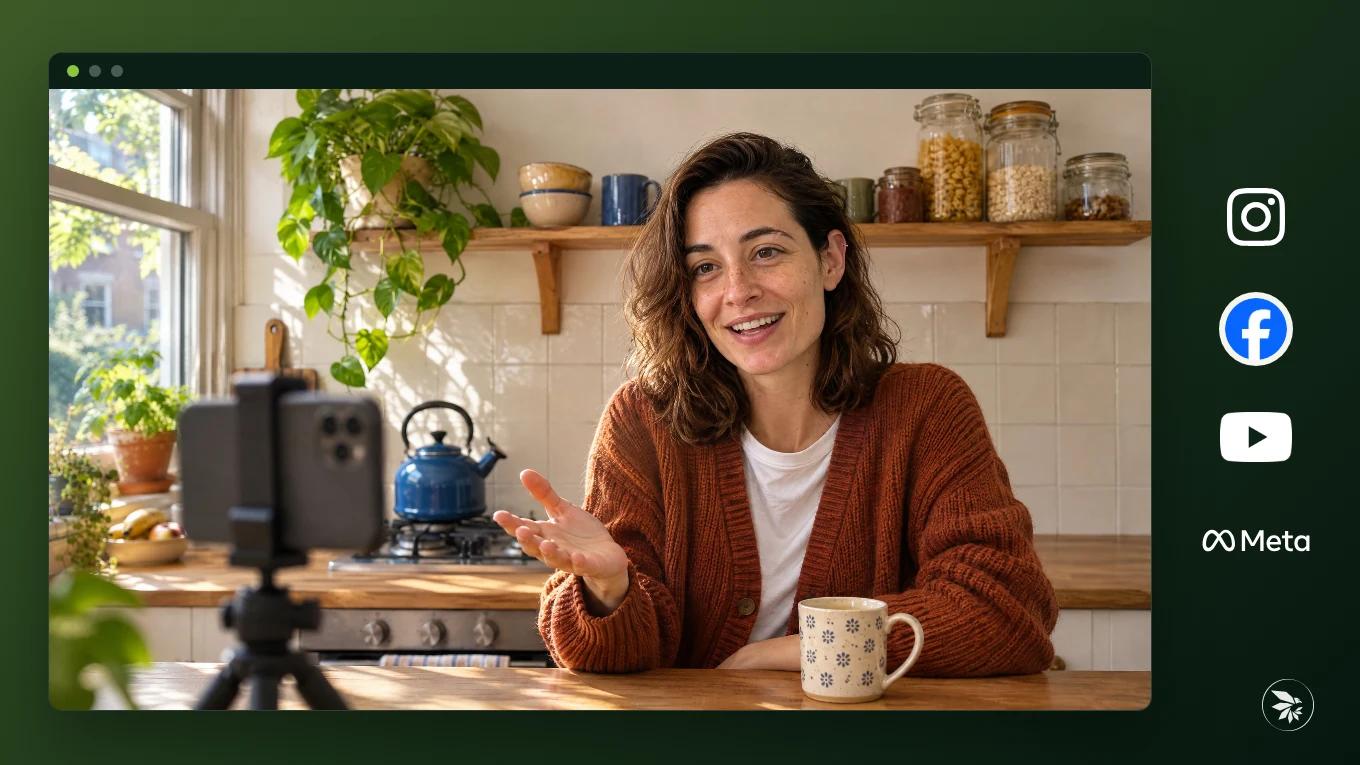
AI influencer marketing covers two different things. One is software that finds, vets and manages human creators. The other is an AI influencer: a character a brand owns, who posts on its accounts and fronts its ads. This guide is about the second, and how a brand puts one to work.
We're Icarus. We offer AI influencers as a service and we run them on our own brands. Most marketers aren't there yet: in Linqia's 2026 survey, only 9% planned to partner with a virtual influencer (Digiday). This guide covers the two meanings, how brands use a character, how to keep it the same, and how to judge it.
Updated 18 November 2026.
What does AI influencer marketing mean?
The phrase is used for two jobs. Coursera lists seven ways AI is used in influencer marketing. Six are tools: finding creators, checking authenticity, predicting results, monitoring campaigns, automating tasks and generating content. The seventh is the virtual influencer itself.
| AI tools for influencer marketing | AI influencers | |
|---|---|---|
| What it is | Software used on a campaign with human creators | A synthetic character, built with AI and computer-generated imagery, that a brand uses as its creator |
| What it does | Finds creators, checks their audiences are real, predicts and tracks results, drafts content | Posts, appears in videos and ads, speaks for the brand |
| Who is on screen | A human creator | The character |
| Who owns the face | The creator | The brand, when the brand commissions the character |
Characters come in two kinds. Lil Miquela, a digital avatar with over 3 million Instagram followers when Forbes covered it in 2024, has worked with Prada and Calvin Klein. Lu do Magalu was created by the Brazilian retailer Magazine Luiza and talks to its customers directly. The first is a media property that brands pay to appear beside. The second is a brand's own spokesperson, and that's the kind we build.
On this page
How do brands use an AI influencer?
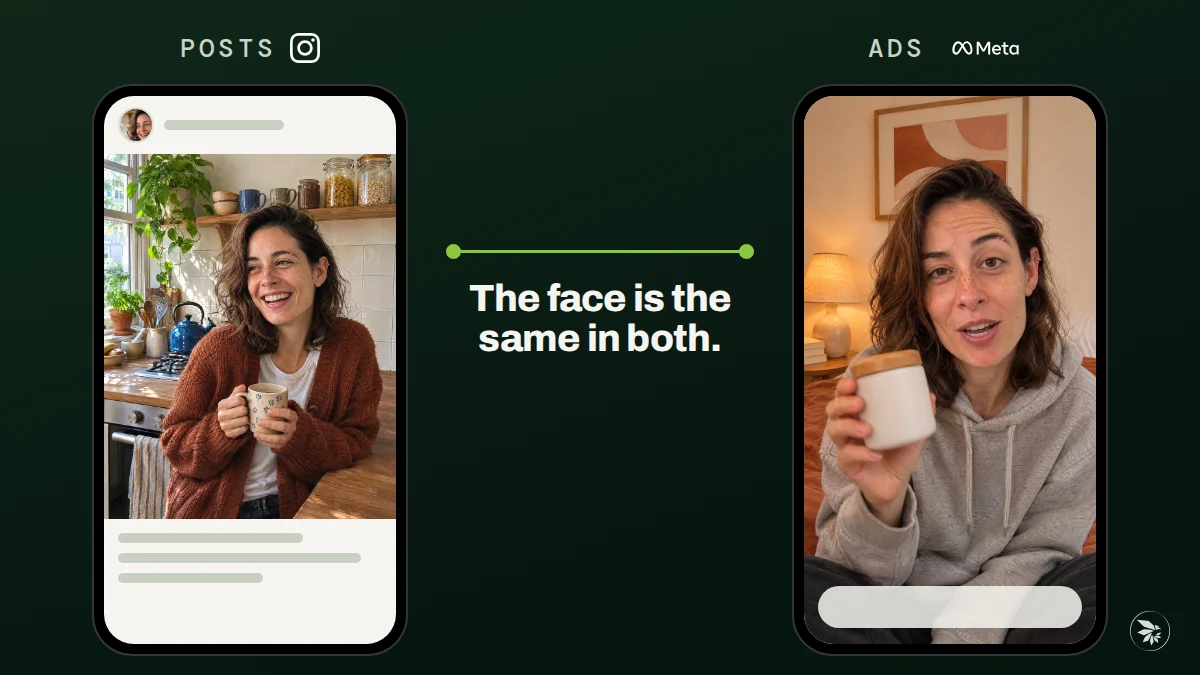
A brand uses an AI influencer in two places: on its own social accounts and in its ads. The face is the same in both.
| Where | What the character does | What it's for |
|---|---|---|
| Posts | Photos and short vertical videos in the character's own rooms and voice, on the brand's accounts | Regular posting, so people get to know the character |
| Ads | UGC-style (made to look like a customer's own video) talking-head clips, street-interview clips and creator-style product clips, short enough for feed placement | New concepts for Meta to test, fronted by a face people already know |
| Product | Holds, shows and tests your product on screen | The product shown inside the character's life |
Posts and ads need different things. Posts need cadence. A feed of ordinary photos and everyday clips, posted regularly, builds familiarity with a character more than polish does.
Ads need volume. Meta's delivery system reads the creative to decide who sees an ad, so a brand needs many genuinely different concepts to test. A character can front new ones, and you won't need a new shoot for each.
How do you start with an AI influencer?
Start with one job for the character, then build it in this order:
- Pick the job. A feed that builds presence, a supply of ad concepts, or both. The two need different content, so name the first one before anything is made.
- Check the fit with your product. In our view the character should make the product easier to understand. One with no link to what you sell gets attention and little else.
- Lock the character. Face, setting and personality, as set out in the next section.
- Test it. Make five images and check the face holds before the first post.
- Plan a month. Each post is built around a format that already works in your niche and one of your real products, so you see the month before anything is made.
- Post on accounts you own. The character works for your brand, so the accounts and the audience stay yours.
- Judge it over weeks. The measuring section below says what to look at.
How do you keep an AI influencer the same in every post?
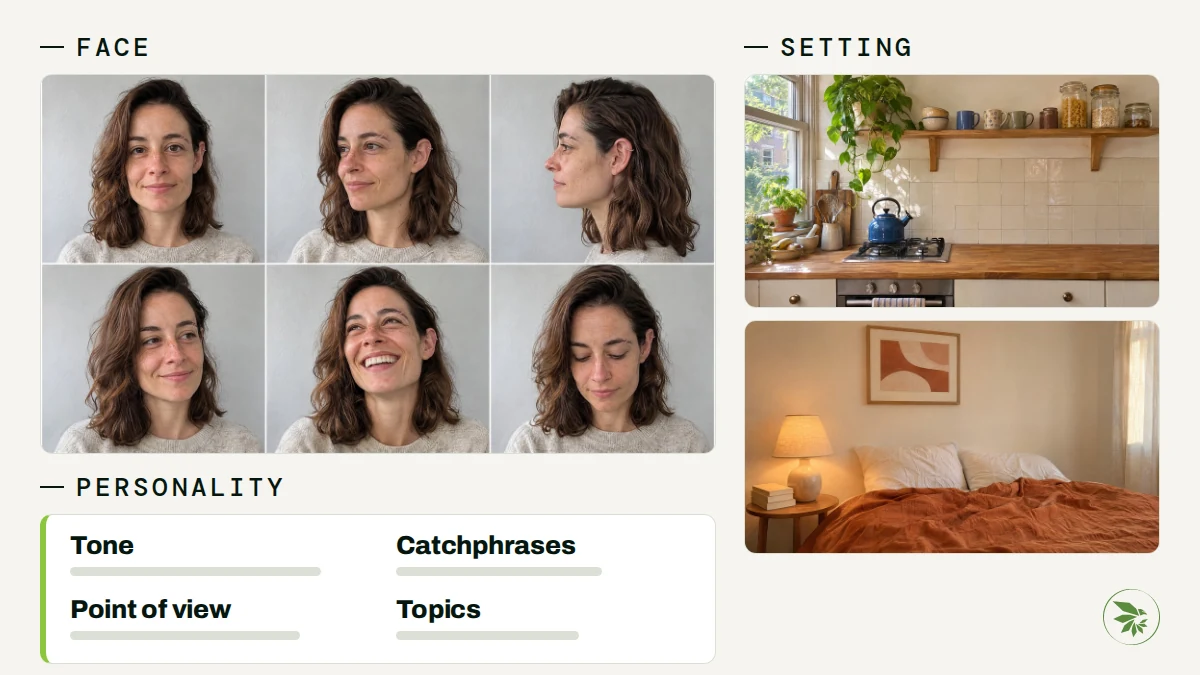
Lock three things before the first post: the face, the setting and the personality. Each one drifts if you don't lock it.
| What drifts | What you lock | What breaks without it |
|---|---|---|
| Face | One reference face used in every generation, plus a character sheet of that face from several angles | People stop recognising the character between posts |
| Setting | Two or three recurring backgrounds, such as a kitchen or a bedroom | The account feels staged. Coming back to familiar rooms feels lived in |
| Personality | A written document with tone, catchphrases, point of view and topics, loaded before every script | The same face says generic things and stops feeling like one person |
One habit keeps it steady. Keep one reference face and one written personality document behind every generation. When a result drifts, change the scene and leave the character alone.
We write what never changes on one page, the character contract, and every later picture and script reads from it.
What does an AI influencer give a brand, and what doesn't it?
An AI influencer gives a brand control and consistency. The look, the message and the schedule are the brand's. Forbes describes greater control over messaging and image, and notes that a character can post at any hour.
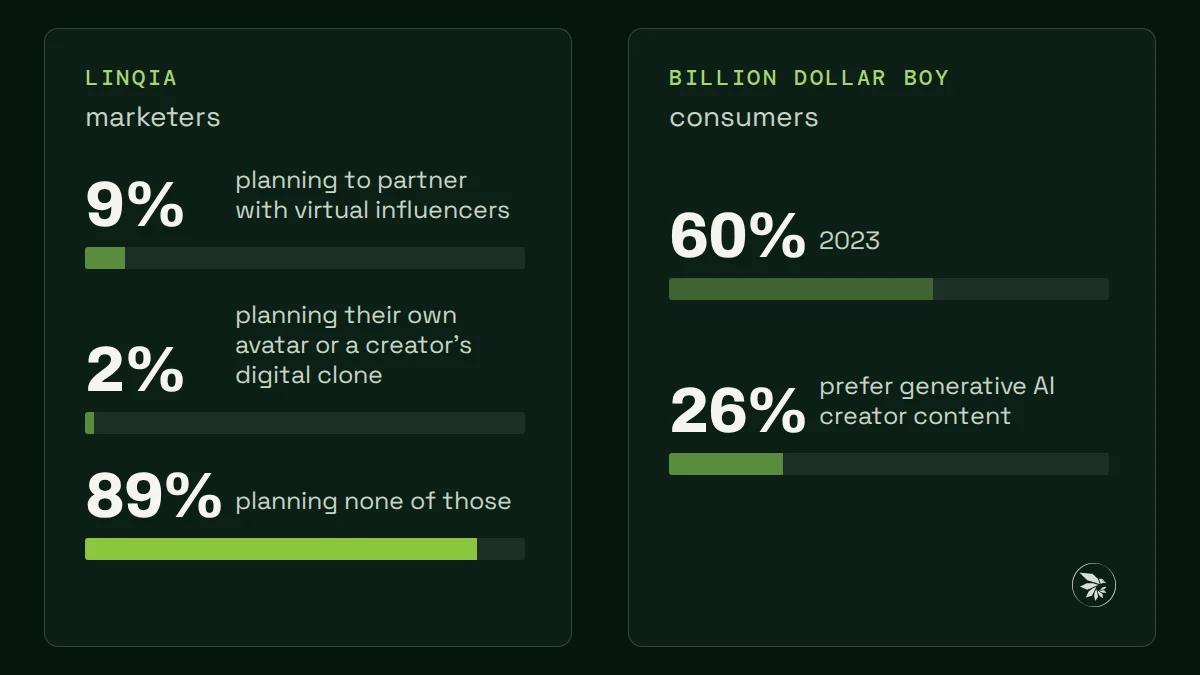
The market numbers aren't friendly, and you should see them. Linqia's 2026 report found 9% of marketers planning to partner with virtual influencers, 2% planning their own avatar or a creator's digital clone, and 89% planning none of those. Billion Dollar Boy found 26% of consumers prefer generative AI creator content to traditional creator content, down from 60% in 2023 (Digiday).
We read that as a warning for characters with no job. The problems a character is built to fix are plain: ads wear out, every new batch means chasing creators, creators charge per concept, and the best one owns the relationship with your audience.
AI influencer, human creator or AI tools: which does a brand need?
A brand doesn't have to pick one. It can run human creators, use AI tools on that work and add a character beside them. In our view the choice comes down to who owns the face and what each new piece of content costs.
| Human creator | AI tools on a creator campaign | Owned AI influencer | |
|---|---|---|---|
| Who is on screen | The creator | The creator | The character |
| Who owns the face and the following | The creator | The creator | The brand |
| What a new concept costs | A new brief and a new fee | A shorter brief, since tools can draft content | Another post from the same character |
| When you stop | The creator keeps their audience and works with others | You lose the tool | The character stays with the brand |
| Suits | A real person's word and lived experience | Teams that already run many creators | Brands that want one face they own and a steady supply of content |
When is an AI influencer the wrong choice?
It's the wrong tool in three cases.
- Your brand story rests on a real person's face, such as a founder or a practitioner.
- Your plan depends on long-form video, which short clips don't suit.
- You have no steady product or content plan to put in front of the character.
How does Meta label AI ads?
On Meta, ads made or edited with generative AI tools carry an AI info label. Meta applies it automatically when an ad uses its own generative features, such as image generation or background generation, and when it detects third-party generative AI tools through industry-standard metadata. The label sits under the three-dot menu, in About this ad, and Meta shows you a message during ad creation when it'll apply one (Meta Business Help Center).
Some places add rules of their own. Meta lists the European Region, California, New York, India and Taiwan, where an advertiser may be able to self-disclose that generative AI was used. Organic content follows a separate labelling approach, so posts and ads need separate checks. We handle the labelling on the accounts we run.
How do you measure AI influencer marketing?
Look at cost to win a customer and what that customer is worth over six to twelve months. Cost to win a customer is your ad spend divided by the new customers it brought in. Lifetime value is what those customers spend with you over that time. ROAS (return on ad spend) on a first order counts only the first sale, so it undersells a customer who buys again. Judge weeks and months of posts, not a day's numbers.
For posts, watch saves, replies, follows and clicks. For ads, watch cost per new customer. Our free ROAS calculator helps you work out what a new customer can cost before you judge any creative.
How Icarus runs AI influencers
We build and run the character. Agents do the volume and people keep the judgement. What you get:
- A character of your own. Name, face, voice and personality, with a face you choose and we lock once it's picked.
- A setting of its own. A few fixed rooms with the same props every time, so your audience learns the setting as well as the face.
- A month plan. You'll see the whole month before anything is made.
- Posts on accounts you own. Instagram, Facebook and YouTube Shorts, set up and run for you through our social team. Three posts a week as standard, more if you want them.
- The same face in your ads. UGC-style clips from the character, alongside the paid ads we run.
- Approval. A person approves every character and every post. You follow the work in your Icarus dashboard, with Slack for talking to the team.
- Ownership. The character is yours. If you leave, the character leaves with you. There's no long-term contract, and the price is set on a call.
If you want a character of your own, talk to us about AI influencers.