
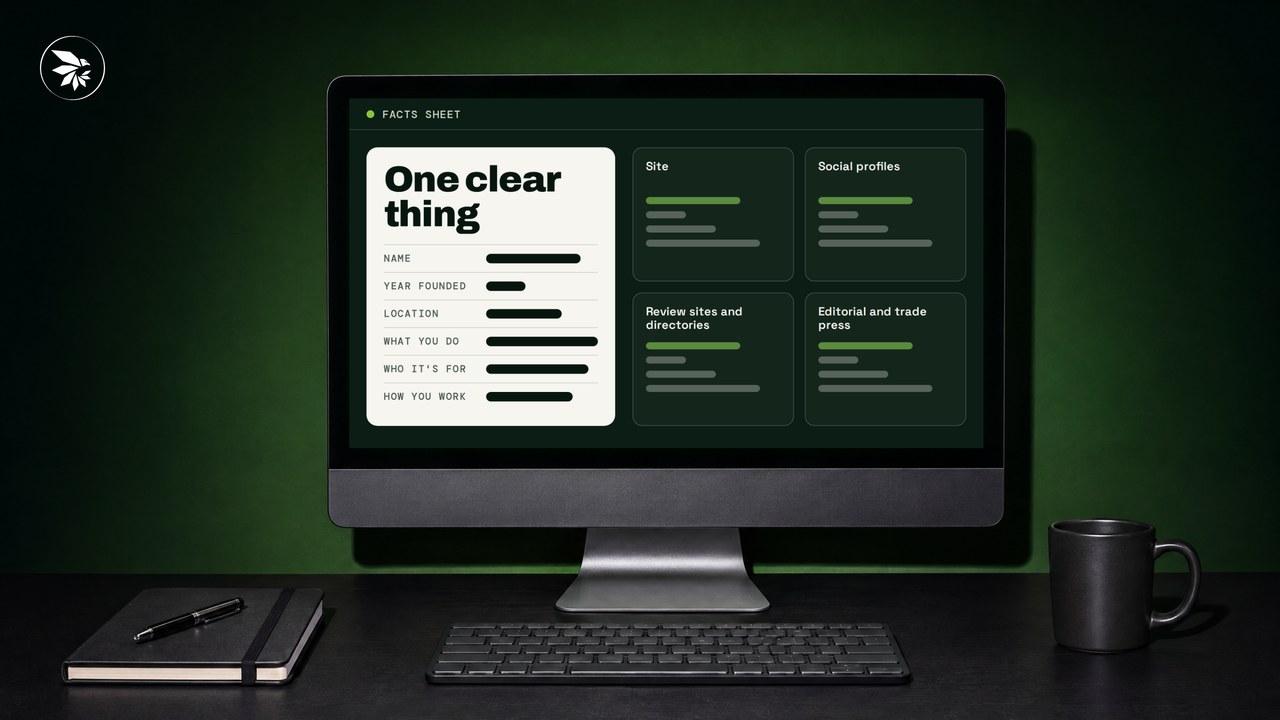
Entity SEO is making sure Google and AI tools know your business as one clear thing: one name, one description and the same facts wherever they look. For a brand owner it comes down to a short facts sheet, every profile matching it, and your company details in schema on your own site. Google says organization markup on your home page can help it tell your business apart from other organizations.
We're Icarus, and entity work sits inside our SEO and AI search service. After the definition you'll find the steps in the order we'd do them, a fill-in facts sheet, a table of the places search engines check, and the parts no one controls, Google included.
Key takeaways
- An entity is a thing. Your company, your founder and each product are separate things a search engine can name.
- Research comes first. One facts sheet, then every profile and listing made to match it.
- Schema confirms the facts. It tells Google what your sheet already says.
- Panels aren't yours to order. Google creates and removes knowledge panels automatically.
- Old listings go first. A stale listing can contradict the facts you publish.
On this page
What is an entity in SEO?
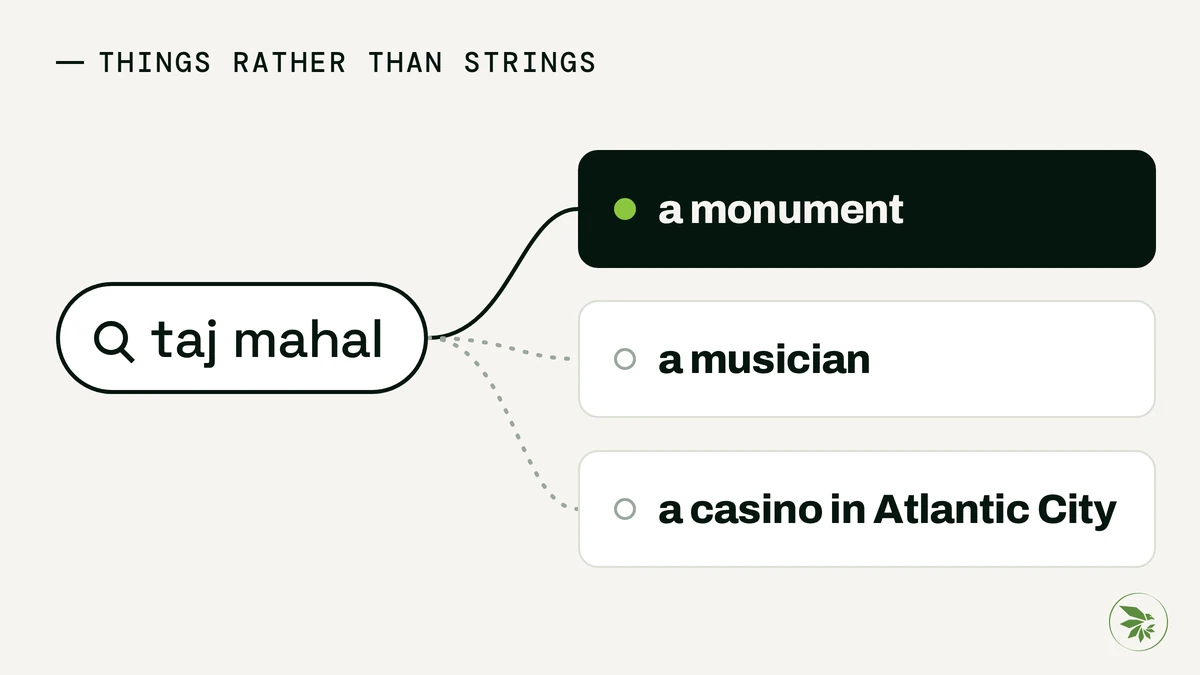
An entity is a thing a search engine can tell apart from every other thing: a company, a person, a product, a place or an idea. Ahrefs defines it as anything singular, unique and well defined.
Google built its Knowledge Graph, its database of things and how they connect, in 2012 on the idea of searching for things rather than strings of words. Its own example was taj mahal, which can mean a monument, a musician or a casino in Atlantic City. The words are identical, so the engine has to work out which thing you mean.
Your business is an entity too. So are the people who run it and each product you sell. The difference from keyword SEO is easiest to see side by side.
| Keyword SEO | Entity SEO | |
|---|---|---|
| What it works on | The words people type | The thing those words point to |
| Example | "entity seo" | Your company, its founder, its services |
| The question it answers | Does this page match the search? | Does the engine know who and what you are? |
| What you do | Choose terms, write pages, rank them | Make every description of you match, then confirm it in schema |
Why does entity SEO matter for a brand?
Entity work matters because a search engine can't phone you to check who you are. Google says organization markup on your home page can help it understand your business's details and disambiguate your organization in search results.
AI tools face the same problem. Our working view is that they can't confirm a company exists either, so they lean on what trusted sources say about it. A brand described the same way in many trusted places is easier to name than one described a dozen different ways. In our view the places that feed search also feed AI answers, so one piece of work covers both.
We can see the problem on our own name. Our Search Console data lists searches for our name in several forms: "icarus digital marketing", "icaris marketing" and "icarus media". Spelling variants are a small thing, but they show how many shapes a business name takes in search, and entity work is about keeping the facts behind it consistent.
How do you do entity SEO? The order we'd follow
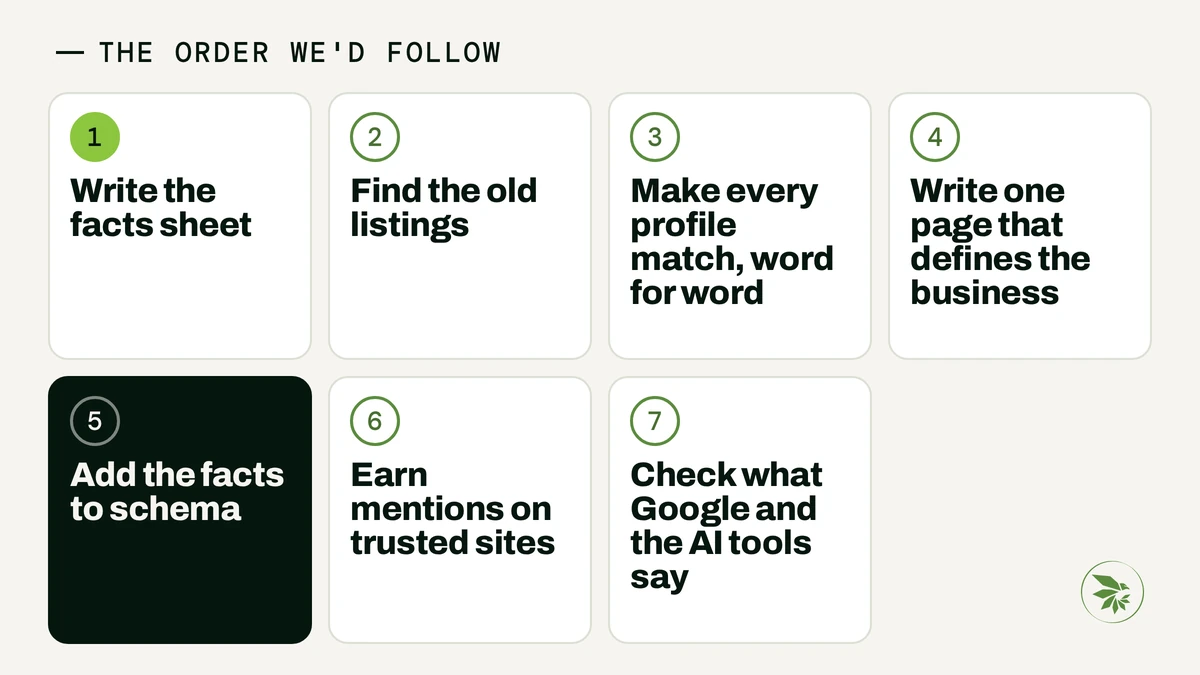
We'd put schema fifth. Entity work is mostly research: checking sources, mapping facts and making them match across the places that describe you. The code comes after.
- Write the facts sheet. One page with your legal name, the name you trade under, the year you were founded, where you're based, what you do, who it's for and one line on how you work. Keep it short enough to paste. Everything else copies from it.
- Find the old listings. List every directory, social profile, press page and marketplace page that describes you, and note what each says. Fix these before you add anything new, because a stale listing can contradict the facts you're about to publish.
- Make every profile match, word for word. Same company name, same one-line description, same address format, same web address. A reader would shrug at small differences, but a search engine may not be sure the listings describe the same business.
- Write one page that defines the business. An about page that says who you are, what you do and where, in plain third-person sentences with a subject, a verb and an object. Then a paragraph still makes sense when a machine lifts it out on its own. For example: "[Brand] is [what it is]. [Brand] was founded in [year]. [Brand] sells [products] to [who]."
- Add the facts to schema. Google recommends organization markup on your home page or a single page that describes your organization, and says it doesn't need to be on every page. It lists no required properties and recommends the most specific type that fits, such as OnlineStore for an ecommerce site. Its own example includes a sameAs list of profile URLs. List the profiles that describe your brand and carry the same facts as your sheet.
- Earn mentions on trusted sites. The table below lists the places, in the order we'd try them.
- Check what Google and the AI tools say, and write it down. Search your brand name, read the results, and ask the AI tools who you are. Save the answers before and after your changes, then reopen the public pages to confirm they now match your sheet.
What goes on the facts sheet
| Field | What to write | Where it has to match |
|---|---|---|
| Name | Your legal name and the name you trade under | Site, every profile, every listing |
| Year founded | The year you were founded | About page, schema, directories |
| Location | City and state or country, in one fixed format | About page, schema, directories |
| What you do | One plain sentence | Home page, social bios, press boilerplate |
| Who it's for | One plain sentence | About page, social bios |
| How you work | One line | About page, press boilerplate |
Where search engines and AI tools look, in our order
| Place | What to do there |
|---|---|
| Editorial and trade press | Pitch real stories, and check each mention uses your exact name and description |
| Social profiles | Copy your sheet: same name, description and web address |
| Review sites and directories | Claim the listing and correct any old facts |
| Community threads | Take part for real. A planted thread doesn't count |
| Newswire releases | Use them for real news, with your sheet's description |
Keep the name, web address and key facts identical in every row. Conflicting data confuses the match.
How many mentions does a brand need?
There's no agreed number. A commonly repeated rule of thumb is about thirty consistent mentions on trusted sites, with sensitive or crowded niches needing more. Other practitioners put the target at 30 to 50, and one view is about 150. All of these are practitioners' estimates. Ten strong sources beat fifty weak ones, so start by counting what you have.
How do content and internal links fit in?
Pages still matter. Write articles on the topics you want the business known for, and link each one to the page that defines you. Link your about page, a founder bio and your service pages to one another in sentences a reader would follow. That shows the engine how the people, the company and what it sells relate, using the same internal linking you'd use for any other SEO job.
What can't entity SEO do?
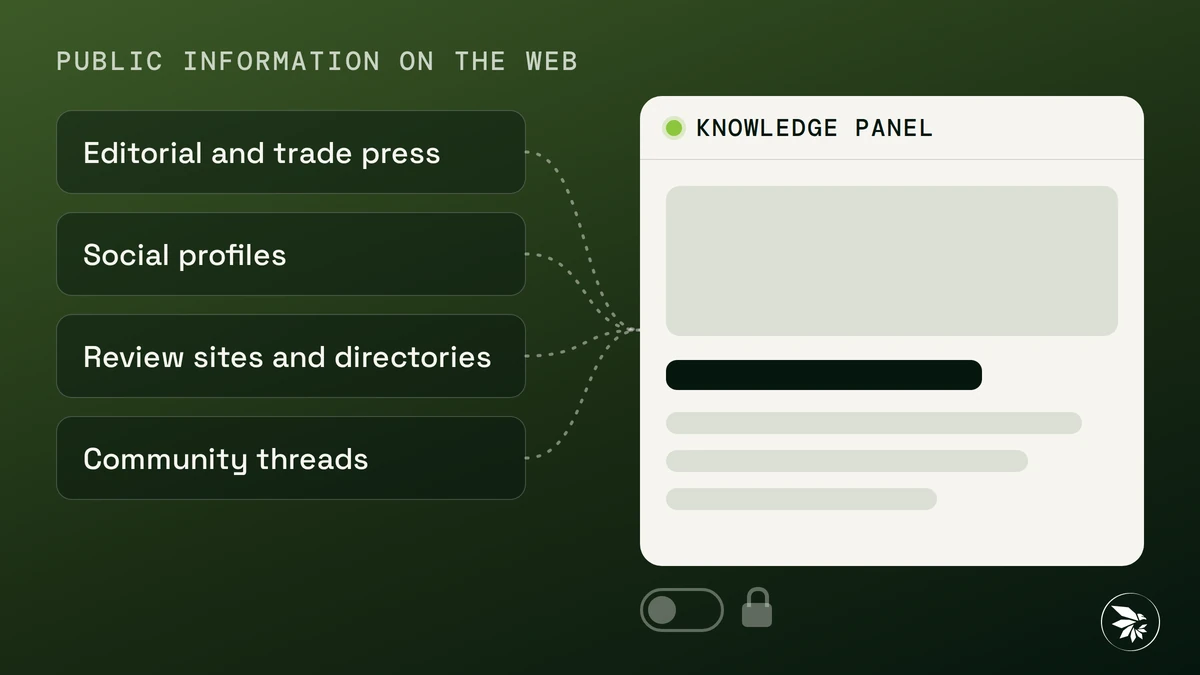
Entity SEO can't give you a knowledge panel on request. Google says panels generate automatically from public information on the web, and that its policy is not to create or delete them by hand. If a panel already exists for you and you verify your identity, you can suggest edits through Google Search.
It also takes time. Branded search is what brings a panel up in the end, and that can take months. We don't promise a panel or a ranking.
Should you do entity SEO yourself or hand it to a team?
Steps 1 to 5 are within a brand owner's reach. They need a spreadsheet, your logins and patience. The time goes on step 2: finding listings nobody has touched in years, then getting each one corrected. Step 7 repeats, since listings and AI answers change over time.
Our SEO and AI search service covers this work. We put your company facts into schema and an entity page, so Google and AI tools find the same facts about your brand wherever they look. We also track whether ChatGPT, Perplexity and Google's AI answers name your brand. A person approves what goes live, and you see the work in your Icarus dashboard. If you're running Meta ads too, they sit in the same place.
If you'd like a team to run your entity work, talk to us about SEO and AI search.