
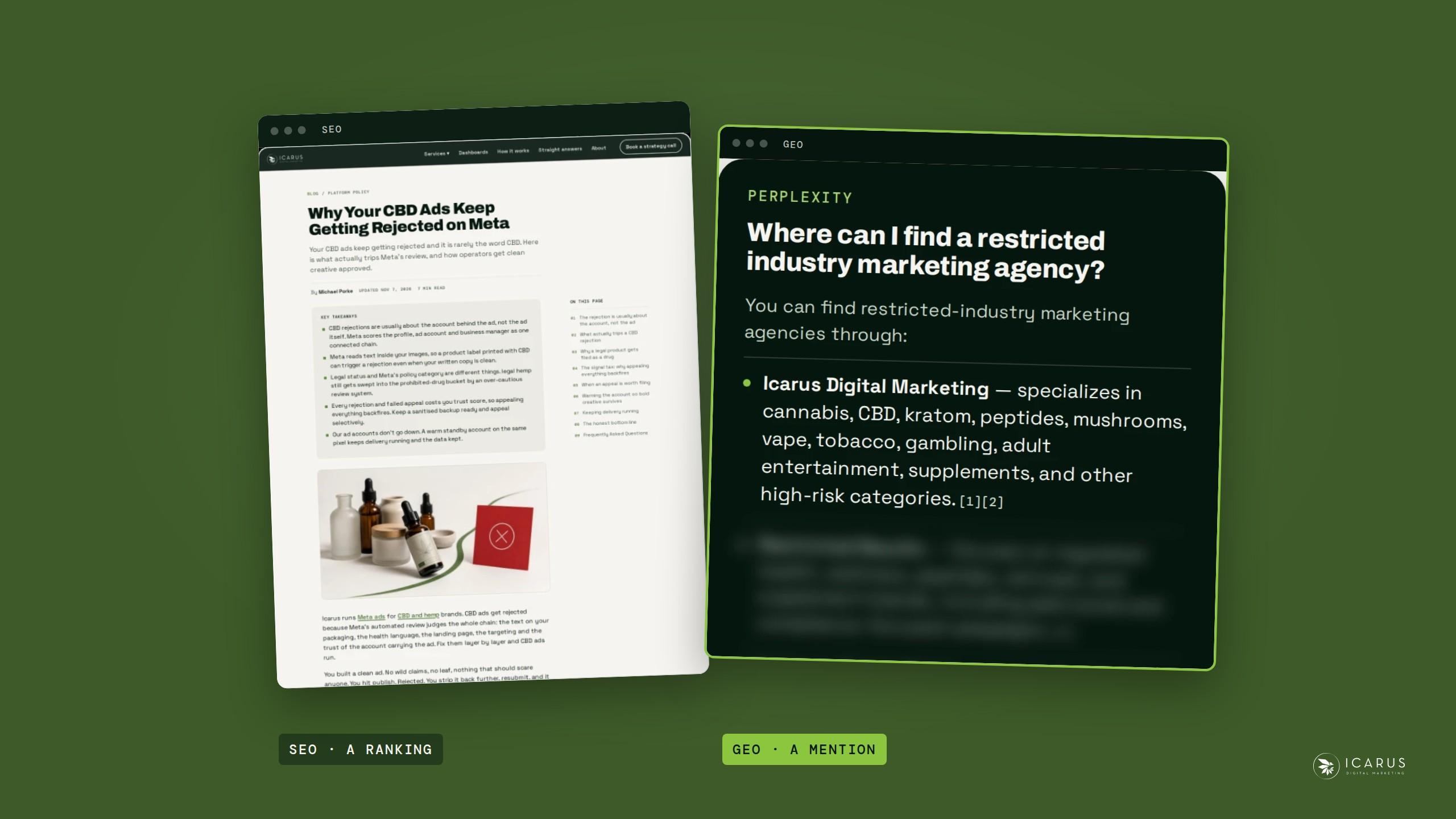
GEO doesn't replace SEO. SEO gets your pages found and ranked in Google. GEO is the work of getting those pages named in AI answers from tools like ChatGPT, Google's AI Overviews and Microsoft Copilot. Google says its AI features need no steps beyond SEO fundamentals, so GEO builds on SEO instead of replacing it.
In Ahrefs' study of 863,000 searches (March 2026), only 38% of the pages Google's AI Overviews cited also ranked in the top 10. Some GEO guides tell you to add special markup for AI answers, and Google's own page says none is needed. We're Icarus, and if you'd like one team to run both jobs for your brand, see our SEO and AI search service.
Updated 18 November 2026.
On this page
GEO vs SEO side by side
GEO and SEO differ in what you earn, where it shows up and how you measure it. GEO stands for generative engine optimisation. You'll also see AEO, for answer engine optimisation. Jasper describes AEO as structuring content to answer user questions directly. We cover both here under GEO.
| SEO | GEO | |
|---|---|---|
| What you're after | A ranking in Google or Bing results | A mention or citation inside an AI-generated answer |
| Where it shows | Search results pages | ChatGPT, Google's AI Overviews and AI Mode, Microsoft Copilot |
| What the page needs | To be crawled, indexed and matched to the search | The same for Google's AI features, with sections that still make sense when quoted on their own |
| How you measure it | Rankings and clicks in Search Console | How often your brand is named across repeated answers, plus citation reports such as Bing's |
| What a win looks like | A visit from the results page | A mention, sometimes with a link |
Search Console reports rankings and clicks from Google's own data. Google counts traffic from AI Overviews and AI Mode inside the same Web search report, and Bing reports Copilot citations in its own tool. So a brand checks more than one place.
AI answers haven't removed the click. Google says that when people click from results pages with AI Overviews, those clicks are higher quality, meaning users are more likely to spend more time on the site. We found no reliable figure for how many clicks AI answers cost, so we don't quote one.
What the data says about ranking and being cited
Fewer than 4 in 10 pages cited in Google's AI Overviews also rank in the top 10 for the same search, according to Ahrefs. The table sets out the studies we found, each with its source.
| Study | What it measured | Result | Source |
|---|---|---|---|
| Ahrefs, 2 March 2026 | 863,000 searches and about 4 million URLs cited in AI Overviews | 37.9% of cited URLs also appeared in the first 10 blocks of the results page, 31.2% in positions 11 to 100 and 31.0% beyond the top 100 | Ahrefs |
| Ahrefs' earlier study, quoted in the 2026 update | Cited pages taken straight from the original results, July 2025 | About 76% | Ahrefs |
The two Ahrefs rounds use different methods, so read the fall as a direction, not an exact drop.
Ahrefs suggests the fall from about 76% to 38% reflects AI Overviews leaning more on the results for related sub-searches than on the original search. Google says AI Overviews and AI Mode may run several related searches across subtopics before they answer. So a page may be cited because it ranks for a follow-up question and not for your main keyword. Ahrefs also found that among cited pages outside the top 100, 18.2% were YouTube URLs, so the page that gets quoted isn't always an article. That's why we plan pages around the follow-up questions a buyer asks, not only the head keyword.
Does GEO replace SEO?
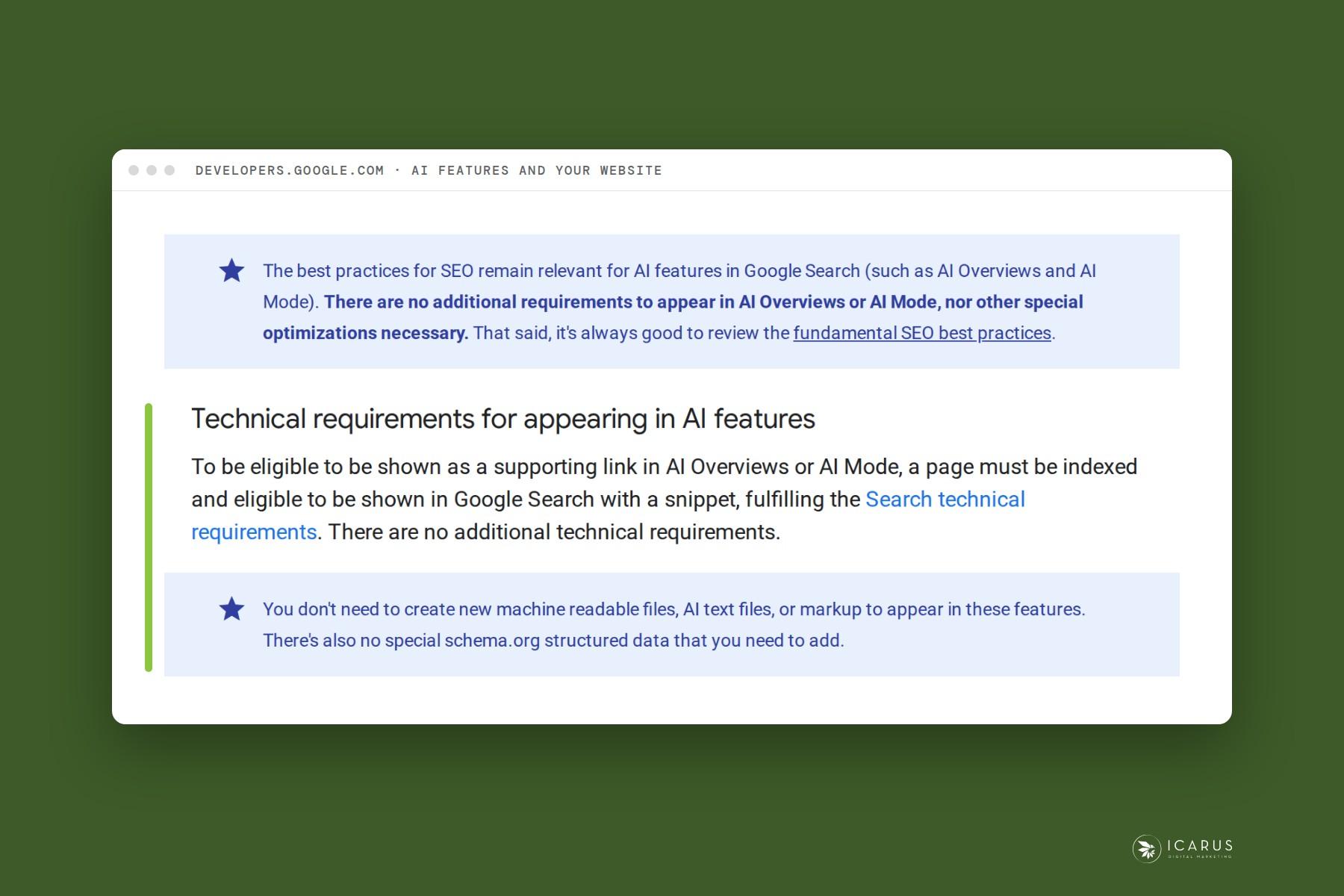
GEO doesn't replace SEO, because Google's own documentation says the best practices for SEO still apply to AI Overviews and AI Mode. The same page (last updated 10 December 2025) says three more things that decide where you spend your time:
- A page must be indexed and eligible to show in Google with a snippet before it can appear as a supporting link in AI Overviews or AI Mode. There are no additional technical requirements.
- You don't need new machine-readable files, AI text files or markup to appear, and there's no special schema.org structured data to add.
- AI Overviews only show when Google's systems judge that they add something to classic search, so they often don't appear at all.
That covers the technical side. Visibility is a separate matter, because Google also says that meeting every requirement doesn't mean a page will be crawled, indexed or served. So the work starts with SEO. If a GEO checklist tells you to add special markup so Google's AI features can find you, Google's documentation says it isn't required.
What SEO and GEO share
SEO and GEO share the same technical foundations. Google lists these fundamentals as still worthwhile for its AI features:
- Crawling is allowed in robots.txt and by any CDN or hosting setup.
- Important pages can be found through internal links.
- The page gives people a good experience.
- Important content is available as text.
- Structured data matches the visible text on the page.
Bing adds a point about freshness. It says accurate, up to date content matters for inclusion and citation in AI-generated answers, and that IndexNow tells participating search engines when content is added, updated or removed. Our SEO work includes setting up Bing as well as Google.
Where GEO asks for something different
Write each section so it can be quoted alone
Put the page's answer near the top, and give each section a clear subject in your own words, so a section still reads right when an answer lifts it out of the page. An analysis of 18,012 ChatGPT citations, reported by Search Engine Land, found that 44.2% came from the first 30% of a page's content and 24.7% from the final third. That study covers ChatGPT, not Google. We write our articles this way, answer first.
Get named on pages other than yours
AI answers cite pages across the web, so your own site is only one place a brand can be named. We look at which pages get cited for a brand's buyer questions, find the ones that name its rivals and not the brand, and work on getting the brand named there.
Measure by asking the same question more than once
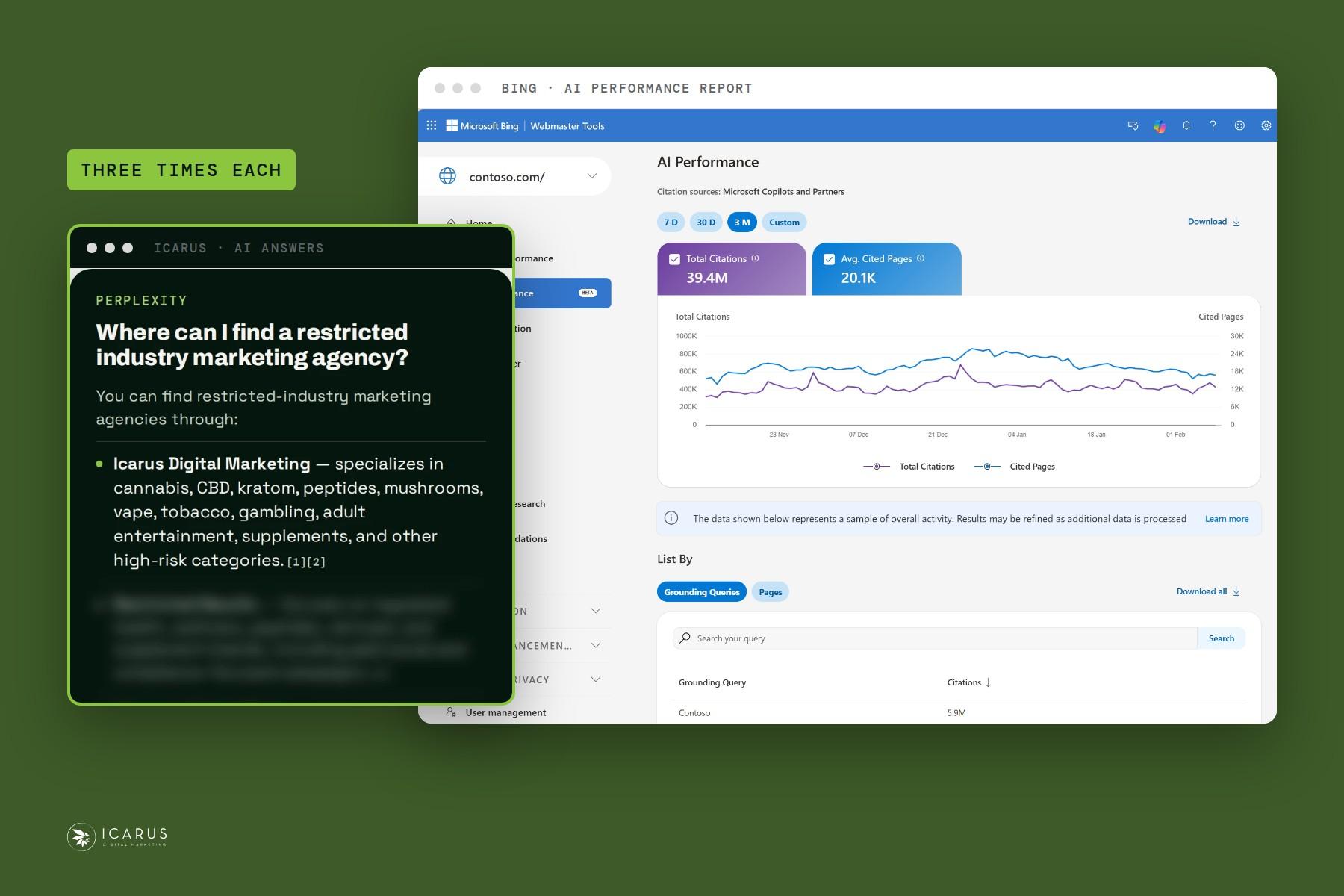
AI answers can differ from one run to the next, so we never score a brand on a single answer. We put 15 real buyer questions to ChatGPT, Perplexity and Google's AI answers, three times each, and report how many answers named the brand. The questions come from real demand data, not a model's guesses. Bing's AI Performance report, which Bing calls an early step toward GEO tooling, covers Copilot, Bing's AI summaries and select partner experiences. It gives four views, and Bing states a limit for each.
| Bing view | What it shows | What Bing says it doesn't show |
|---|---|---|
| Total citations | How many times your pages were displayed as sources in AI-generated answers | Placement or presentation within an answer |
| Average cited pages | The average number of your unique pages displayed as sources per day | Ranking, authority, or a page's role in an answer |
| Grounding queries | A sample of the key phrases the AI used when retrieving the content it cited | The full picture, because the data is a sample |
| Page-level citation activity | Citation counts for specific URLs | A page's importance, ranking or placement |
So read the report as one signal beside your own check. We read the grounding phrases as hints at the follow-up questions behind an answer.
Which to start with, and in what order
Start with whichever step your pages are stuck on. GEO work on pages Google hasn't indexed can't show up in Google's AI features, and SEO work alone won't tell you whether AI answers name you. This table matches where you are to the first job.
| Where you stand | Start with | Why |
|---|---|---|
| Key pages aren't indexed in Google | SEO: crawling and indexing | A page has to be indexed and eligible to show with a snippet to appear in Google's AI features |
| Pages rank, but the answer sits low on the page | Rewrite answer first | In the ChatGPT analysis, 44.2% of citations came from the first 30% of the content |
| Pages rank and read clearly, but AI answers name your rivals | GEO: the cited pages | Find the pages AI answers cite and work out why your brand isn't on them |
| You haven't checked yet | The three-times question check | One answer says little, and a count across repeated answers says more |
The order we'd work in:
- Check Google can index your key pages. Verify the site in Search Console, which Google recommends for finding technical problems quickly. If key pages aren't indexed, stop here.
- Set up Bing Webmaster Tools. It holds the AI Performance report for Copilot citations, and IndexNow can tell Bing when you publish or change a page.
- Rewrite your main pages answer first. Put the answer in the opening lines and make each section name its subject.
- List the questions your buyers ask AI tools. Ask each one three times and log whether you're named.
- Open the pages cited when you're missing. Work out why they're there and whether your brand could be.
- Run the check again on a schedule. Answers move. We run a weekly sweep and a monthly pass.
How we run both at Icarus
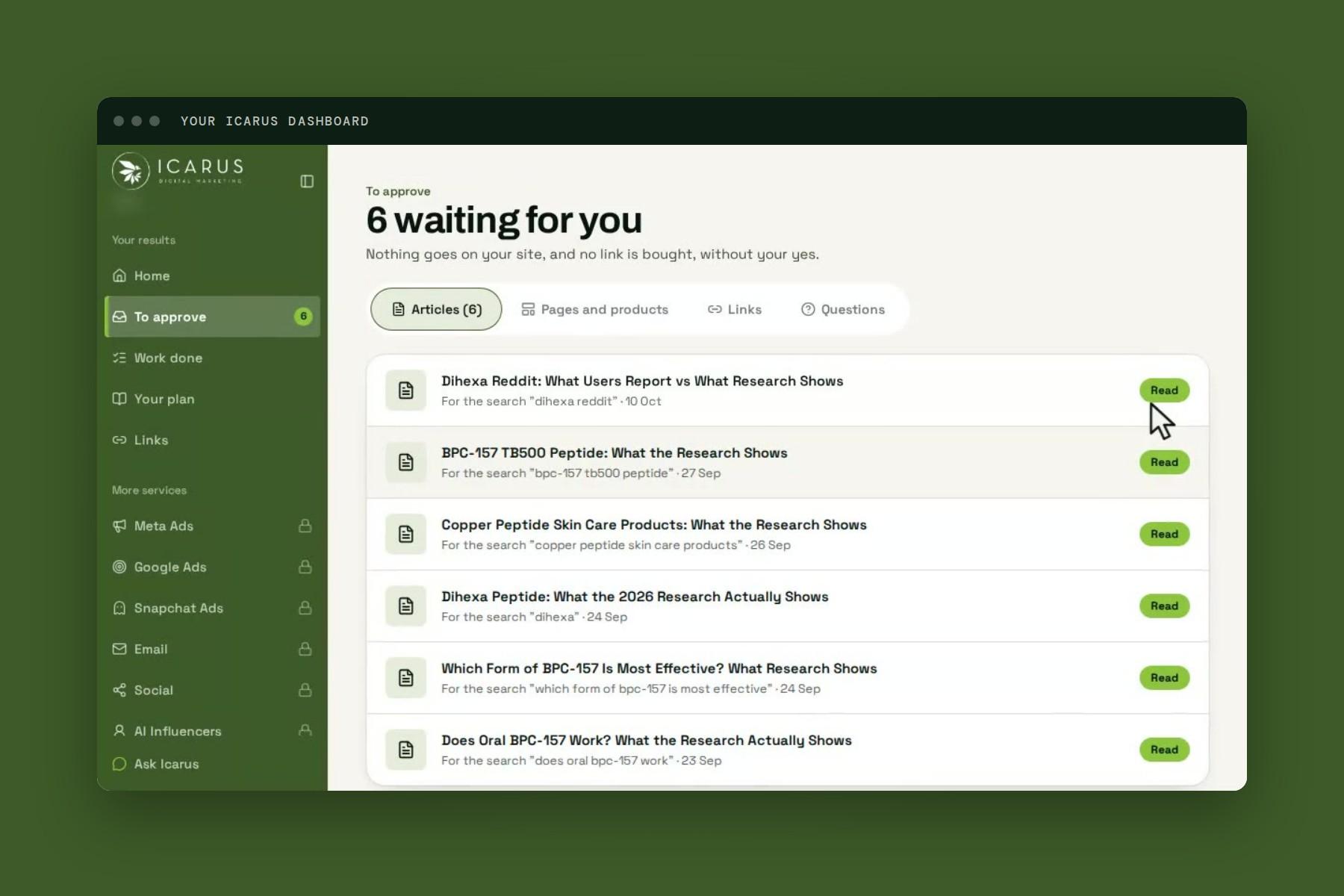
We run SEO and AI search as one service, and we've worked with restricted brands since 2016. Sage, our SEO agent, works through your site, writes articles and runs the answer checks, and our people make the calls. You see the work in your Icarus dashboard and approve it before anything goes live.
Many restricted brands want search that doesn't depend on an ad platform's rules, and we run it alongside their Meta ads. Nobody controls what an AI answer says, so we measure it instead of promising it. We don't promise rankings, traffic or a mention in any answer.
If you'd like a team that handles both, talk to us about SEO and AI search.